


| Issue |
A&A
Volume 706, February 2026
|
|
|---|---|---|
| Article Number | A361 | |
| Number of page(s) | 10 | |
| Section | Extragalactic astronomy | |
| DOI | https://doi.org/10.1051/0004-6361/202557376 | |
| Published online | 20 February 2026 | |
Expect the unexpected: Augmented mixture models for black-hole-population studies
Institut für Theoretische Astrophysik, ZAH, Universität Heidelberg Albert-Ueberle-Str. 2 69120 Heidelberg, Germany
★ Corresponding author: This email address is being protected from spambots. You need JavaScript enabled to view it.
Received:
23
September
2025
Accepted:
8
January
2026
Abstract
Context. Black-hole-population studies are currently performed either using astrophysically motivated models (informed but rigid in their functional forms) or via non-parametric methods (flexible, but not directly interpretable).
Aims. In this paper, we present a statistical framework to complement the predictive power of astrophysically motivated models with the flexibility of non-parametric methods.
Methods. Our method makes use of the Dirichlet distribution to robustly infer the relative weights of different models as well as of the Gibbs sampling approach to efficiently explore the parameter space.
Results. After having validated our approach using simulated data, we applied this method to the binary black-hole mergers observed during the first three observing runs of the LIGO-Virgo-KAGRA collaboration using both phenomenological and astrophysical models as parametric models, finding results in agreement with the currently available literature.
Key words: gravitational waves / methods: statistical / stars: black holes
© The Authors 2026
 Open Access article, published by EDP Sciences, under the terms of the Creative Commons Attribution License (https://creativecommons.org/licenses/by/4.0), which permits unrestricted use, distribution, and reproduction in any medium, provided the original work is properly cited.
This article is published in open access under the Subscribe to Open model. This email address is being protected from spambots. You need JavaScript enabled to view it. to support open access publication.
1. Introduction
With 69 gravitational waves (GWs) from binary black-hole (BBH) mergers detected by the LIGO (Aasi et al. 2015), Virgo (Acernese et al. 2015), and KAGRA (Akutsu et al. 2020) collaboration (LVK) at the end of the third observing run (O3) (Abbott et al. 2023a) and 84 events newly added by GWTC-4.0 (The LIGO Scientific Collaboration 2025b), BBH population studies are now a prime tool for astrophysicists when it comes to investigating the physics of massive-binary evolution. The characterisation of the astrophysical BH distribution requires a profound understanding of the details of massive-star evolution such as the mass loss due to stellar winds (Kruckow et al. 2024; Romagnolo et al. 2024; Vink et al. 2024; Merritt et al. 2025; van Son et al. 2025), its metallicity dependence (Belczynski et al. 2016; Hirschi et al. 2025), and the effect of the pair-instability supernova process (Mapelli et al. 2020; Vink et al. 2021). At the same time, it is also crucial to model the possible formation channels for compact binaries: the proposed models can be broadly divided into two classes: isolated evolution and dynamical formation. The isolated-evolution scenario considers the possibility of the progenitors of the two compact objects already being part of a binary system during the stellar stage: in this case, for example, the mass transfer (either stable or unstable) can tamper with the mass ratio of the binary (Röpke & De Marco 2023) and thus leave an imprint on the resulting BH distribution (Marchant et al. 2021; Gallegos-Garcia et al. 2021; Willcox et al. 2023). Conversely, dynamically assembled systems are binaries where the components are already brought together at the stage of compact objects as a result of dynamical interactions happening in dense environments, as is the case of three-body encounters, dynamical captures, and star clusters (Ziosi et al. 2014; Rodriguez et al. 2016; Kremer et al. 2020; Banerjee 2022). For a comprehensive review of the available models, we refer the reader to Mapelli (2020) and Mandel & Farmer (2022). Due to the significant complexity of the astrophysical processes, the distribution induced by the aforementioned models cannot be expressed in terms of simple functions: the modelling community relies on numerical methods capable of producing synthetic catalogues of merging BBHs. For the same reason, developing an all-encompassing model accounting for all possible physical processes and formation channels is considered a titanic task.
Despite the effort put into accelerating and optimising population-synthesis codes, these algorithms are not yet fast enough to be embedded in the MCMC methods commonly used to analyse the GW data – with the notable exception of machine-learning-enhanced approaches (e.g. Colloms et al. 2025). The available literature often makes use of phenomenological parametrised models inspired by the expected features of the BH distribution: among others we mention the POWERLAW+PEAK model (Abbott et al. 2023b), describing the primary mass distribution as a weighted superposition of a tapered power-law and a Gaussian distribution, as well as its updated version BROKEN POWER LAW + 2 PEAKS (The LIGO Scientific Collaboration 2025a), currently favoured by the data. These models, albeit simplified with respect to the fully fledged astrophysical models, are still capable of providing insights into the processes at play behind the observed BHs. This is the main approach employed by the LVK collaboration (Abbott et al. 2019, 2021, 2023b; The LIGO Scientific Collaboration 2025a) and many authors (e.g. Fishbach & Holz 2017; Talbot & Thrane 2018; Farah et al. 2023; Gennari et al. 2025; Rinaldi et al. 2025a). For a comprehensive review, please see Callister (2024). Due to the fact that the functional forms are merely inspired by the astrophysical models and do not have any direct connection with the physical processes at play, the possibility of assuming a functional form that does not encompass the true underlying distribution, and thus biasing the analysis, cannot be neglected entirely. Moreover, new, previously unforeseen features in the spectrum must be added by hand when needed.
To ensure the robustness of the population analysis in this respect, a complementary approach has been developed based on the concept of non-parametric methods. These, despite the potentially misleading name, are models that employ a functional form with a countably infinite number of parameters that can approximate arbitrary probability densities: in other words, a base for the space of normalised functions. These models have the advantage of being solely data-driven and not encoding any previous belief concerning the expected shape of the distribution, making them useful tools to discover new features in the BH spectrum. Among the ones developed within the GW community, we mention autoregressive processes (Callister & Farr 2024), Dirichlet process Gaussian mixture models (Rinaldi & Del Pozzo 2022), Gaussian processes (Li et al. 2021), reversible-jump Markov chain Monte Carlo processes (Toubiana et al. 2023), and binned approaches (Ray et al. 2023; Heinzel et al. 2025). The flexibility of such models comes with the cost that the resulting reconstructed probability density is merely a description of the underlying distribution, not immediately interpretable in terms of astrophysical processes – although in Rinaldi et al. (2025b) we propose a way to circumvent this limitation.
In summary, we can broadly categorise the models employed as either ‘informed but rigid’ (astrophysical and parametrised) or ‘flexible but not interpretable’ (non-parametric), with somewhat complementary pros and cons. Several works employ a semi-parametric approach, in which the model is defined as the product of a parametric and a non-parametric distribution, each applied on a disjoint partition of the binary parameter space (e.g. a non-parametric model for the masses and a parametric model to describe the redshift and spin parameters). What is currently missing, to the best of our knowledge, is a way of bringing the two categories together to describe the same binary parameters in a ‘flexible and informed’ way: in this work, we present the augmented mixture model (AMM), a weighted superposition of parametric (or astrophysical) and non-parametric models designed to infer the BH distribution accounting for the possible presence of unforeseen features in the spectrum while retaining the interpretability offered by the informed models.
The paper is organised as follows: in Section 2, we summarise the statistical framework used to analyse GW data; Section 3 introduces the AMM, along with an outline of the algorithmic implementation; Section 4 demonstrates the applicability of our method using synthetic data, whereas Section 5 applies the AMM to the GW events detected during the third LVK observing run; lastly, Section 6 summarises our findings.
2. Summary of statistical framework
In this work, we made use of the statistical framework presented in Mandel et al. (2019) and Vitale et al. (2022), which is briefly recapped in this Section. Concerning the notation, we denote the data associated with the N observed GW events included in the catalogue with d = {d1, …dN}. Each GW signal is described by a set of parameters, θ (e.g. masses and spins of the binary components, distance, sky position, etc.). The fact that a specific GW event is detectable is denoted with 𝔻. The astrophysical probability distribution is denoted with p(θ|Λ), where Λ is the set of parameters used to describe the astrophysical distribution. Albeit not used in this section, in the specific case of non-parametric methods we denote the (infinitely many) parameters with Θ.
Following Mandel et al. (2019), the likelihood reads
 (1)
(1)
having assumed that the events are independent and identically distributed. Making use of Bayes’ theorem, the integrand can be refactored as
 (2)
(2)
The assumption here is that the detectability of an observed event is, by definition, equal to 1. The denominator is the detectability fraction,
 (3)
(3)
and it is usually estimated via Monte Carlo integration using a set of simulated signals to marginalise over noise realisations. Making use of Bayes’ theorem on p(di|θi), Eq. (1) becomes
 (4)
(4)
In the specific case in which the astrophysical model is a weighted superposition of M models, whose parameters we denote with Λ = {Λ1, …, ΛM},
 (5)
(5)
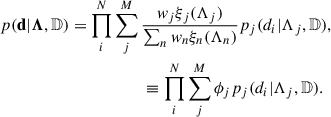
the likelihood takes the simple form of a superposition of likelihoods where the relative weights account for the different detectability fractions (Rinaldi et al. 2025a):
 (6)
(6)
Here, pj(di|Λj, 𝔻) refers to the likelihood defined in Eq. (4) evaluated using the j-th model, pj(θ|Λj); ϕ ≡ {ϕ1, …ϕM} are the ‘observed’ mixture fractions – namely, the fraction of events that are generated from the corresponding mixture component after applying selection effects; and w ≡ {w1, …, wM} denotes the ‘intrinsic’ mixture fractions (as above, but before the application of selection effects).
3. The augmented mixture model
In the previous section, we did not make any assumption regarding the specific models pj(θ|Λj). In what follows, we consider a mixture of parametric models, plus one non-parametric model whose parameters are denoted by Θ. In this case, differently from Eq. (5), we require that Σjwj ≤ 1 to account for the presence of the additional non-parametric channel. Next,
 (7)
(7)
here, we denote the non-parametric model with NP(θ|Θ), as opposed to the parametric models, pj(θ|Λj). We refer to this superposition as the ‘augmented mixture model’ (AMM).
This specific choice, namely including a non-parametric component in the mixture, addresses the possibility that the parametric models might not capture all the features that are present in the underlying distribution encoded in the data; observations that are unlikely to be explained by the available parametric models – either because they come from a region with little support or because there is an unforeseen overabundance of detections – can be captured by the non-parametric channel, acting in this case as a sort of ‘additional storage’, where the data that do not fit the analytical predictions can be collected. This ensures that only observations that are consistent with the functional form of the specific parametric model, j, are considered while estimating its parameters, Λj, thus preventing mismodelling biases in the inferred posterior distribution, p(Λj|d, 𝔻). In the same fashion, the non-parametric reconstruction was obtained making use of only the data that are unlikely to be explained by the available physically informed models, and thus describing only the features that are yet to be accounted for. The property of the non-parametric model of being able to – at least in principle – approximate arbitrary probability densities translates to the AMM, making this model potentially overcomplete: this means that there might be more than one arbitrarily precise representation of the underlying data. This might be the case, for example, when a parametric model already including the features required to describe the data is augmented with a non-parametric model: both the case in which all the data are explained by the parametric model and the one where all the observations are captured by the non-parametric channel are precise descriptions of the underlying distribution. For the same reason, it is in principle possible for the non-parametric channel to ‘take over’ the reconstruction and explain the entirety of the data alone, even if the parametric model could, in principle, account for a subset of the observations. This, however, is not expected to happen, due to the parametric model carrying more information about the expected shape of the distribution and thus being a priori favoured in certain areas of the parameter space with respect to the completely agnostic non-parametric method.
In the remainder of this section, we illustrate our algorithmic implementation of the AMM. In general, the joint parameter space (Λ, Θ) can be explored using a variety of techniques, mainly depending on the specific non-parametric model used; here, we make use of the collapsed Gibbs sampling approach and (H)DPGMM (Rinaldi & Del Pozzo 2022) as the non-parametric method.
3.1. Summary of (H)DPGMM and FIGARO
We now recap the key aspects of both (H)DPGMM and its associated sampling scheme. For the full derivation, we refer the reader to Rinaldi & Del Pozzo (2022).
The model we use, (H)DPGMM, is a non-parametric model based on the Gaussian mixture model (GMM), a potentially infinite weighted sum of multivariate Gaussian distributions able to approximate arbitrary probability densities (Nguyen et al. 2020):
 (8)
(8)
Here, the parameters are the weights λ ≡ {λ1, λ2, …} with Σkλk = 1, the mean vectors μ ≡ {μ1, μ2, …}, and the covariance matrices σ ≡ {σ1, σ2, …}; they are collectively denoted with Θ = {λ, μ, σ}. In Rinaldi & Del Pozzo (2022), we introduced this non-parametric model as well as a scheme based on the collapsed Gibbs sampling approach to draw samples from the posterior distribution p(Θ|d, 𝔻). This scheme is implemented in the FIGARO1 code (Rinaldi & Del Pozzo 2024). The potentially infinite number of Gaussian components in the mixture is accounted for by making use of a Dirichlet process (Ferguson 1973) prior on the weights, λ, controlled by its concentration parameter, αDP; despite the number of components in a specific realisation of the GMM always being finite given a finite number of observations, d, this choice makes it possible to – for every new data point added to the pool – compute both the probability of the new dN + 1 having been drawn from one of the already observed K Gaussian components (meaning that at least one of the other data points has been drawn from each of these K components), as well as the probability of the new dN + 1 having been drawn from one of the infinitely many (and equally probable) unobserved components. This effectively a new Gaussian component to the mixture when required by the available data.
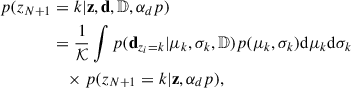
In particular, if we introduce a set of indicator variables, z = {z1, …zN}, where each indicator variable, zi = k, reads “the data di has been drawn from the k-th Gaussian component”, it is possible to compute the probability of dN + 1 being drawn from the component, k (Rinaldi & Del Pozzo 2022, Eq. 28):
 (9)
(9)
where p(dzi = k|μ, σ, 𝔻) is the likelihood in Eq. (4) evaluated considering only the events assigned to the k-th component and the new dN + 1 if k is one of the previously observed K Gaussian components, or only dN + 1 if k = K + 1; i.e. a new, previously unobserved component. The categorical probability distribution expressed by the second term on the right hand side reads (Rinaldi & Del Pozzo 2022, Eq. 25 and 26)
 (10)
(10)
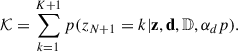
Here, nk denotes the number of events already associated with the component, k. Summing over all the possible components plus the new, unobserved one gives the normalisation constant, 𝒦:
 (11)
(11)
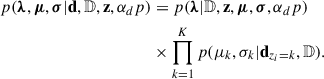
The introduction of indicatory variables is particularly useful when it comes to sampling the posterior distribution p(Θ|d, 𝔻). Since all Gaussian components of the mixture are independent of each other, conditioning on z makes the parameter space partially separable:
 (12)
(12)
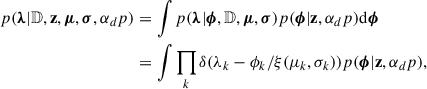
The posterior distribution on λ, under the assumption of a Dirichlet prior, reads
 (13)
(13)
where we made use of the definitions given in Eq. (3) for ξ(μ, σ) and Eq. (6) for ϕ, and
 (14)
(14)
This parameter space is explored by FIGARO using the collapsed Gibbs sampling approach. The Gibbs sampling scheme (Geman & Geman 1984; Gelfand & Smith 1990; Smith & Roberts 1993) is useful in all these situations where directly sampling from the joint parameter space – in our case, p(Θ, z|d, 𝔻) – is expensive or impossible, but sampling from the conditioned distributions p(z|Θ, d, 𝔻) and p(Θ|z, d, 𝔻) is simple. If one of the conditional probabilities can be efficiently marginalised over the conditioned variable, thus making the exploration of the parameter space even simpler, the scheme is referred to as collapsed Gibbs sampling (Liu 1994); this is the case, for example, of p(z|d, 𝔻) in Eq. (9).
Operatively, FIGARO draws a single sample from the posterior distribution p(Θ|d, 𝔻) via the following steps.
-
Draw a sample for z:
-
(a)
Consider an empty mixture model, with no observations. Out of the N available events, pick one at random and assign it to the first component. At this stage, z = {z1 = 1}.
-
(b)
Randomly pick a new event from the remaining N − 1. Using Eq. (9) conditioned on the current value of z, compute the probability of assigning this second event to the same component as the first one (z2 = 1) or to a new one (z2 = 2) and draw z2 accordingly.
-
(c)
Repeat this procedure until all the observations have been added to the mixture, which will eventually have K active components. This will be the z sample.
-
(a)
-
Draw a sample for Θ conditioned on the z sample:
-
(a)
For each of the K active components of the mixture, draw a sample for (μk, σk) using each of the terms in the product of Eq. (12). These will be the μ and σ samples.
-
(b)
From Eq. (14), draw a sample for ϕ.
-
(c)
Using the μ and σ samples to compute ξ(μk, σk), convert the ϕ sample into a λ sample to obtain Θ = {λ, μ, σ}.
-
(a)
These steps can be repeated to produce as many samples for Θ as needed. The z samples, at this stage, are just a byproduct and can be discarded.
3.2. Inferring the parameters of an AMM
We now turn our attention to the problem of exploring the parameter space of the AMM, leveraging on the same sampling scheme used for the non-parametric method. From a mathematical point of view, most of the derivation is identical to the one we just summarised for the non-parametric methods. The main difference is that now the number of components – parametric models plus a non-parametric one – is finite and equal to M + 1. Therefore, the prior on the weights, w, is not a Dirichlet process, but its finite equivalent, the Dirichlet distribution. This distribution takes, as input, a vector of M + 1 positive numbers γ = {γ1, …, γM + 1} acting as a priori pseudo-counts for each channel. The choice in which γi = 1 ∀i corresponds to the uniform distribution on the M-dimensional simplex.
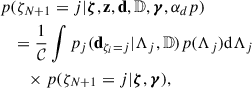
In particular, denoting the indicator variables for the augmented mixture model with ζ = {ζ1, …, ζN}, Eq. (9) becomes
 (15)
(15)
if j < M + 1, thus corresponding to a parametric model, and
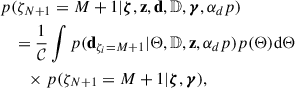 (16)
(16)
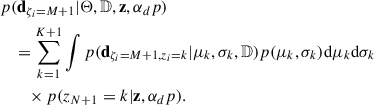
when considering the non-parametric model. The integrand can be further broken down using z:
 (17)
(17)
These are the same terms used in the non-parametric inference presented in the previous Subsection just with the additional condition of considering only the events actually associated with the non-parametric channel. The categorical probability distribution corresponding to the one in Eq. (10) reads, due to the finite number of mixture components,
 (18)
(18)
As in Eq. (11), the normalisation constant 𝒞 in Eqs. (15) and (16) is simply the sum over all the possible models:
 (19)
(19)
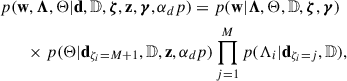
Finally, the posterior distribution on (w, Λ, Θ) can be expressed as
 (20)
(20)
where  is given by Eq. (12) and
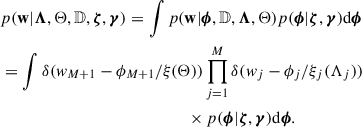 (21)
(21)
The posterior distribution for ϕ is the same as Eq. (14):
 (22)
(22)
In this derivation, we tacitly assumed that the parametric models have completely disjoint sets of parameters. If this is not the case, the models sharing at least one parameter have to be inferred jointly.
With all these ingredients, we are able to draw samples from the posterior distribution p(Λ, Θ|d, 𝔻). The steps are listed below.
-
Draw a sample for ζ and z.
-
(a)
Starting from an empty mixture, randomly select one of the available events and compute the probability of assigning it to one of the parametric models (Eq. (15)) or to the non-parametric component (Eq. (16)); then, draw ζ1 accordingly. If ζ1 = M + 1, also assign the event to one of the Gaussian components of the non-parametric model.
-
(b)
Repeat the previous step adding all the N − 1 remaining events in a random order, each time conditioning on the current values of ζ and z. Events for which ζi = M + 1 should also be used to update z following the procedure described in Section 3.1. This will produce a sample for ζ and one for z.
-
(a)
-
Draw a sample for Λ, Θ, and w conditioned on ζ and z.
-
(a)
For each parametric model, draw a sample for Λj using a stochastic sampling scheme (e.g. Markov Chain Monte Carlo, MCMC) for every term of the product in Eq. (20), producing a sample for Λ.
-
(b)
Draw a sample for Θ as in Section 3.1.
-
(c)
From Eq. (22), draw a sample for ϕ.
-
(d)
Using the Λ and Θ sample to compute ξj(Λj) and ξ(Θ), convert the ϕ sample into a w sample.
-
(a)
Again, this procedure can be iterated to produce multiple (w, Λ, Θ) samples. In this case, the auxiliary variable ζ can be useful in determining which channel is more likely to have produced each of the available events.
To accompany this derivation, we developed ANUBIS, a Python code implementing the algorithm presented in this Section. ANUBIS relies on FIGARO for the non-parametric inference and on ERYN (Foreman-Mackey et al. 2013; Karnesis et al. 2023; Katz et al. 2023) as an MCMC sampler. In our implementation, the integral in Eq. (15) is carried out using a Monte Carlo approximation with samples drawn from the prior p(Λj):
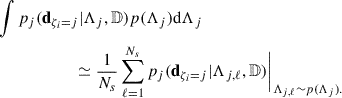 (23)
(23)
A single sample out of the Ns used in the Monte Carlo sum is also randomly selected at every iteration with probability proportional to pj(dζi = j|Λj, ℓ, 𝔻) to be used as starting point for the MCMC chain of step 2a. This ensures that the chain is already in a thermalised state – shortening the overall algorithm runtime – and that subsequent samples of Λj are independent. The code is publicly available2 and is used in the analyses of the following sections.
4. Simulated data
To demonstrate the capability of AMMs to capture features in distributions, we applied the framework described in the previous section to two different simulated scenarios inspired by the BH distribution presented in Abbott et al. (2023b). The inferred values for the parameters are reported quoting the median and 68% credible interval.
4.1. One-dimensional distribution
The first, simplified example presented here is a one-dimensional distribution describing the BBH primary mass. The underlying distribution is assumed to be a truncated power-law (PL) distribution with the spectral index α, bounded between between Mmin = 3 M⊙ and Mmax = 80 M⊙ (assumed known) and superimposed to a Gaussian distribution:
 (24)
(24)
The PL distribution is defined as
 (25)
(25)
To generate the mock data presented in this section, we used α = 3.5, μ = 35 M⊙, σ = 4 M⊙, and wPeak = 0.05. The selection function through which we filtered the data, reported in Figure 1a as a dashed grey line, is modelled after the one presented in Veske et al. (2021). From this distribution we draw 100 observed values M = {M1, …, M100}, and for each of these we simulated a posterior distribution p(θi|di) as a log-normal distribution as
 (26)
(26)
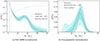 |
Fig. 1. Inferred distribution for one-dimensional POWERLAW+PEAK example presented in Section 4.1 in the PL+NP case. The solid blue line marks the median reconstruction, the shaded areas correspond to the 68% and 90% credible regions, and the solid red line shows the true underlying distribution. The grey dashed line in the left panel corresponds to the selection function used. |
where σr = 0.15 for all events and
 (27)
(27)
In this simplified example, we do not account for the correlation between detection efficiency and measurement uncertainty: we include this feature in the more realistic simulation presented in the next section. In what follows, we analyse these simulated data with different AMMs.
//
4.1.1. PL + NP
In this first test, we assume a PL model augmented with the non-parametric channel (PL+NP), simulating the scenario where we have a good theoretical understanding of only one BBH formation channel. The free parameters are the PL index α and the relative weights w = {wNP, wPL}. The inferred distribution is reported in Figure 1a. The inferred value for the PL index is α = 3.5 ± 0.4, which is consistent with the simulated value. For comparison, if we do not include the non-parametric channel, we obtain α = 2.4 ± 0.1 – a value biased by the presence in the data of a feature not accounted for in the model.
The non-parametric reconstruction, reported in Figure 1b, highlights the presence of a feature at around 30 − 35 M⊙ consistent with the simulated Gaussian distribution. The weights (wNP, wPL) are reported in Figure 2 (blue histograms). The inferred non-parametric weight is  , in agreement with the simulated value wPeak = 0.05 that the non-parametric channel is expected to capture.
4.1.2. PL + linear + NP
Secondly, we show that the AMM is robust with respect to the inclusion of a ‘useless’ component – a channel not part of the underlying distribution – in the mixture. In particular, we add a linear distribution bounded between the same Mmin and Mmax as the PL distribution:
 (28)
(28)
The red histogram in Figure 2 shows how the inference is unaffected by the presence of an additional, unused channel: the weight associated with the linear distribution is found to be negligible and thus such channel does not contribute to the overall inference, leading to a reconstruction almost identical to the PL+NP case.
4.1.3. PL + peak + NP
The last case considered here is the one in which we have all the necessary components in the parametric mixture to describe the underlying distribution, thus making the non-parametric channel redundant: in particular, we include a PL distribution, a Gaussian peak, and a non-parametric model in the analysis. We find, for the parameters of this mixture, α = 3.7 ± 0.4,  and
and  – all in agreement with the simulated values. Figure 1b reports, with a dashed green, the Gaussian distribution corresponding to the median inferred μ and σ: this is in good agreement with the non-parametric feature reconstructed in the PL+NP case.
The green histograms in Figure 2 show the posterior distribution for the three weights (wNP, wPL, wPeak): in this case, the presence of additional, non-parametric features is disfavoured by the presence of the Gaussian channel ( and wPeak = 0.04 ± 0.02). The suppression of the unused channel is, however, not as confident as it is in the previous PL+linear+NP case due to the flexibility of the non-parametric model. The mixture model being over-complete, it is always possible to associate some of the available events with the NP channel, thus resulting in a non-zero associated weight. Nonetheless, the shape of the posterior distribution for wNP suggests that the parametric models alone are sufficient to explain the data.
4.2. Three-dimensional distribution
We now consider a more realistic example modelled after the real LVK GW detections, including the primary mass M1, the mass ratio q, and the redshift z in the analysis. The primary mass follows a POWERLAW+PEAK distribution (described in Appendix B1.b of Abbott et al. 2023b) with parameters α = 3.5, δ = 5 M⊙, Mmin = 3 M⊙, μ = 35 M⊙, σ = 4 M⊙, and wPeak = 0.02. The maximum mass, Mmax = 80 M⊙, is assumed known. The mass ratio is distributed according to a power law:
 (29)
(29)
with β = 1.1, and the redshift is
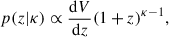 (30)
(30)
with κ = 2 between z = 0 and z = 2. For all the other parameters (spins and extrinsic parameters), we used isotropic and uniform distributions, assumed known. From these distribution, we draw 105 binaries and inject the corresponding signals in simulated noise representative of O3 sensitivity3. For each signal, we computed the network signal-to-noise ratio, ρ, randomly selected 59 events with ρ > 10, and estimated their parameters using BILBY (Ashton et al. 2019) to produce a mock catalogue with properties similar to the BBHs observed during O3. The selection effects can therefore accounted for using the search sensitivity estimates for O3 (The LIGO Scientific Collaboration 2023b, v2) released along with the third Gravitational Wave Transient Catalog (GWTC-3).
We analysed this mock catalogue using the tapered power law (TPL) of the POWERLAW+PEAK model augmented with (H)DPGMM. The posterior distribution for the parameters ΛTPL = {α, δ, Mmin, κ, β} is reported in Figure 3a, whereas Figure 3b shows the non-parametric reconstruction of the marginal M1 − z distribution. The inferred distributions are consistent with the expectations, both being in agreement with the simulated values and highlighting the presence of the Gaussian feature at around 35 M⊙.
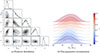 |
Fig. 3. Inferred distributions for three-dimensional mock catalogue presented in Section 4.2. Left: Posterior distribution for ΛTPL. The blue cross-hairs mark the true values. Right: Non-parametric marginal M1 − z distribution. For each redshift value, the mass distribution has been normalised, and the shaded areas mark the 68% credible regions. |
The interpretation of the relative weights (wNP, wTPL) requires some care, however, due to the presence of a censored area in the binary parameter space – namely the low-mass, high-redshift region. Since the GW detectors are not able to detect gravitational signals with such properties, the inferred population distribution will have to rely on extrapolation to cover that specific region of the binary parameter space. The non-parametric methods, however, are by construction informed only by the available data, and they are thus unable to extrapolate beyond the point where data are observable: the detector horizon. Reconstructing the intrinsic distribution in censored areas would yield diverging uncertainties (see, e.g. the yellow shaded area in Figure 2 of Toubiana et al. (2025), where this point is further discussed)4. To prevent this issue, FIGARO is coded such that the inferred distribution vanishes in the censored areas, effectively preventing extrapolation towards high redshifts. In practice this means that, out of all the possible Gaussian components represented by combinations of μk and σk, the ones for which the individual detectability fraction defined in Eq. (3) is smaller than a threshold value, ξ(μk, σk) < ξth, are not considered for inclusion in the mixture. For the examples presented in this paper, we set ξth = 10−3. This is by all means an effective artificial cut-off of the inferred distribution in the parameter space and must be kept in mind while interpreting the outcome of the inference. This model-specific prescription, limiting the number of high-redshift binaries as a result of the exclusion of the corresponding mixture components, affects the calculation of the overall detectability fraction, ξ(Θ), skewing the inference of wNP towards smaller values. In such cases, it can become difficult to distinguish whether the presence of the non-parametric channel is required by the data or not. The posterior distribution for the observed mixture fraction ϕ, reported in Figure 4, solves the issue showing that the non-parametric channel is actually required to account for ∼35% of the observed GW events.
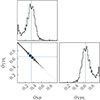 |
Fig. 4. Posterior distribution for ϕ using three-dimensional mock catalogue of Section 4.2. The blue cross-hairs mark the true values. |
The intrinsic mixture fractions, w, are inherently affected by the specific choices made in the non-parametric model to cure the divergences due to the presence of censored regions in the parameter space. Therefore, while w is useful in the study of mixtures of parametric models only, in the specific context of AMMs we believe that the main quantities to consider to assess the presence (or absence) of some features in the data are the observed mixture fractions, ϕ. These quantities are exclusively driven by the number of observed events associated with each mixture component, as shown in Eq. (22), and as such the most robust against the effects of selection-bias deconvolution.
5. BBHs from GWTC-3
Having demonstrated the capability of our approach in simulated scenarios, we now analyse the primary mass, mass ratio, and redshift distribution of BBHs using the publicly available GW events detected by the LVK collaboration. In this section, we describe how we made use of the 69 GW events released in GWTC-3 (Abbott et al. 2023a) with false-alarm rates of < 1 yr−1. The selection effects were accounted for using the sensitivity estimates for the first three observing runs (O1+O2+O3 – The LIGO Scientific Collaboration 2023a, v2) released along with GWTC-3. This choice was driven by the fact that the focus of this work is on the new methodology that we introduce rather than on the astrophysical interpretation of the findings. An application of this method to the newly released GWTC-4.0 and a discussion of the results yielded will be the subject of a future paper.
5.1. Parametrised model
In this first analysis, we applied the same AMM used in Section 4.2, TPL+NP, with ΛTPL = {α, δ, Mmin, κ, β}. Mmax is fixed at 100 M⊙ to ensure that the parametric distribution has non-zero support on the whole mass range. This analysis has a similar concept to the one presented in Rinaldi et al. (2025a), where we analysed the same dataset using a weighted superposition of a TPL and a Gaussian peak with independent redshift evolutions; following this paper, we included only the primary mass, mass ratio, and redshift in the analysis, and we assumed a fixed isotropic spin distribution (see Section 3 of Rinaldi et al. 2025a). Moreover, we compare our findings with the ones presented in the aforementioned paper.
The posterior distribution for ΛTPL is reported in Figure 5, which is found to be in good agreement with Rinaldi et al. (2025a). The differences between the two distributions are to be ascribed to the fact that the NP channel used in this analysis has more flexibility than the Gaussian peak, thus affecting the inference of the TPL parameters differently. The reconstructed marginal non-parametric distribution for M1 and z is reported in Figure 6a, highlighting the presence of the ∼35 M⊙ pileup. This non-parametric reconstruction can be converted into a posterior on the parameters of a Gaussian distribution using the remapping procedure presented in Rinaldi et al. (2025b): the result of this remapping is shown in Figure 6b. We find  and
and  , which is in agreement with the expectation of μ ∼ 35 M⊙ and σ ∼ 4 M⊙ (Abbott et al. 2023b). The inferred relative weight of the NP channel is
  , corresponding to an observed relative weight
  – 13 GW events associated with the non-parametric channel.
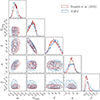 |
Fig. 5. Posterior distribution for ΛTPL using GWTC-3. |
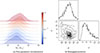 |
Fig. 6. Left: M1 − z non-parametric reconstruction using GWTC-3 events. For each redshift value, the mass distribution has been normalised, and the shaded areas mark the 68% credible regions. Right: Posterior distribution for μ and σ of a Gaussian distribution obtained from the non-parametric reconstruction using the remapping procedure presented in Rinaldi et al. (2025b). |
5.2. Population synthesis
In this last example, we will show that astrophysical models can also be augmented with non-parametric methods. We consider an isolated evolution channel using the rapid binary population synthesis code SEVN5 (Spera et al. 2019; Mapelli et al. 2020; Iorio et al. 2023b), and in particular the publicly available catalogues6 (Iorio et al. 2023a, v2) released alongside Iorio et al. (2023b). For simplicity, we made use of the Fiducial model assuming only one metallicity (Z = 10−3) and one value for the common envelope efficiency (αCE = 3). This model is described in detail in Section 3.2 of Iorio et al. (2023b). To obtain a probability density function, we fitted a GMM approximant to the M1 and q SEVN samples. Other choices for the approximant are also possible, such as the normalising flow emulator presented in Colloms et al. (2025), which allows for the exploration of different values for αCE and Z. The redshift model is the one given in Eq. (30); therefore, in this case, ΛSEVN = {κ}.
We find that, for the SEVN+NP model,  . Concerning the relative importance of the two channels, we obtain
  , corresponding to an observed relative weight of ϕNP = 0.35 ± 0.14. This suggests that around 44 out of 69 GW events can be explained using the isolated evolution model, whereas the remaining ones have to be accounted for using the non-parametric channel.
When comparing the primary-mass non-parametric reconstructions of the SEVN+NP and the TPL+NP models, reported in Figure 7a, we see that the former has more support towards more massive BHs. This is a direct consequence of the difference in support between the PL model – which is deliberately extended all the way to Mmax = 100 M⊙ – and the SEVN catalogue, which is cut at around 40 M⊙ due to the pair-instability model used (both reported in Figure 7b). This highlights the fact that not only is the isolated evolution model used in this section incapable of describing the ∼35 M⊙ feature, some additional channels (i.e. dynamical models) are needed to explain the high-mass end of the spectrum. We remind the reader, however, that the example presented here is purely for demonstration purposes: an in-depth study investigating the features that population synthesis codes are able or unable to predict is beyond the scope of this work and will be the subject of a future study.
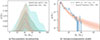 |
Fig. 7. Left: Marginal non-parametric reconstruction for M1 in the SEVN+NP case (blue) and TPL+NP case (red). Right: Comparison between SEVN catalogue used in Section 5.2 (blue histogram) and the TPL inferred in Section 5.1 (solid red). In both panels, the shaded areas represent the 68% and 90% credible regions. |
6. Summary
In this paper, we introduce the concept of the AMM, a model designed to allow parametric and astrophysical models to accommodate unforeseen features in the analysed data. We achieved this by building a weighted superposition of parametric models and an additional non-parametric model. We validated our formalism applying it to the reconstruction of simulated datasets mimicking the currently available GW observations. We also analysed the real GW events from GWTC-3, finding good agreement with the available literature about the most pronounced features of the primary mass distribution.
The possibility of equipping astrophysical models with non-parametric methods will be extremely valuable to both data analysts and theoreticians. Having a channel able to collect events that are unlikely to be explained by the physically informed models included in the analysis will prevent biases due to mismodelling, as well as highlighting the areas in which astrophysical models need to be further developed. With the grand total of observed GWs after the first third of O4, just above the 150 detection, the newly released GWTC-4.0 will be a perfect playground for AMMs to possibly reveal new features in the astrophysical distribution of BBHs while strengthening our understanding of the formation paths of the compact objects that populate our Universe.
Acknowledgments
The author is grateful to Walter Del Pozzo, Gabriele Demasi, and Michela Mapelli for useful discussion, to Vasco Gennari, Giuliano Iorio, and Amedeo Romagnolo for comments on the initial draft of this paper, and to Gabriele also for providing the script used to generate the mock data used in Section 4.2. This work was funded by the Deutsche Forschungsgemeinschaft (DFG, German Research Foundation) – project number 546677095. The author acknowledges financial support from the German Excellence Strategy via the Heidelberg Cluster of Excellence (EXC 2181 – 390900948) STRUCTURES, from the state of Baden-Württemberg through bwHPC, from the German Research Foundation (DFG) through grants INST 35/1597-1 FUGG and INST 35/1503-1 FUGG and from the European Research Council for the ERC Consolidator grant DEMOBLACK, under contract no. 770017. This research has made use of data or software obtained from the Gravitational Wave Open Science Center (gwosc.org), a service of the LIGO Scientific Collaboration, the Virgo Collaboration, and KAGRA. This material is based upon work supported by NSF’s LIGO Laboratory which is a major facility fully funded by the National Science Foundation, as well as the Science and Technology Facilities Council (STFC) of the United Kingdom, the Max-Planck-Society (MPS), and the State of Niedersachsen/Germany for support of the construction of Advanced LIGO and construction and operation of the GEO600 detector. Additional support for Advanced LIGO was provided by the Australian Research Council. Virgo is funded, through the European Gravitational Observatory (EGO), by the French Centre National de Recherche Scientifique (CNRS), the Italian Istituto Nazionale di Fisica Nucleare (INFN) and the Dutch Nikhef, with contributions by institutions from Belgium, Germany, Greece, Hungary, Ireland, Japan, Monaco, Poland, Portugal, Spain. KAGRA is supported by Ministry of Education, Culture, Sports, Science and Technology (MEXT), Japan Society for the Promotion of Science (JSPS) in Japan; National Research Foundation (NRF) and Ministry of Science and ICT (MSIT) in Korea; Academia Sinica (AS) and National Science and Technology Council (NSTC) in Taiwan.
References
- Aasi, J., Abbott, B. P., Abbott, R., et al. 2015, CQG, 32, 074001 [Google Scholar]
- Abbott, B. P., Abbott, R., Abbott, T. D., et al. 2019, ApJ, 882, L24 [Google Scholar]
- Abbott, R., Abbott, T. D., Acernese, F., et al. 2021, ApJ, 913, L7 [NASA ADS] [CrossRef] [Google Scholar]
- Abbott, R., Abbott, T. D., Acernese, F., et al. 2023a, PRX, 13, 041039 [Google Scholar]
- Abbott, R., Abbott, T. D., Acernese, F., et al. 2023b, PRX, 13, 011048 [Google Scholar]
- Acernese, F., Agathos, M., Agatsuma, K., et al. 2015, CQG, 32, 024001 [NASA ADS] [CrossRef] [Google Scholar]
- Akutsu, T., Ando, M., Arai, K., et al. 2020, PTEP, 2021, 05A101 [Google Scholar]
- Ashton, G., Hübner, M., Lasky, P. D., et al. 2019, ApJS, 241, 27 [NASA ADS] [CrossRef] [Google Scholar]
- Banerjee, S. 2022, A&A, 665, A20 [NASA ADS] [CrossRef] [EDP Sciences] [Google Scholar]
- Belczynski, K., Heger, A., Gladysz, W., et al. 2016, A&A, 594, A97 [NASA ADS] [CrossRef] [EDP Sciences] [Google Scholar]
- Callister, T. A. 2024, arXiv e-prints [arXiv:2410.19145] [Google Scholar]
- Callister, T. A., & Farr, W. M. 2024, PRX, 14, 021005 [Google Scholar]
- Colloms, S., Berry, C. P. L., Veitch, J., & Zevin, M. 2025, ApJ, 988, 189 [Google Scholar]
- Farah, A. M., Edelman, B., Zevin, M., et al. 2023, ApJ, 955, 107 [NASA ADS] [CrossRef] [Google Scholar]
- Ferguson, T. S. 1973, AnSta, 1, 209 [Google Scholar]
- Fishbach, M., & Holz, D. E. 2017, ApJ, 851, L25 [NASA ADS] [CrossRef] [Google Scholar]
- Foreman-Mackey, D., Hogg, D. W., Lang, D., & Goodman, J. 2013, PASP, 125, 306 [Google Scholar]
- Gallegos-Garcia, M., Berry, C. P. L., Marchant, P., & Kalogera, V. 2021, ApJ, 922, 110 [NASA ADS] [CrossRef] [Google Scholar]
- Gelfand, A. E., & Smith, A. F. M. 1990, JASA, 85, 398 [Google Scholar]
- Geman, S., & Geman, D. 1984, ITPAM, PAMI-6, 6, 721 [Google Scholar]
- Gennari, V., Mastrogiovanni, S., Tamanini, N., Marsat, S., & Pierra, G. 2025, Phys. Rev. D, 111, 123046 [Google Scholar]
- Heinzel, J., Mould, M., Álvarez-López, S., & Vitale, S. 2025, Phys. Rev. D, 111, 063043 [Google Scholar]
- Hirschi, R., Goodman, K., Meynet, G., et al. 2025, MNRAS, 543, 2796 [Google Scholar]
- Iorio, G., Costa, G., Mapelli, M., et al. 2023a, https://zenodo.org/records/7794546 [Google Scholar]
- Iorio, G., Mapelli, M., Costa, G., et al. 2023b, MNRAS, 524, 426 [NASA ADS] [CrossRef] [Google Scholar]
- Karnesis, N., Katz, M. L., Korsakova, N., Gair, J. R., & Stergioulas, N. 2023, MNRAS, 526, 4814 [Google Scholar]
- Katz, M., Karnesis, N., & Korsakova, N. 2023, https://doi.org/10.5281/zenodo.7705496 [Google Scholar]
- Kremer, K., Spera, M., Becker, D., et al. 2020, ApJ, 903, 45 [NASA ADS] [CrossRef] [Google Scholar]
- Kruckow, M. U., Andrews, J. J., Fragos, T., et al. 2024, A&A, 692, A141 [NASA ADS] [CrossRef] [EDP Sciences] [Google Scholar]
- Li, Y.-J., Wang, Y.-Z., Han, M.-Z., et al. 2021, ApJ, 917, 33 [NASA ADS] [CrossRef] [Google Scholar]
- Liu, J. S. 1994, JASA, 89, 958 [Google Scholar]
- Mandel, I., & Farmer, A. 2022, PhR, 955, 1 [Google Scholar]
- Mandel, I., Farr, W. M., & Gair, J. R. 2019, MNRAS, 486, 1086 [Google Scholar]
- Mapelli, M. 2020, FrASS, 7 [Google Scholar]
- Mapelli, M., Spera, M., Montanari, E., et al. 2020, ApJ, 888, 76 [NASA ADS] [CrossRef] [Google Scholar]
- Marchant, P., Pappas, K. M. W., Gallegos-Garcia, M., et al. 2021, A&A, 650, A107 [NASA ADS] [CrossRef] [EDP Sciences] [Google Scholar]
- Merritt, J., Stevenson, S., Sander, A., et al. 2025, arXiv e-prints [arXiv:2507.17052] [Google Scholar]
- Nguyen, T. T., Nguyen, H. D., Chamroukhi, F., & McLachlan, G. J. 2020, CMS, 7, 1750861 [Google Scholar]
- Ray, A., Magaña Hernandez, I., Mohite, S., Creighton, J., & Kapadia, S. 2023, ApJ, 957, 37 [NASA ADS] [CrossRef] [Google Scholar]
- Rinaldi, S., & Del Pozzo, W. 2022, MNRAS, 509, 5454 [Google Scholar]
- Rinaldi, S., & Del Pozzo, W. 2024, JOSS, 9, 6589 [NASA ADS] [CrossRef] [Google Scholar]
- Rinaldi, S., Liang, Y., Demasi, G., Mapelli, M., & Del Pozzo, W. 2025a, A&A, 702, A52 [NASA ADS] [CrossRef] [EDP Sciences] [Google Scholar]
- Rinaldi, S., Toubiana, A., & Gair, J. R. 2025b, JCAP, 2025, 031 [Google Scholar]
- Rodriguez, C. L., Sourav, C., & Frederic, A. R. 2016, Phys. Rev. D, 93, 084029 [NASA ADS] [CrossRef] [Google Scholar]
- Romagnolo, A., Gormaz-Matamala, A. C., & Belczynski, K. 2024, ApJ, 964, L23 [NASA ADS] [CrossRef] [Google Scholar]
- Röpke, F. K., & De Marco, O. 2023, LRCA, 9, 2 [Google Scholar]
- Smith, A. F. M., & Roberts, G. O. 1993, JRSS, 55, 3 [Google Scholar]
- Spera, M., Mapelli, M., Giacobbo, N., et al. 2019, MNRAS, 485, 889 [Google Scholar]
- Talbot, C., & Thrane, E. 2018, ApJ, 856, 173 [NASA ADS] [CrossRef] [Google Scholar]
- The LIGO Scientific Collaboration, the Virgo Collaboration & the KAGRA Collaboration 2023a, https://zenodo.org/records/7890398 [Google Scholar]
- The LIGO Scientific Collaboration, the Virgo Collaboration & the KAGRA Collaboration 2023b, https://zenodo.org/records/7890437 [Google Scholar]
- The LIGO Scientific Collaboration, the Virgo Collaboration, & the KAGRA Collaboration 2025a, arXiv e-prints [arXiv:2508.18083] [Google Scholar]
- The LIGO Scientific Collaboration, The Virgo Collaboration, & the KAGRA Collaboration 2025b, arXiv e-prints [arXiv:2508.18082] [Google Scholar]
- Toubiana, A., Katz, M. L., & Gair, J. R. 2023, MNRAS, 524, 5844 [NASA ADS] [CrossRef] [Google Scholar]
- Toubiana, A., Gerosa, D., Mould, M., et al. 2025, arXiv e-prints [arXiv:2507.13249] [Google Scholar]
- van Son, L. A. C., Roy, S. K., Mandel, I., et al. 2025, ApJ, 979, 209 [Google Scholar]
- Veske, D., Bartos, I., Márka, Z., & Márka, S. 2021, ApJ, 922, 258 [NASA ADS] [CrossRef] [Google Scholar]
- Vink, J. S., Higgins, E. R., Sander, A. A. C., & Sabhahit, G. N. 2021, MNRAS, 504, 146 [NASA ADS] [CrossRef] [Google Scholar]
- Vink, J. S., Sabhahit, G. N., & Higgins, E. R. 2024, A&A, 688, L10 [NASA ADS] [CrossRef] [EDP Sciences] [Google Scholar]
- Vitale, S., Gerosa, D., Farr, W. M., & Taylor, S. R. 2022, in Handbook of Gravitational Wave Astronomy, eds. C. Bambi, S. Katsanevas, & K. D. Kokkotas, 45 [Google Scholar]
- Willcox, R., MacLeod, M., Mandel, I., & Hirai, R. 2023, ApJ, 958, 138 [NASA ADS] [CrossRef] [Google Scholar]
- Ziosi, B. M., Mapelli, M., Branchesi, M., & Tormen, G. 2014, MNRAS, 441, 3703 [Google Scholar]
Publicly available at https://github.com/sterinaldi/FIGARO and via pip.
It can be found at https://github.com/sterinaldi/ANUBIS and also installed via pip
The noise curves used are publicly available here: https://dcc.ligo.org/LIGO-T2000012-v1/public
A simple way of picturing this is saying that the non-parametric method being ‘unable to decide’ whether the lack of observations in an empty area of the binary parameter space is either due to the intrinsic distribution not having support in such an area or the selection function completely depleting it.
Publicly available at https://gitlab.com/sevncodes/sevn
All Figures
|
Fig. 1. Inferred distribution for one-dimensional POWERLAW+PEAK example presented in Section 4.1 in the PL+NP case. The solid blue line marks the median reconstruction, the shaded areas correspond to the 68% and 90% credible regions, and the solid red line shows the true underlying distribution. The grey dashed line in the left panel corresponds to the selection function used. |
| In the text | |
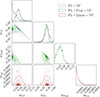 |
Fig. 2. Inferred weights for different mixture models considered in Section 4.1. |
| In the text | |
|
Fig. 3. Inferred distributions for three-dimensional mock catalogue presented in Section 4.2. Left: Posterior distribution for ΛTPL. The blue cross-hairs mark the true values. Right: Non-parametric marginal M1 − z distribution. For each redshift value, the mass distribution has been normalised, and the shaded areas mark the 68% credible regions. |
| In the text | |
|
Fig. 4. Posterior distribution for ϕ using three-dimensional mock catalogue of Section 4.2. The blue cross-hairs mark the true values. |
| In the text | |
|
Fig. 5. Posterior distribution for ΛTPL using GWTC-3. |
| In the text | |
|
Fig. 6. Left: M1 − z non-parametric reconstruction using GWTC-3 events. For each redshift value, the mass distribution has been normalised, and the shaded areas mark the 68% credible regions. Right: Posterior distribution for μ and σ of a Gaussian distribution obtained from the non-parametric reconstruction using the remapping procedure presented in Rinaldi et al. (2025b). |
| In the text | |
|
Fig. 7. Left: Marginal non-parametric reconstruction for M1 in the SEVN+NP case (blue) and TPL+NP case (red). Right: Comparison between SEVN catalogue used in Section 5.2 (blue histogram) and the TPL inferred in Section 5.1 (solid red). In both panels, the shaded areas represent the 68% and 90% credible regions. |
| In the text | |
Current usage metrics show cumulative count of Article Views (full-text article views including HTML views, PDF and ePub downloads, according to the available data) and Abstracts Views on Vision4Press platform.
Data correspond to usage on the plateform after 2015. The current usage metrics is available 48-96 hours after online publication and is updated daily on week days.
Initial download of the metrics may take a while.