


Fig. 8.
Download original image
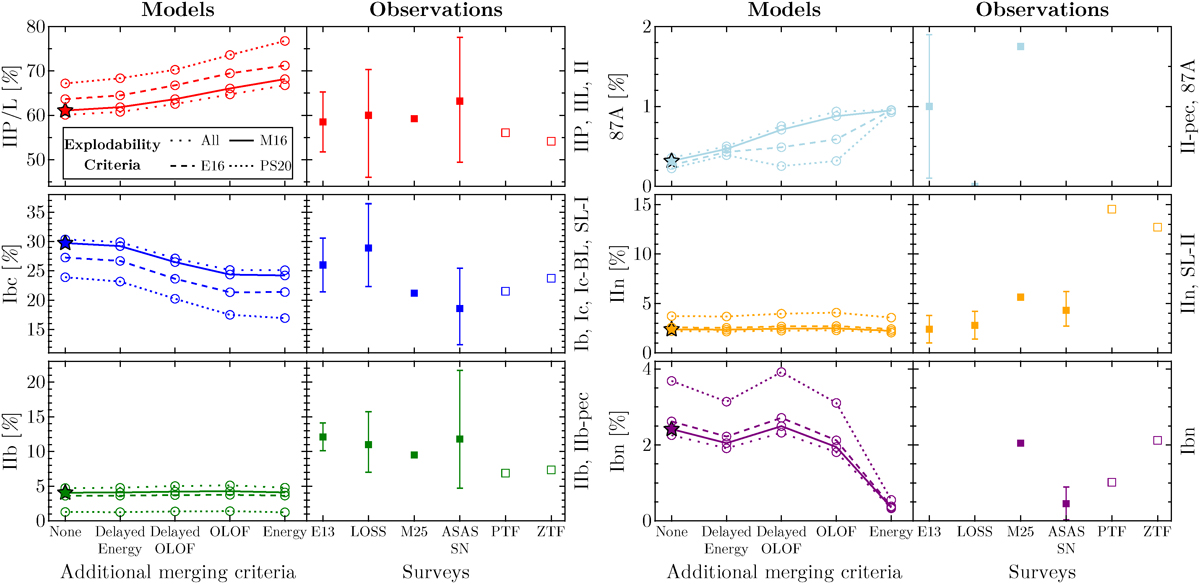
Comparison between the predictions on the fractions of supernovae of different types (different blocks) produced by the models (left subpanel, with our supernova nomenclature on the left y-axis) and the observed fractions (right subpanel, with the observed subtypes that we clumped in each group on the right y-axis). The numbers are reported as a fraction of all core-collapse supernovae. For the models, a line plot show the variation of the fraction of supernovae subtypes as a function of different merger criteria added on top of the hard-coded criteria (‘None’ on the x-axis), sorted from left to right by those that produce less to more mergers that reach core collapse (see text). Different dashes shows the same while assuming different explodability criteria sorted by increasing number of implosions, that all stars successfully explode (All), Müller et al. (2016, M16), Ertl et al. (2016, E16), and Patton & Sukhbold (2020, PS20). The star corresponds to the fiducial model. For the observation, we show the estimates from volume-limited samples from Eldridge et al. 2013 (E13), the LOSS survey (specifically, the subsample from high-mass galaxies, which serves as a proxy of high-metallicity environments; Graur et al. 2017), and the samples from Ma et al. 2025b (M25) and ASAS-SN (Pessi et al. 2025) with filled markers. We also include for reference the magnitude-limited samples from PTF (Schulze et al. 2021) and ZTF (Hinds et al. 2025), shown with empty markers.
Current usage metrics show cumulative count of Article Views (full-text article views including HTML views, PDF and ePub downloads, according to the available data) and Abstracts Views on Vision4Press platform.
Data correspond to usage on the plateform after 2015. The current usage metrics is available 48-96 hours after online publication and is updated daily on week days.
Initial download of the metrics may take a while.