


| Issue |
A&A
Volume 706, February 2026
|
|
|---|---|---|
| Article Number | A331 | |
| Number of page(s) | 11 | |
| Section | Galactic structure, stellar clusters and populations | |
| DOI | https://doi.org/10.1051/0004-6361/202558281 | |
| Published online | 24 February 2026 | |
A study of wide binary open clusters in the Milky Way from Gaia DR3
Institute of Astronomy and Information, Dali University,
Dali
671003,
China
★ Corresponding author: This email address is being protected from spambots. You need JavaScript enabled to view it.
Received:
27
November
2025
Accepted:
1
January
2026
Abstract
Context. Some Galactic open clusters may form in binary or multiple systems. Binary clusters provide direct constraints on the clustered star-formation process, the gravitational potential of the Galactic disk, and the internal dynamical evolution of star clusters. However, only dozens of gravitationally bound binary clusters have been firmly recognized so far.
Aims. As a part of the Dali Binary Cluster Project (DL-BCP), we searched for the wide binary open clusters (WBOCs) in the Milky Way using the data from Gaia Data Release 3 (Gaia DR3), and derived their fundamental astrophysical parameters and possible orbital evolution.
Methods. We started from a Gaia-based open cluster catalog of 7167 clusters, and selected cluster pairs with separations of less than 100 pc and larger than the sum of the radii of sub-clusters at first. Then we checked whether the sub-clusters of every pair are gravitationally bound. Gravitationally bound pairs with two gravitationally bound sub-clusters are regarded as WBOCs. The ages, reddenings, and metallicities of their sub-clusters were re-derived by isochrone fitting in the (GBP–GRP) versus G color–magnitude diagram. Three-dimensional orbits were integrated in a three-component axisymmetric Galactic potential for the following 500 Myr and for the period before now.
Results. We finally identified four new WBOCs and two known WBOCs. Two certain primordial binary open clusters (PBOCs) were found and studied. The cluster masses of these WBOCs range from 131.13 M⊙ to 1155.86 M⊙. Age differences between the two components are ≤40 Myr for all of these WBOCs, and their separations vary from 20 to near 100 pc. The result enlarges the currently known BOC sample and provides a uniform set of fundamental parameters and orbital analysis for six WBOCs.
Key words: open clusters and associations: general / galaxies: star clusters: general
© The Authors 2026
 Open Access article, published by EDP Sciences, under the terms of the Creative Commons Attribution License (https://creativecommons.org/licenses/by/4.0), which permits unrestricted use, distribution, and reproduction in any medium, provided the original work is properly cited.
This article is published in open access under the Subscribe to Open model. This email address is being protected from spambots. You need JavaScript enabled to view it. to support open access publication.
Introduction
Star clusters are thought to be the fundamental units of star formation in the Milky Way. Although most star clusters may form and evolve independently, a non-negligible fraction of open clusters (OCs) may originate from the same molecular cloud and remain gravitationally bound as binary or multiple clusters (de La Fuente Marcos & de La Fuente Marcos 2009; Bica & Bonatto 2011; Camargo et al. 2016). The existence of such cluster systems was predicted by hierarchical star-formation simulations (Fujii & Portegies Zwart 2015) and is supported by the observation of analogous pairs in galaxies such as the Milky Way and Magellanic Clouds (Song et al. 2022; Palma et al. 2025; Coenda et al. 2025; Li & Zhu 2025). However, the fraction of binary open clusters (BOCs) that were discovered and simulated is somewhat low (1 to 10 percent) (Subramaniam et al. 1995; de la Fuente Marcos & de la Fuente Marcos 2021). One can see papers such as Li & Zhu (2025) and the references therein for a history of the identification of such systems.
The fraction of BOCs is small, but such systems are important for studies on the evolution of both stars and star clusters, because most stars are thought to form in star clusters and cluster interactions may change the evolution of clusters. It is therefore necessary to make the formation and evolution of BOCs clear. Only a small fraction of BOCs have consistent astrometric, photometric, and velocity evidence for their primordial formation, in other words, primordial binary open clusters (PBOCs). This suggests that most BOCs may form from sequential formation (Brown et al. 1995) or tidal capture (de La Fuente Marcos & de La Fuente Marcos 2009; Camargo 2021). The formation of BOCs remains unclear, because of the limited BOC sample. As a result, we needed to search for more BOCs and investigate their formation and evolution in detail.
Following our first paper from the Dali Binary Cluster Project (DL-BCP), Li & Zhu (2025) (Paper I), which searched for and investigated the close binary open clusters (CBOCs) in detail in the Milky Way and identified nine new CBOC candidates, the aim of this paper was to try to search for wide binary open cluster (WBOC) candidates. We redetermined the fundamental parameters (age, reddening, distance, and mass) of sub-clusters and computed their orbital evolution in a realistic Galactic potential. The high-precision astrometry and photometry data from Gaia Data Release 3 (Gaia DR3) (Gaia Collaboration 2023) were used.
The paper is organized as follows: Section 2 describes the data used to search for new WBOCs and study their properties. Section 3 outlines the WBOC-selection algorithm, isochrone fitting method, and orbit analysis technique. Section 4 presents the results and Section 5 summarizes our conclusions and discusses this work.
2 Data
Similar to our previous work on CBOCs, we used the OC catalog of Hunt & Reffert (2023) and Hunt & Reffert (2024) (hereafter HR23 and HR24) for this work. HR23 provide an updated census of 7167 Galactic open clusters with homogeneous mean parallaxes, proper motions, and central coordinates derived from Gaia DR3. The star clusters were identified by the five-parameter astrometric solutions (α, δ, ϖ, µα, and µδ) and photometry in three bands (G, GBP, and GRP), which were taken from Gaia DR3. It contains 5647 open clusters, and the gravitationally binding statuses of objects have been studied by the work of HR24. The small photometric uncertainties (0.006, 0.108, and 0.052 mag for G, GBP, and GRP at G = 20 mag) were imposed to guarantee negligible systematic errors in color–magnitude diagrams (CMDs).
3 Method
3.1 Pair identification
For this work, we searched for WBOC candidates with separations of less than 100 pc. The three-dimensional Euclidean separation (d) between the sub-clusters of each cluster pair was computed via
 (1)
in a Galactic Cartesian frame centered on the Sun. We note that X, Y, and Z denote the three-dimensional coordinates. Cluster pairs with d ≤ 100 pc but larger than the sum of the tidal radii of two sub-clusters, and with similar proper motions (with a difference not larger than σpm) for two sub-clusters, have been kept for further inspection. Note that 100 pc is the typical upper size limit for an individual giant molecular cloud (GMC; Heyer & Dame 2015). To avoid duplicate entries, we applied a friends-of-friends linking length of 100 pc. In this method, two sub-clusters were assigned to a pair if their separation is smaller than 100 pc. This made a cluster in different pairs, and the pair with the smallest separation is considered to be BOC candidate.
(1)
in a Galactic Cartesian frame centered on the Sun. We note that X, Y, and Z denote the three-dimensional coordinates. Cluster pairs with d ≤ 100 pc but larger than the sum of the tidal radii of two sub-clusters, and with similar proper motions (with a difference not larger than σpm) for two sub-clusters, have been kept for further inspection. Note that 100 pc is the typical upper size limit for an individual giant molecular cloud (GMC; Heyer & Dame 2015). To avoid duplicate entries, we applied a friends-of-friends linking length of 100 pc. In this method, two sub-clusters were assigned to a pair if their separation is smaller than 100 pc. This made a cluster in different pairs, and the pair with the smallest separation is considered to be BOC candidate.
3.2 Gravitationally bound verification
A genuine binary cluster must be composed of two self-bound stellar aggregates. We therefore verified the gravitational status of each component cluster using the HR24 flag of different types of objects. The HR24 flag provides a classifier that labels objects as an “open cluster,” “moving group,” “globular cluster,” and two other types. Objects labeled as an open cluster are gravitationally bound open clusters and they were therefore chosen for this work. The verification of the bound pairs followed the same method as in Paper I, but it differed from other works, including Palma et al. (2025), Coenda et al. (2025), and Liu et al. (2025). However, the results of this work can be mutually verified with those from other works.
3.3 Orbital analysis
If a cluster pair is gravitationally bound, the two sub-clusters should move in elliptical orbits around their common center of mass. We checked the three-dimensional orbits of the center of mass of each WBOC member cluster. If the movements of the two sub-clusters exhibit periodic changes, they are gravitationally bound WBOCs. We performed orbital analysis for a few pairs of star clusters exhibiting similar kinematic characteristics using precise astrometric data and radial velocity (RV) measurements from Hunt & Reffert (2024). By integrating the trajectories of clusters within the current Galactic potential, we reconstructed their orbital evolution from formation epochs to the present and predicted their future kinematic paths over the next 500 Myr. Orbital integration was conducted using the MWPotential2014 Galactic potential model implemented in the galpy package (Bovy 2015). This composite potential consists of three components: a bulge modeled with a power-law density profile, a Miyamoto–Nagai disk (Miyamoto & Nagai 1975), and a dark matter halo described by a Navarro-Frenk-White profile (Navarro et al. 1996). This model was applied to the second paper of DL-BCP, Zhu et al. (2025) (Paper II), for a similar analysis.
3.4 Isochrone fitting and mass determination
For all member clusters of WBOC candidates, we constructed their CMDs (G versus GBP–GRP). Simultaneous isochrone fitting was carried out with the GPU-accelerated version of Powerful CMD (Li et al. 2017). Powerful CMD is a CMD fitting code that compares the star fractions of observed and theoretical CMDs. It divides the color–magnitude plane into 1500 cells, with 50 color bins and 30 magnitude bins, and counts the stars in each cell. Then it compares the observed and theoretical star fractions in each bin. The sum of the star fraction differences of all bins, WAD, is taken as the goodness indicator of CMD fitting. The best-fitting parameters of star clusters correspond to the theoretical model with the least WAD. Powerful CMD can utilize different kinds of stellar population models for CMD fitting, although Powerful CMD can utilize different kinds of stellar population models for CMD fitting, although it considers ASPS models (Li et al. 2012, 2016) as the standard models. For this work, we used the stellar population models built from the PARSEC v1.2s stellar isochrones (Bressan et al. 2012). They take the initial mass function (IMF) of Kroupa shape (Kroupa 2001) with various IMF indices Γ (Γ = α – 1) from 0.6 to 1.4, with an interval of 0.1. These stellar population models include both single star populations and binary star populations, but only the ones without binary stars were utilized for this work because the binary sequence is not obvious in most observed CMDs of our sample clusters. The free parameters of isochrone fitting are metallicity (Z), age (t), distance modulus (m-M)0, and color excess E(GBP–GRP). The best-fit parameters minimize the statistical difference of the star fraction (WAD) between the observed and synthetic CMDs. The total cluster mass (Moc) of a cluster is obtained by scaling the best-fit synthetic population to the observed number of stars in the color and magnitude ranges of the observed CMD. Statistical uncertainties were derived from 20 bootstrap resamplings of the member list, by taking the typical color and magnitude uncertainties. The adopted values are the best-fit results from the original observed CMD.
4 Results
4.1 WBOC candidates
The pair identification results in 17 CBOC candidates with separations (d) not greater than the sum of tidal radii of two sub-clusters (r1 + r2), and 87 WBOC candidates that have separations between (r1 + r2) and 100 pc. The CBOC candidates finally lead to nine newly found CBOCs, which have been reported by Li & Zhu (2025), and they are excluded from the BOC sample of this study. This work focuses only on the WBOC candidates. This finally results in 87 initial pairs.
When we carried out the gravitationally bound verification of the sub-clusters of the initial pairs, only those labeled as an open cluster by an HR24 flag were considered to be open clusters.
The cluster pairs that include two such open cluster components were identified as WBOC candidates. As a result, 47 pairs are chosen as WBOC candidates. Fig. 1 shows the comparison of the numbers of different pairs that consist of open clusters and moving groups. All of these pairs were used for our study.
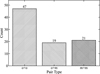 |
Fig. 1 Comparison of the numbers of three types of object pairs with separations between the sum of the tidal radii of sub-clusters and 100 pc. Note that “o” and “m” mean open cluster and moving group, respectively. |
4.2 Fundamental parameters
The fundamental parameters are of key importance in the studies of star clusters. In order to make them reliable, we determined them in this work. The results are given in Table A.1. As can be seen, the isochrone fitting of the sub-clusters of the 47 WBOC candidates yields individual cluster ages in the range t = 31–1111 Myr and metallicities in the range [Fe/H] = 0.010 ∼ 0.017 dex. The metallicities [Fe/H] of two sub-clusters of a WBOC are smaller than 0.07 dex. For most pairs, the age difference between the two components satisfies |∆t| ≤ 80 Myr.
The total stellar masses of the member clusters of WBOC candidates were estimated by fitting the CMD to those of stellar populations with different IMFs. IMF indices in the range Γ = 1.6–2.4 were reported for the Kroup IMF function (Kroupa 2001). The best-fit mass of a cluster corresponds to the IMF index that leads to the smallest difference between the observed and simulated CMDs. Table B.1 lists the results. The masses of clusters range from 78.58 to 8334.79 M⊙. Note that the total stellar mass here is different from the sum of the masses of the observed stars in a star cluster. The total stellar mass is usually obviously larger, because it includes not only the massive (or bright) stars, but also less massive (or faint) stars that were not observed. In fact, most faint stars (>∼20 mag) were not observed because of the observational limit.
4.3 Four newly found and two known WBOCs
We checked the gravitationally bound status of WBOC candidates because a BOC system should be gravitationally bound. This was done by comparing the Roche radius of a cluster pair and the tidal radii of two sub-clusters. If the tidal radii are larger than the Roche radius for both sub-clusters, a WBOC candidate is a gravitationally bound system. The original 47 candidate cluster pairs were reduced to six WBOCs via this process. Readers can refer to Table B.1 for the Roche and tidal radii of the candidates, which were computed for this work, and refer to Fig. 2 for their comparison. We find that all WBOC candidates containing sub-clusters with less than 20 stars form unbound pairs, because such sub-clusters are of extremely small tidal radii.
The results were then double-checked by orbital analysis. For each star cluster, we defined distinct integration timescales based on available age determinations: backward integration to their respective formation epochs and forward integration for 500 Myr. An adaptive time-stepping scheme was implemented to maintain numerical accuracy across these varying temporal ranges. It is shown that all six cluster pairs have periodic orbits (see Figs. 3 and 4). However, based on the orbital evolution shown in Fig. 3, the WBOC (CWNU 459 and CWNU 2262) exhibits an increasing separation and will possibly be disrupted within the next 250 Myr due to the Galactic tidal field. The results of orbital evolution are visualized in three projection planes: X–Y, X–Z, and Y–Z. These diagrams clearly indicate the current positions of clusters (triangular markers), their formation sites (stellar markers), and predicted locations at 250 Myr (square markers) and 500 Myr (circular markers) into the future. This shows the difference of the orbit of bound and unbound pairs, and confirms that the six WBOCs are gravitationally bound pairs once again. For comparison, the orbit of a candidate, judged as an unbound cluster pair based on the Roche and tidal radii, namely pair DB2001 22 and UBC 587, was checked using the same method (bottom line of Fig. 4). The orbit analysis suggests that it is an unbound cluster pair rather than a WBOC.
Table 1 lists the spatial positions of the sub-clusters of six WBOCs, that is, right ascension (RA), declination (Dec), and parallax. In order to understand the properties of newly found WBOCs better, Fig. 5 shows the distributions of the member stars of six WBOCs in the proper motion space, CMD space, and equatorial coordinate space. The parallax distributions of member stars are also given in the figure. We observes a clear similarity for the two sub-clusters of each WBOC.
When we checked the age and metallicity differences of the sub-clusters of WBOCs, the sub-clusters of five WBOCs have a similar age and metallicity values. The small differences are consistent with a common formation event. They are therefore possibly PBOCs. When observing the CMDs of the two sub-clusters of a WBOC, we find that WBOC (CWNU 1281 and HSC 1636) and WBOC (CWNU 1684 and HSC 1421) show close CMDs for their sub-clusters. Thus, these two WBOCs are surely PBOCs. Meanwhile, WBOC (HSC 2149 and UBC 1449) may not be a PBOC, because the metallicities of two sub-clusters are inconsistent within the uncertainties.
As a final step, we cross matched the newly found WBOCs to the existing results. This shows that two WBOCs – CWNU 1684 and HSC 1421 as well as HSC 2691 and HSC 2708 – have been found before. Cluster CWNU 459 formed a new pair with a different cluster (CWNU 2262), compared to Palma et al. (2025). We therefore consider the result to be a newly found WBOC. This leads to four newly found WBOCs.
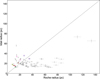 |
Fig. 2 Comparison of the Roche and tidal radii of 47 WBOC candidates. Gravitationally bound WBOCs where the Roche radius is smaller than the tidal radius are represented by red, green, yellow, brown, and pink colors. A candidate with a tidal radius somewhat larger than the Roche radius is shown in purple, for test purposes. |
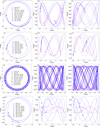 |
Fig. 3 Orbits of four new WBOCs, shown in (a) X–Y, (b) X–Z, and (c) Y–Z projections. |
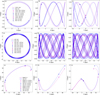 |
Fig. 4 Similar to Fig. 3, but for two other newly found WBOCs and an unbound cluster pair. Pairs CWNU 1684 and HSC 1421 as well as HSC 2691 and HSC 2708 are known WBOCs. Pair DB2001 22 and UBC 587 is an unbound system. |
Spatial positions of six WBOC candidates.
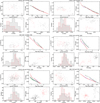 |
Fig. 5 Distributions of the proper motions, CMDs, parallaxes, and celestial position of the member stars of four newly found WBOCs and two known WBOCs. In the panels except for the CMD, black and red colors are for two sub-clusters. For the CMD panel, blue and red colors are used, in which crosses and points denote the observed stars and best-fit isochrones. Error bars show the average uncertainties. |
5 Conclusion and discussion
This is a parallel work of Li & Zhu (2025).We discovered four gravitationally bound WBOCs and identified two known ones in this work, via different methods, compared to previous works on paired clusters, including Palma et al. (2025), Coenda et al. (2025), and Liu et al. (2025). The sub-clusters of four WBOCs are coeval within the age and metallicity uncertainties. In particular, the CMDs of the sub-clusters of two WBOCs – CWNU 1281 and HSC 1636 as well as CWNU 1684 and HSC 1421 – provide strong evidence for this. Such characteristics are naturally explained by primordial formation, that is to say the two components condensed in the same GMC and remained attached while the parent GMC dispersed. Simulations of hierarchically collapsing clouds routinely produce multiple density peaks separated by 20–100 pc with negligible velocity dispersion (Fujii & Portegies Zwart 2015). The observed mass ratio distribution (q ≥ 0.5 in 83% of the pairs) further agrees with the stochastic fragmentation spectrum of magneto-turbulent GMCs.
The large fraction (83%) of PBOCs within the six WBOCs suggests that BOCs mainly result from primordial formation. This agrees well with simulations (Klessen & Burkert 2000; Kruijssen 2012). However, HSC 2149 and UBC 1449 may have various metallicities. This WBOC may form by an alternative scenario, that is, tidal capture during GMC encounters: a cluster passing near another may dissipate enough orbital energy through dynamical friction against the gas reservoir to become bound (Theuns & David 1992).
The most critical limitation is the scarcity of RVs. Only a few cluster pairs have at least ten reliable RV members per component and the RV uncertainties are always large, making it impossible to study these star clusters via velocity. Moreover, we have only been able to carry out a simple orbit simulation, but it would be better to perform N-body simulations in the future via reliable codes such as the first simulation code of composite populations of single and binary clusters, NbodyCP (Li & Spurzem 2025). In addition, spectroscopic follow-up is mandatory to confirm the results and to investigate the WBOCs in the Milky Way in more depth.
Finally, our isochrone fitting ignored binary-star blends. Although neglecting binaries may introduce a slight bias in the derived mass due to the lower stellar count, which leads to a lower estimated mass, the impact on the tidal and Roche radii is minimal. The reason is that there are only a few unresolved binary stars when observational errors are taken into account. Meanwhile, the poor CMDs of many sub-clusters in the WBOC candidates also affect the results, which underscores the need for further improvements in the identification of the member stars of clusters (see also Li et al. 2022; Li & Mao 2023, 2024).
Therefore, we suggest carrying out spectroscopic observations and member identifications for the WBOCs and WBOC candidates. Combined with Gaia astrometry, this will reduce the result uncertainty significantly. In addition, it will not be necessary to perform some N-body simulations for these WBOCs.
We are preparing direct N-body models for a few representative WBOCs that formed by various evolutionary channels using the NbodyCP code (Li & Spurzem 2025) for the third paper of DL-BCP (Paper III). These runs will include a live Galactic potential, stellar evolution, and a primordial binary fraction to predict the detailed kinematic fingerprints of mergers and disruptions. They can be used as benchmarks for the theory of multiple stellar population formation.
Data availability
The data can be derived from Zenodo (DOI: https://doi.org/10.5281/zenodo.17647788).
Acknowledgements
This work has been supported by the National Natural Science Foundation of China (No. 12473029) and Development Fund Project of Dali University. It has made use of data from the European Space Agency (ESA) mission Gaia (https://www.cosmos.esa.int/gaia), processed by the Gaia Data Processing and Analysis Consortium (DPAC, https://www.cosmos.esa.int/web/gaia/dpac/consortium). Funding for the DPAC has been provided by national institutions, in particular the institutions participating in the Gaia Multilateral Agreement.
References
- Bica, E., & Bonatto, C. 2011, A&A, 530, A32 [NASA ADS] [CrossRef] [EDP Sciences] [Google Scholar]
- Bressan, A., Marigo, P., Girardi, L., et al. 2012, MNRAS, 427, 127 [NASA ADS] [CrossRef] [Google Scholar]
- Brown, J. H., Burkert, A., & Truran, J. W. 1995, ApJ, 440, 666 [NASA ADS] [CrossRef] [Google Scholar]
- Bovy, J. 2015, ApJS, 216, 29 Camargo, D. 2021, ApJ, 923, 21 [Google Scholar]
- Camargo, D., Bica, E., & Bonatto, C. 2016, MNRAS, 455, 3126 [Google Scholar]
- Coenda, V., Baume, G., Palma, T., et al. 2025, A&A, 699, A15 [NASA ADS] [CrossRef] [EDP Sciences] [Google Scholar]
- de La Fuente Marcos, R., & de La Fuente Marcos, C. 2009, A&A, 500, L13 [NASA ADS] [CrossRef] [EDP Sciences] [Google Scholar]
- de la Fuente Marcos, C., & de la Fuente Marcos, R. 2021, A&A, 646, L14 [NASA ADS] [CrossRef] [EDP Sciences] [Google Scholar]
- Fujii, M. S., & Portegies Zwart, S. 2015, MNRAS, 449, 726 [NASA ADS] [CrossRef] [Google Scholar]
- Gaia Collaboration (Vallenari, A., et al.) 2023, A&A, 674, A1 [NASA ADS] [CrossRef] [EDP Sciences] [Google Scholar]
- Heyer, M., & Dame, T. M. 2015, ARA&A, 53, 583 [Google Scholar]
- Hunt, E. L., & Reffert, S. 2023, A&A, 673, A114 [NASA ADS] [CrossRef] [EDP Sciences] [Google Scholar]
- Hunt, E. L., & Reffert, S. 2024, A&A, 686, A42 [NASA ADS] [CrossRef] [EDP Sciences] [Google Scholar]
- Klessen, R. S., & Burkert, A. 2000, ApJS, 128, 287 [NASA ADS] [CrossRef] [Google Scholar]
- Kroupa, P. 2001, MNRAS, 322, 231 [NASA ADS] [CrossRef] [Google Scholar]
- Kruijssen, J. M. D. 2012, MNRAS, 426, 3008 [Google Scholar]
- Li, Z., & Mao, C. 2023, ApJS, 265, 3 [NASA ADS] [CrossRef] [Google Scholar]
- Li, Z.-M., & Mao, C.-Y. 2024, Res. Astron. Astrophys., 24, 055014 [Google Scholar]
- Li, Z.-M., & Spurzem, R. 2025, Res. Astron. Astrophys., 26, 15009 [Google Scholar]
- Li, Z., & Zhu, Z. 2025, A&A, 700, A280 [NASA ADS] [CrossRef] [EDP Sciences] [Google Scholar]
- Li, Z., Mao, C., Chen, L., et al. 2012, ApJ, 761, 2, L22 [Google Scholar]
- Li, Z., Mao, C., Zhang, L., et al. 2016, ApJS, 225, 7 [Google Scholar]
- Li, Z.-M., Mao, C.-Y., Luo, Q.-P., et al. 2017, Res. Astron. Astrophys., 17, 71 [Google Scholar]
- Li, Z., Deng, Y., Chi, H., et al. 2022, ApJS, 259, 19 [NASA ADS] [CrossRef] [Google Scholar]
- Liu, G., Zhang, Y., Zhong, J., et al. 2025, A&A, 702, A48 [NASA ADS] [CrossRef] [EDP Sciences] [Google Scholar]
- Miyamoto, M., & Nagai, R. 1975, PASJ, 27, 533 [NASA ADS] [Google Scholar]
- Navarro, J. F., Frenk, C. S., & White, S. D. M. 1996, ApJ, 462, 563 [Google Scholar]
- Palma, T., Coenda, V., Baume, G., et al. 2025, A&A, 693, A218 [NASA ADS] [CrossRef] [EDP Sciences] [Google Scholar]
- Song, F., Esamdin, A., Hu, Q., & Zhang, M. 2022, A&A, 666, A75 [NASA ADS] [CrossRef] [EDP Sciences] [Google Scholar]
- Subramaniam, A., Gorti, U., Sagar, R., & Bhatt, H. C. 1995, A&A, 302, 86 [NASA ADS] [Google Scholar]
- Theuns, T., & David, M. 1992, ApJ, 384, 587 [Google Scholar]
- Zhu, Z., Li, Z., & Zhang, S. 2025, A&A, 702, A259 [NASA ADS] [CrossRef] [EDP Sciences] [Google Scholar]
Appendix A Fundamental parameters
Fundamental parameters and astrometric information of 47 WBOC candidates.
Appendix B Dynamical Parameters
Dynamical parameters and star numbers of 47 WBOC candidates.
All Tables
All Figures
|
Fig. 1 Comparison of the numbers of three types of object pairs with separations between the sum of the tidal radii of sub-clusters and 100 pc. Note that “o” and “m” mean open cluster and moving group, respectively. |
| In the text | |
|
Fig. 2 Comparison of the Roche and tidal radii of 47 WBOC candidates. Gravitationally bound WBOCs where the Roche radius is smaller than the tidal radius are represented by red, green, yellow, brown, and pink colors. A candidate with a tidal radius somewhat larger than the Roche radius is shown in purple, for test purposes. |
| In the text | |
|
Fig. 3 Orbits of four new WBOCs, shown in (a) X–Y, (b) X–Z, and (c) Y–Z projections. |
| In the text | |
|
Fig. 4 Similar to Fig. 3, but for two other newly found WBOCs and an unbound cluster pair. Pairs CWNU 1684 and HSC 1421 as well as HSC 2691 and HSC 2708 are known WBOCs. Pair DB2001 22 and UBC 587 is an unbound system. |
| In the text | |
|
Fig. 5 Distributions of the proper motions, CMDs, parallaxes, and celestial position of the member stars of four newly found WBOCs and two known WBOCs. In the panels except for the CMD, black and red colors are for two sub-clusters. For the CMD panel, blue and red colors are used, in which crosses and points denote the observed stars and best-fit isochrones. Error bars show the average uncertainties. |
| In the text | |
Current usage metrics show cumulative count of Article Views (full-text article views including HTML views, PDF and ePub downloads, according to the available data) and Abstracts Views on Vision4Press platform.
Data correspond to usage on the plateform after 2015. The current usage metrics is available 48-96 hours after online publication and is updated daily on week days.
Initial download of the metrics may take a while.