


| Issue |
A&A
Volume 708, April 2026
|
|
|---|---|---|
| Article Number | A234 | |
| Number of page(s) | 7 | |
| Section | Stellar structure and evolution | |
| DOI | https://doi.org/10.1051/0004-6361/202558406 | |
| Published online | 08 April 2026 | |
High-mass X-ray binaries as members of open clusters
1
Department of Theoretical Physics and Astrophysics, Masaryk University, Kotlářská 2, 611 37 Brno, Czechia
2
Advanced Technologies Research Institute, Faculty of Materials Science and Technology in Trnava, Slovak University of Technology in Bratislava, Bottova 25, 917 24 Trnava, Slovakia
★ Corresponding authors: This email address is being protected from spambots. You need JavaScript enabled to view it.
, This email address is being protected from spambots. You need JavaScript enabled to view it.
Received:
4
December
2025
Accepted:
5
February
2026
Abstract
Context. Traditionally, high-mass X-ray binaries (HMXBs) are considered atypical products of close binary evolution where the primary component of the progenitor binary has formed a compact object through a supernova explosion, shedding a significant portion of the overall binary mass in the process. This rapid mass loss from the system results in an extra peculiar systemic velocity with respect to the system’s local standard of rest. Moreover, there is also a contribution to the peculiar systemic velocity from a natal velocity kick, which is imparted to the compact object upon formation. Provided that the binary remains bound, both the rapid mass loss and the natal kick cause the system to gain a significant systemic velocity of typically several tens of kilometers per second with respect to its standard of rest. This makes the system rapidly leave the environment where it was born. This classical picture has now been challenged by discoveries of systems with low or negligible peculiar systemic velocities, arising from more exotic supernova types, such as electron-capture or ultrastripped supernovae. These supernovae explode with a low degree of asymmetry and only eject a small amount of mass, yielding low peculiar systemic velocities.
Aims. We investigate the occurrence of HMXBs in open clusters and, if they are present, use the cluster parameters to constrain the system properties and the physics of the supernovae that produced them.
Methods. We used Gaia astrometry data and derived catalogs to examine whether known HMXBs are physical members of open clusters, using membership criteria based on positions, parallaxes, and proper motions.
Results. We identify four HMXB and HMXB candidates that are members of open clusters: IGR J16465-4507 in CWNU 2672, SGR 0755-2933 in HSC 1981, HD 119682 in NGC 5281, and NGC 6649 9 in NGC 6649. Their presence in open clusters implies that they were born without significant systemic kick, which provides important constraints to supernova explosion mechanisms in close binary systems. The residual tangential velocities we derive (0.9 ± 0.4 km/s for SGR 0755-2933 and 2.6 ± 0.5 km/s for IGR J16465-4507) provide direct observational evidence for the ultralow kick mode recently identified in Be X-ray binary populations, demonstrating that such systems can remain gravitationally bound to their parent clusters
Key words: binaries: general / stars: neutron / X-rays: binaries
© The Authors 2026
 Open Access article, published by EDP Sciences, under the terms of the Creative Commons Attribution License (https://creativecommons.org/licenses/by/4.0), which permits unrestricted use, distribution, and reproduction in any medium, provided the original work is properly cited.
This article is published in open access under the Subscribe to Open model. This email address is being protected from spambots. You need JavaScript enabled to view it. to support open access publication.
1. Introduction
High-mass X-ray binaries (HMXBs) are systems comprising a compact object primary – a neutron star or black hole – and an early-type secondary in the process of stellar evolution, typically a massive (M ≳ 8 M⊙) OB-type star. As their name suggests, these objects are bright in X-rays, which are produced as matter from the secondary star is being accreted by the primary (e.g., Liu et al. 2006; Fortin et al. 2023; Neumann et al. 2023).
High-mass X-ray binaries offer a crucial opportunity for studying neutron stars and black holes, as these objects are very hard to detect when they are in isolation without being bound in a close binary. Although a significant number of neutron stars that show pulsar behavior are known (thanks to radio surveys), deriving precise distances to these objects is still challenging. With the advent of the Gaia mission, notably the most recent Gaia Data Release 3 (GDR3; Gaia Collaboration 2021; Lindegren et al. 2021; Gaia Collaboration 2023), we now have access to high-precision optical parallaxes for an unprecedented number of objects. These parallaxes have allowed us to derive geometric distance estimates to almost 1.5 billion sources. However, because of the brightness limit of Gaia, among isolated neutron stars, only the Crab pulsar is bright enough in the optical spectrum to have a complete astrometric solution. Despite this, Gaia data have been instrumental in deriving the distances and kinematic properties of many X-ray binaries, especially with luminous secondaries (Prišegen 2020; Fortin et al. 2023; Neumann et al. 2023; Fortin et al. 2024). The superb Gaia astrometry was also pivotal for uncovering an increasing number of noninteracting compact object binaries (e.g., El-Badry et al. 2023, 2024b,a). However HMXBs, together with their low-mass counterparts – low-mass X-ray binaries (e.g., Liu et al. 2007; Avakyan et al. 2023; Fortin et al. 2024), still constitute the most prolific channel for neutron star and black hole discovery.
Due to their limited lifetime, the kinematics of HMXBs (in conjunction with their other properties, such as orbital parameters) encode information about the past supernova explosion that occurred in the system (e.g., Brandt & Podsiadlowski 1995). The supernova explosion imparts an extra space velocity, often termed peculiar velocity, to the binary system through the “Blaauw kick” mechanism and the asymmetric supernova velocity kick. The latter velocity component results from a natal kick imparted to the nascent compact object because of strong asymmetries in the supernova explosion. Provided that the binary remains bound, the compact object has had to share its momentum with the secondary, dragging it along with it (e.g., Podsiadlowski et al. 2004, 2005; Cerda-Duran & Elias-Rosa 2018). The former component is specific to binaries and is the consequence of the rapid removal of mass from the binary system. Even if the supernova explosion was completely symmetric with respect to the exploding star (the primary), the extra velocity is still imparted to the binary system as the mass loss is rapid and not symmetric with respect to the binary presupernova center of mass (Blaauw 1961; Cerda-Duran & Elias-Rosa 2018).
However, establishing precise peculiar systemic velocities imparted by supernovae to HMXBs has been a challenge, even when utilizing the unprecedented quality of the Gaia astrometry. Aside from the uncertainties arising from astrometric measurements, the accuracy of the derived HMXB kinematics is further affected by our limited knowledge of the fundamental Galactic parameters, most importantly the shape of the Galactic rotation velocity curve in relation to the Galactocentric distance (e.g., Reid et al. 2014; Mróz et al. 2019). Accurate radial velocities for early-type systems are also difficult to obtain (e.g., van Oijen 1989). Furthermore, there is also limited knowledge about the movement of HMXBs prior to the supernova explosion in the progenitor binary. For example, the velocity dispersion of the parent population from which the HMXB progenitor originated can be as high as several kilometers per second (Mel’nik & Dambis 2017; Melnik & Dambis 2020). Additionally, the HMXB progenitor could have acquired some peculiar velocity long before the supernova explosion via some other mechanism, often by a dynamical ejection from its parent association early in its lifetime. This two-step ejection scenario is probably common for HMXBs (Dorigo Jones et al. 2020), and this makes it hard to determine the magnitude of changes in the system kinematics due to the supernova explosion itself.
In this context, it is therefore very useful to identify the star cluster or association from which the HMXB has originated. This alleviates complications with the establishment of the local standard of rest, which is pivotal in deriving the precise peculiar systemic velocity. Identifying the parent population also helps to derive important properties of the HMXB, since the overall and kinematic age of the HMXB can be established. This makes it possible to derive the original mass of the primary component of the HMXB and the total mass lost in the supernova explosion. Several HMXBs have been backtracked to their parent cluster or an association using astrometry. For instance, Ankay et al. (2001) used the Hipparcos proper motion to associate HMXB 4U 1700-37 with the OB association Sco OB1. This association was later confirmed and refined using Gaia astrometry by van der Meij et al. (2021), who pinpointed the origin of the system to the open cluster (OC) NGC 6231, which is the nucleus of Sco OB1. The HMXB candidate 1H 11255-567 was associated with the Lower-Centaurus-Crux group by Neuhäuser et al. (2020). In addition, the well-established HMXB 4U 2206+54 was traced back to the subgroup of the Cep OB1 association by Hambaryan et al. (2022). Recently, Fortin et al. (2022) also identified seven HMXBs with motion that could be tracked back to one or more possible parent OCs. Still, some of these associations might be spurious due to the fact that a considerable fraction of HMXBs have likely been subject to two-step ejection.
Despite the significant interest in HMXBs that can be backtracked to their parent clusters, no HMXB has been conclusively shown to be a current member of a star cluster. This is understandable, since HMXBs are considered typical runaway systems. However, there is mounting evidence for neutron-star-hosting HMXBs that seem to have received a very small or negligible peculiar velocity upon formation (e.g., Prišegen 2020; Richardson et al. 2023; Valli et al. 2025). Therefore, we try to look for such systems in their parent clusters. In this work, we report the association of four HMXBs and HMXB candidates with OCs. In contrast to previous work on this topic, the systems presented here are still astrometric members of their parent OCs. Since the astrometric parameters of these systems are consistent with the astrometric parameters of the associated OCs, it is unlikely that these systems have experienced two-step ejection. Also, since these astrometric parameters also include proper motions, this indicates that these systems did not experience any significant natal kick at all, rather than being in the extremely early phase after the supernova explosion where they did not have sufficient time to escape the OC. This work is organized as follows. In Sect. 2, we briefly describe our search for HMXBs in OCs and discuss the recovered HMXB-OC pairings. In Sect. 3, we analyze these pairings and discuss the implications of the existence of these systems. Finally, we provide a summary and conclusions in Sect. 4.
2. Recovered pairings
To search for HMXB that are potential OC members, we used the OC catalog of Hunt & Reffert (2023) and the latest version of the HMXB catalogs of Fortin et al. (2023) and Neumann et al. (2023). The crossmatch was performed using Gaia DR3 source_id, which is the main source identifier in Hunt & Reffert (2023) and is also listed for all sources with an optical counterpart within the magnitude limit of Gaia in Fortin et al. (2023) and Neumann et al. (2023). This crossmatching yielded four potential HMXB–OC associations, which are listed in Table 1 and discussed in subsections below. We also searched for possible associations between low-mass X-ray binaries and OCs in the catalogs of Avakyan et al. (2023) and Fortin et al. (2024). However, this search did not yield any likely associations.
High-mass X-ray binaries and candidates associated with OCs.
2.1. IGR J16465-4507 and CWNU 2672
CWNU 2672 is a heavily absorbed OC of about 50 stars first identified in Gaia DR3 astrometry using the DBSCAN algorithm in the work of He et al. (2023). These authors also provide an age estimate for this OC of ∼16 Myr. Hunt & Reffert (2023) also provide a consistent age estimate of  Myr. Cavallo et al. (2024) provide an even younger age estimate of
  Myr. Since there has been a large increase in newly discovered OCs with the advent of Gaia astrometry, a significant portion of them have not been studied in detail or validated, including CWNU 2672. While He et al. (2023) do not provide a statistical measure for the significance of their newly detected OCs, they filtered out and do not consider the groupings that do not have enough members and do not show the conventional evolutionary sequence expected for OCs, by visually inspecting their color-magnitude diagrams. Hunt & Reffert (2023) provide two quantifiable measures of OC reliability. First, there is the cluster significance test (CST), which compares the nearest–neighbor distribution of grouping stars with that of field stars near the grouping. This then produces a signal-to-noise ratio, with CST scores greater than 5σ corresponding to highly likely OCs. The second one is the score resulting from their color-magnitude diagram (CMD) classifier that compares how well the CMDs of their putative OCs resemble a homogeneous single population of stars as in real OCs, where a score above 0.5 indicates a likely OC with a relatively clean CMD. The CST score for CWNU 2672 is highly significant (∼10.5σ), which means that it stands out as a strong OC in the astrometric phase space. However, the CMD score for CWNU 2672 is (≲0.1), which means that the CMD does not resemble a well-defined and clean OC, which is also apparent in Figure 1. However, the OC is very young and heavily absorbed. This might limit the observable stars to those most evolved and from the top of the main sequence.
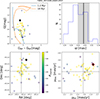 |
Fig. 1. Top left: Color-magnitude diagram of OC CWNU 2672 members from Hunt & Reffert (2023) with the HMXB IGR J16465-4507 marked by a black dot. Here and in the subsequent plots, the color encodes the probability of OC membership. A MIST isochrone or a set of MIST isochrones (Dotter 2016; Choi et al. 2016) corresponding to the OC age (as discussed in the text) are plotted. These are shifted in the visual magnitude space using the distances from Hunt & Reffert (2023) and extinctions in Cavallo et al. (2024). Solar metallicity is assumed. Top right: Parallax distribution of OC members with the parallax of the HMXB marked by a vertical black line. Bottom left: Position diagram of the OC members and HMXB in the equatorial coordinate system. The median RA and Dec of the OC members are marked by dotted black lines. Bottom right: Vector-point diagram (VPD) of the OC members and HMXB. The median μRA and μDec are marked by dotted black lines. |
IGR J16465-4507 is an HMXB that possesses the properties of a supergiant HMXB and a supergiant fast X-ray transient source (La Parola et al. 2010; Clark et al. 2010; Chaty et al. 2016). The secondary is a massive fast-rotating B0.5-B1 Ib star (Negueruela et al. 2005; Chaty et al. 2016). The system is also an X-ray pulsar with a spin (pulse) period of 228 s (Walter et al. 2006) with an orbital period of 30 d (Clark et al. 2010; Sidoli & Paizis 2018). As can be seen in Fig. 1, the system is situated northwest of the OC center and the proper motion vector is also pointing in a similar direction.
2.2. SGR 0755-2933 and HSC 1981
HSC 1981 is an OC of more than a hundred stars identified by Hunt & Reffert (2023) using the HDBSCAN clustering algorithm in Gaia DR3 astrometric data. Hunt & Reffert (2023) provide a coarse estimate for its age of  Myr, while Cavallo et al. (2024) provide a more constrained age of
  Myr. The OC has a well-behaved CMD (CMD score ∼1.0) and is also well pronounced in the astrometric phase space (CST = 12.8; Hunt & Reffert 2023).
SGR 0755-2933 was identified by Swift/BAT as a soft gamma-ray repeater candidate, and was later reclassified as a HMXB by Doroshenko et al. (2021), who also pinpointed its optical counterpart to a massive emission-line star and identified a spin (pulse) period of 308 s. The spectral classification of the counterpart was later refined by Richardson et al. (2023) to B0Ve. They also find that the orbital period of the system is 59.5 d, the orbit is almost circular, and that the radial velocity of the system does not indicate that it is a runaway system. Informed by these properties, Richardson et al. (2023) also model the system evolution and conclude that the system descended from an ultrastripped supernova. As can be seen in Fig. 2, the system is situated to the south of the OC center and the proper motion vector is also pointing approximately in the same direction.
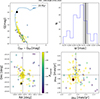 |
Fig. 2. Same as in the Fig.1. but for OC HSC 1981 and HMXB SGR 0755-2933. |
2.3. HD 119682 and NGC 5281
NGC 5281 is a rich and prominent OC of about 200 members (e.g., Hunt & Reffert 2023). Due to its nature, it has been recovered in multiple OC searches using various clustering approaches, and dedicated studies of this OC also exist. Therefore, there are many age estimates for this OC in the literature, ranging from ∼40 Myr to ∼100 Myr (Sanner et al. 2001; Kharchenko et al. 2013; Netopil et al. 2016; Bossini et al. 2019; Cantat-Gaudin et al. 2020; Dias et al. 2021; Hunt & Reffert 2023).
One of the well-established prominent members of this OC is HD 119682 (spectral type B0Ve), which has been classified as a γ Cas analog (Rakowski et al. 2006; Levenhagen & Leister 2006). This is a class of early Be stars that exhibit unusually bright and hard X-ray emission. However, the binary nature of the γ Cas analogs and, if present, the nature of their companion stars, is disputed. Therefore, it is uncertain whether these objects are bona fide HMXBs (e.g., Smith et al. 2016; Postnov et al. 2017; Nazé et al. 2022). The properties of the source suggest an orbital period of about 90 d and a pulse period of ∼1500 s (Safi-Harb et al. 2007; Nazé et al. 2022). The object is located in the center of the OC and from an inspection of Fig. 3 it is a blue straggler.
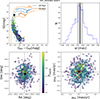 |
Fig. 4. Same as in the Fig. 1. but for OC NGC 6649 and HMXB NGC 6649 9. |
2.4. NGC 6649 9 and NGC 6649
NGC 6649 is a well-established, heavily reddened, and rich OC, with an estimated age ranging from approximately 28 to 70 Myr. The OC lies in the direction of the Galactic center and is about 2 kpc away (Cantat-Gaudin et al. 2020; Dias et al. 2021; Hunt & Reffert 2023).
NGC 6649 9 is among the HMXBs listed in Neumann et al. (2023) and also in Fortin et al. (2023), although it is likely erroneously matched to SNR 021.5-00.9, which is approximately 2 kpc in the background of the object and already has an established probable association with a pulsar (Camilo et al. 2006; Ranasinghe & Leahy 2018). The object has been classified as a γ Cas analog (Nazé et al. 2020) and is located in the center of the OC. The spectral type of the optical counterpart is B0Ve (Mathew & Subramaniam 2011). Its photometric properties are also consistent with those of a blue straggler.
3. Discussion
We report a detection of four confirmed and possible HMXBs that are strong astrometric members of known OCs. The presence of HMXBs in OCs suggests that these systems must have only lost negligible mass during the supernova and that very low kicks were imparted to the neutron stars. This is in tension with the current established supernova explosion models, which suggest velocity kicks of at least several tens of kilometers per second, which would lead to the rapid expulsion of the HMXB from its parent OC, since OCs are only weakly gravitationally bound (e.g., Nakamura et al. 2019). The search for possible associations between low-mass X-ray binaries and the cataloged OCs resulted in no viable associations, which is an expected outcome, as low-mass X-ray binaries are typically old objects that start the X-ray emitting phase long after their parent OC has dispersed in the Galactic field.
3.1. SGR 0755-2933: Potentially an ultrastripped supernova remnant
SGR 0755-2933 represents a compelling case for an HMXB that has retained OC membership due to a low-kick supernova. Richardson et al. (2023) conducted a detailed spectroscopic and evolutionary analysis of this system, demonstrating that it descended from an ultrastripped supernova. Their orbital analysis yields a circular (or nearly circular, with e = 0.06 ± 0.06) 59.5-day period with a systemic radial velocity of 58.1 ± 0.35 km s−1 (assuming circular solution). Despite this seemingly high radial velocity, their kinematic analysis shows that the system has a modest total peculiar systemic velocity of only 15.3 ± 3.0 km s−1 (with peculiar tangential and radial velocity components of 5.8 ± 0.4 km s−1 and 14.2 ± 3.0 km s−1, respectively).
Associating the HMXB with an OC presents a more precise basis for calculating the peculiar systemic velocity. The magnitude of the residual proper motion of the HMXB that is obtained when subtracting the proper motion of the HXMB from the proper motion of the OC, accounting for the uncertainties and correlations, is 0.06 ± 0.02 mas/yr. At the assumed OC distance of 3416 ± 33 pc (Hunt & Reffert 2023), this translates to a residual (peculiar) tangential velocity of 0.9 ± 0.4 km s−1. The precise radial velocity for the OC is not yet determined. Hunt & Reffert (2023) report a radial velocity value for this OC, but it is based on measurements for only two members of the OC. Therefore, we cannot provide a more stringent peculiar radial velocity for the HMXB. However, the new estimate for the residual tangential velocity is of the same magnitude as a typical velocity dispersion of stars in an OC, which is generally ≲1 km s−1.
The near-circular orbit is particularly constraining. Richardson et al. (2023) used binary population and spectral synthesis (BPASS) models to demonstrate that maintaining a circular orbit requires ejecta masses of Mejecta < 0.1Mtotal. Their evolutionary models suggest the system descended from a progenitor binary with initial masses of M1 = 12 M⊙ and M2 = 8.4–9.6 M⊙. The primary underwent efficient mass transfer toward the end of its main sequence evolution, stripping its hydrogen envelope and leaving a low-mass helium star with a final CO core mass of approximately 1.5 M⊙. This mass is too high for the progenitor to have experienced an electron-capture supernova in an ONeMg core, indicating instead that the system underwent iron-core collapse as an ultrastripped supernova. The minimal ejecta mass from this explosion is the key to understanding both the circular orbit and the low kick velocity.
The age of the associated OC provides further support for HMXB membership and the modeling done in Richardson et al. (2023), which suggests that the progenitor lifetime was about ∼23 Myrs, and the HMXB is very young – observed only up to a few million years after the supernova event. This timeline aligns well with the estimated OC age of  Myr (Cavallo et al. 2024).
3.2. IGR J16465-4507: A rapid-rotating SFXT
IGR J16465-4507 is a supergiant HMXB and supergiant fast X-ray transient (SFXT) with properties that distinguish it from typical wind-fed systems. The system hosts a B0.5–B1 Ib supergiant companion (Negueruela et al. 2005; Chaty et al. 2016) and exhibits X-ray pulsations with a spin period of 228 s (Walter et al. 2006) and an orbital period of approximately 30 days (Clark et al. 2010). The most remarkable characteristic of this system is the exceptionally high rotation velocity of the supergiant companion, measured to be v sin i = 320 ± 8 km s−1 by Chaty et al. (2016). This rotation velocity is significantly higher than typical values for supergiant HMXBs, which generally range between 50 and 150 km s−1 (Liu et al. 2006).
The high rotation velocity implies that the supergiant must have a relatively small radius (approximately 15 R⊙) to avoid rotational disruption. Chaty et al. (2016) also identified P-Cygni profiles in the H I 1093.8 nm line and emission in the wings of Hα, indicating the presence of circumstellar material with an expansion velocity of 160–180 km s−1. These spectroscopic signatures suggest that the system is surrounded by a disk-like or extended envelope, which may play a role in the observed X-ray variability characteristic of SFXTs.
The system’s membership in CWNU 2672, a young OC with a disputed age ranging from 1.2 to  Myr (Hunt & Reffert 2023; He et al. 2023), provides some constraints on the system’s evolutionary history. Even when considering the higher end of the OC age estimate, it implies that the supernova that formed the compact object occurred very recently, consistent with the system’s position and kinematics showing no evidence of significant displacement from its birthplace. The OC membership therefore indicates that the compact object formation was accompanied by minimal natal kick and mass ejection. The magnitude of the residual proper motion of the HMXB that is obtained when subtracting the proper motion of the HXMB from the proper motion of the OC, accounting for the uncertainties and correlations, is 0.181 ± 0.032 mas/yr. At the assumed OC distance of 3050 ± 50 pc (Hunt & Reffert 2023), this translates to a residual (peculiar) tangential velocity of 2.6 ± 0.5 km s−1, which is slightly above the typical velocity dispersion of OC stars.
The exceptionally high rotation velocity of the companion star presents an intriguing evolutionary puzzle. Chaty et al. (2016) suggest that the system may be a descendant of a Be X-ray binary, where the rapidly rotating Be star has evolved into a supergiant while retaining its high rotational velocity. This interpretation is supported by the system’s position in the Corbet diagram, which places IGR J16465-4507 in an intermediate region between classical Be X-ray binaries and wind-fed supergiant systems. Chaty et al. (2016) note that two other SFXTs (IGR J11215-5952 and IGR J18483-0311) occupy similar positions in this diagram, possibly indicating an evolutionary link in which Be systems evolve into supergiant systems. However, the young age of CWNU 2672 ( Myr) suggests an alternative scenario in which the compact object formed relatively recently. If mass transfer from the primary to the secondary occurred shortly before the supernova, this could explain both the rapid rotation and the relatively small radius required to avoid rotational disruption, without requiring the secondary to be an evolved Be star.
If IGR J16465-4507 is indeed a very young post-supernova system, its OC membership becomes particularly significant. The system would have experienced the supernova explosion within the past few million years while remaining gravitationally bound to CWNU 2672. Given the weak gravitational binding of OCs, this strongly constrains both the mass ejection and kick velocity during compact object formation. The 30-day orbital period makes OC membership particularly remarkable. Wider orbits are more weakly bound and therefore more vulnerable to disruption from both mass loss and natal kicks during supernova explosions. The fact that the system survived with such a wide orbit provides even stronger constraints on the supernova properties, requiring both extremely low mass ejection and negligible kick velocity. This is in contrast to classical SFXTs with orbital periods of only a few days, which have tighter, more strongly bound orbits that can tolerate somewhat larger perturbations. The combination of young OC age, rapid stellar rotation, and intermediate SFXT properties makes IGR J16465-4507 a valuable laboratory for studying the immediate aftermath of supernova explosions in massive binaries and the evolutionary connections between different classes of HMXBs.
3.3. Nature of the primaries in HD 119682 and NGC 6649 9
Both IGR J16465-4507 and SGR 0755-2933 are well-established HMXBs with neutron star primaries. However, the physical nature of the HD 119682 and NGC 6649 9 primaries is uncertain, as both of these systems are γ Cas analogs. The identification of both HD 119682 and NGC 6649 9 as blue stragglers within their associated OCs provides strong support for their binary nature and the presence of compact companions. Blue stragglers in OCs are typically formed through mass transfer in binary systems, where the visible star has been rejuvenated by accreting material from an evolving companion. The positioning of both systems above the main sequence turn-off of their parent OCs indicates they have gained mass, most likely from the compact object’s progenitor during its earlier evolutionary stages (e.g., Jadhav & Subramaniam 2021; Qin et al. 2025). This mass transfer phase could lead to the formation of a stripped helium core in the primary, which would subsequently undergo an ultrastripped supernova or possibly an electron-capture supernova – exactly the scenarios required to produce a compact object with little to minimal kick while keeping the system within the OC. The rapid rotation typical of Be stars and γ Cas analogs is consistent with spin-up during this mass accretion phase.
Nevertheless, the nature of the compact object primaries is uncertain. In OCs with ages of 28–100 Myr, white dwarf formation from progenitors in the 8–10 M⊙ range is possible, though such systems would represent the most massive white dwarf progenitors. Definitive detections of X-ray pulsations or precise mass measurements are necessary to ascertain the nature of the compact object. We note that for NGC 6649 9 in particular, the young OC age (28–70 Myr) would require a progenitor mass near the canonical 8–10 M⊙ boundary between white dwarf and neutron star formation, making a neutron star companion perhaps more likely.
4. Summary and conclusions
We systematically searched for HMXBs and HMXB candidates that are astrometric members of OCs by crossmatching the catalogs of Fortin et al. (2023) and Neumann et al. (2023) with the OC catalog of Hunt & Reffert (2023) using Gaia DR3 source identifiers. This search yielded four systems with strong evidence for OC membership: the confirmed HMXBs IGR J16465-4507 in CWNU 2672 and SGR 0755-2933 in HSC 1981, along with the γ Cas analogs HD 119682 in NGC 5281 and NGC 6649 9 in NGC 6649.
The presence of these systems in their parent OCs has profound implications for understanding compact object formation in close binaries. Open clusters are only weakly gravitationally bound, so for an HMXB to remain a member, it must have experienced both negligible natal kick velocity and minimal mass ejection during the supernova explosion that formed the compact object. This provides strong observational support for exotic supernova mechanisms, particularly ultrastripped supernovae and possibly electron-capture supernovae, which are predicted to produce low-mass ejecta and minimal asymmetries. Our findings provide direct observational evidence for the ultralow kick mode recently identified through statistical analysis of Be X-ray binary orbital properties (Valli et al. 2025).
SGR 0755-2933 represents perhaps the most compelling case. The detailed analysis by Richardson et al. (2023) demonstrates that this system evolved through efficient mass transfer that stripped the primary’s hydrogen envelope, leaving a low-mass helium star that underwent iron-core collapse as an ultrastripped supernova. The system’s nearly circular 59.5-day orbit requires ejecta masses of Mejecta < 0.1Mtotal, while our analysis yields a residual tangential velocity of only 0.9 ± 0.4 km s−1 relative to HSC 1981. This minimal peculiar velocity, comparable to typical OC velocity dispersions, confirms that the system experienced essentially no natal kick.
IGR J16465-4507 provides complementary evidence from a different evolutionary channel. This supergiant HMXB in the young OC CWNU 2672 exhibits unusual properties, including an exceptionally high stellar rotation velocity (v sin i = 320 ± 8 km s−1) and a relatively wide 30-day orbit. Its residual tangential velocity of 2.6 ± 0.5 km s−1 is only slightly above typical OC velocity dispersions. The survival of this wide-orbit system and its OC membership places stringent constraints on the supernova properties, as wider orbits are more vulnerable to disruption from both mass loss and natal kicks.
The identification of HD 119682 and NGC 6649 9 as blue stragglers within their respective OCs provides strong circumstantial evidence for their binary nature and the presence of compact companions. Their positions above the main sequence turn-off indicate mass gain, most likely from the progenitor of the compact object during a prior mass transfer phase. This naturally leads to the formation of a stripped helium core that could undergo a low-kick supernova, consistent with their continued OC membership. However, the nature of their compact companions remains uncertain, and definitive detection of X-ray pulsations or precise mass measurements are needed to confirm whether they host neutron stars or possibly massive white dwarfs. Still, the young age of NGC 6649 (28-70 Myr) particularly suggests a neutron star primary for NGC 6649 9, since the progenitor mass would lie near or above the canonical white dwarf or neutron star formation boundary.
Our results demonstrate that not all HMXBs are runaway systems, and provide crucial observational validation of the multimodal natal kick distribution recently proposed by Valli et al. (2025). Although the classical picture of HMXB formation through core-collapse supernovae with substantial kicks of tens to hundreds of kilometers per second remains valid for many systems, a population of HMXBs exists that formed through minimal-kick channels with velocities below 10 km s−1. The identification of OC member HMXBs provides the cleanest possible constraints on this ultralow kick population because OC membership eliminates uncertainties about the local standard of rest and presupernova kinematics that complicate systemic velocity measurements for field systems. Continued OC membership, particularly of systems with relatively wide orbits like IGR J16465-4507 (30 days) and SGR 0755-2933 (59.5 days), demonstrates that the natal kicks must have been extremely small, providing stringent constraints on supernova explosion mechanisms. Future spectroscopic studies of the parent OCs, in particular precise radial velocity measurements, will further refine the kinematic analysis of these systems and strengthen the constraints on supernova physics.
Acknowledgments
This work was supported by the grant GAČR 23-07605S. M. Prišegen is supported by the European Regional Development Fund, project No. ITMS2014+: 313011W085.
References
- Ankay, A., Kaper, L., de Bruijne, J. H. J., et al. 2001, A&A, 370, 170 [NASA ADS] [CrossRef] [EDP Sciences] [Google Scholar]
- Avakyan, A., Neumann, M., Zainab, A., et al. 2023, A&A, 675, A199 [NASA ADS] [CrossRef] [EDP Sciences] [Google Scholar]
- Blaauw, A. 1961, Bull. Astron. Inst. Netherlands, 15, 265 [NASA ADS] [Google Scholar]
- Bossini, D., Vallenari, A., Bragaglia, A., et al. 2019, A&A, 623, A108 [NASA ADS] [CrossRef] [EDP Sciences] [Google Scholar]
- Brandt, N., & Podsiadlowski, P. 1995, MNRAS, 274, 461 [NASA ADS] [CrossRef] [Google Scholar]
- Camilo, F., Ransom, S. M., Gaensler, B. M., et al. 2006, ApJ, 637, 456 [NASA ADS] [CrossRef] [Google Scholar]
- Cantat-Gaudin, T., Anders, F., Castro-Ginard, A., et al. 2020, A&A, 640, A1 [NASA ADS] [CrossRef] [EDP Sciences] [Google Scholar]
- Cavallo, L., Spina, L., Carraro, G., et al. 2024, AJ, 167, 12 [NASA ADS] [CrossRef] [Google Scholar]
- Cerda-Duran, P., & Elias-Rosa, N. 2018, Astrophys. Space Sci. Libr., 457, 1 [Google Scholar]
- Chaty, S., LeReun, A., Negueruela, I., et al. 2016, A&A, 591, A87 [NASA ADS] [CrossRef] [EDP Sciences] [Google Scholar]
- Choi, J., Dotter, A., Conroy, C., et al. 2016, ApJ, 823, 102 [Google Scholar]
- Clark, D. J., Sguera, V., Bird, A. J., et al. 2010, MNRAS, 406, L75 [NASA ADS] [Google Scholar]
- Dias, W. S., Monteiro, H., Moitinho, A., et al. 2021, MNRAS, 504, 356 [NASA ADS] [CrossRef] [Google Scholar]
- Dorigo Jones, J., Oey, M. S., Paggeot, K., Castro, N., & Moe, M. 2020, ApJ, 903, 43 [NASA ADS] [CrossRef] [Google Scholar]
- Doroshenko, V., Santangelo, A., Tsygankov, S. S., & Ji, L. 2021, A&A, 647, A165 [NASA ADS] [CrossRef] [EDP Sciences] [Google Scholar]
- Dotter, A. 2016, ApJS, 222, 8 [Google Scholar]
- El-Badry, K., Rix, H.-W., Quataert, E., et al. 2023, MNRAS, 518, 1057 [Google Scholar]
- El-Badry, K., Rix, H.-W., Latham, D. W., et al. 2024a, Open J. Astrophys., 7, 58 [Google Scholar]
- El-Badry, K., Simon, J. D., Reggiani, H., et al. 2024b, Open J. Astrophys., 7, 27 [NASA ADS] [Google Scholar]
- Fortin, F., García, F., & Chaty, S. 2022, A&A, 665, A69 [NASA ADS] [CrossRef] [EDP Sciences] [Google Scholar]
- Fortin, F., García, F., Simaz Bunzel, A., & Chaty, S. 2023, A&A, 671, A149 [NASA ADS] [CrossRef] [EDP Sciences] [Google Scholar]
- Fortin, F., Kalsi, A., García, F., Simaz-Bunzel, A., & Chaty, S. 2024, A&A, 684, A124 [NASA ADS] [CrossRef] [EDP Sciences] [Google Scholar]
- Gaia Collaboration (Brown, A. G. A., et al.) 2021, A&A, 649, A1 [NASA ADS] [CrossRef] [EDP Sciences] [Google Scholar]
- Gaia Collaboration (Vallenari, A., et al.) 2023, A&A, 674, A1 [NASA ADS] [CrossRef] [EDP Sciences] [Google Scholar]
- Hambaryan, V., Stoyanov, K. A., Mugrauer, M., et al. 2022, MNRAS, 511, 4123 [NASA ADS] [CrossRef] [Google Scholar]
- He, Z., Liu, X., Luo, Y., Wang, K., & Jiang, Q. 2023, ApJS, 264, 8 [NASA ADS] [CrossRef] [Google Scholar]
- Hunt, E. L., & Reffert, S. 2023, A&A, 673, A114 [NASA ADS] [CrossRef] [EDP Sciences] [Google Scholar]
- Hunt, E. L., & Reffert, S. 2024, A&A, 686, A42 [NASA ADS] [CrossRef] [EDP Sciences] [Google Scholar]
- Jadhav, V. V., & Subramaniam, A. 2021, MNRAS, 507, 1699 [NASA ADS] [CrossRef] [Google Scholar]
- Kharchenko, N. V., Piskunov, A. E., Schilbach, E., Röser, S., & Scholz, R. D. 2013, A&A, 558, A53 [NASA ADS] [CrossRef] [EDP Sciences] [Google Scholar]
- La Parola, V., Cusumano, G., Romano, P., et al. 2010, MNRAS, 405, L66 [NASA ADS] [CrossRef] [Google Scholar]
- Levenhagen, R. S., & Leister, N. V. 2006, MNRAS, 371, 252 [Google Scholar]
- Lindegren, L., Klioner, S. A., Hernández, J., et al. 2021, A&A, 649, A2 [EDP Sciences] [Google Scholar]
- Liu, Q. Z., van Paradijs, J., & van den Heuvel, E. P. J. 2006, A&A, 455, 1165 [NASA ADS] [CrossRef] [EDP Sciences] [Google Scholar]
- Liu, Q. Z., van Paradijs, J., & van den Heuvel, E. P. J. 2007, A&A, 469, 807 [NASA ADS] [CrossRef] [EDP Sciences] [Google Scholar]
- Mathew, B., & Subramaniam, A. 2011, Bull. Astron. Soc. India, 39, 517 [NASA ADS] [Google Scholar]
- Mel’nik, A. M., & Dambis, A. K. 2017, MNRAS, 472, 3887 [Google Scholar]
- Melnik, A. M., & Dambis, A. K. 2020, MNRAS, 493, 2339 [NASA ADS] [CrossRef] [Google Scholar]
- Mróz, P., Udalski, A., Skowron, D. M., et al. 2019, ApJ, 870, L10 [Google Scholar]
- Nakamura, K., Takiwaki, T., & Kotake, K. 2019, PASJ, 71, 98 [CrossRef] [Google Scholar]
- Nazé, Y., Motch, C., Rauw, G., et al. 2020, MNRAS, 493, 2511 [CrossRef] [Google Scholar]
- Nazé, Y., Rauw, G., Czesla, S., Smith, M. A., & Robrade, J. 2022, MNRAS, 510, 2286 [CrossRef] [Google Scholar]
- Negueruela, I., Smith, D. M., & Chaty, S. 2005, ATel., 429, 1 [Google Scholar]
- Netopil, M., Paunzen, E., Heiter, U., & Soubiran, C. 2016, A&A, 585, A150 [NASA ADS] [CrossRef] [EDP Sciences] [Google Scholar]
- Neuhäuser, R., Gießler, F., & Hambaryan, V. V. 2020, MNRAS, 498, 899 [CrossRef] [Google Scholar]
- Neumann, M., Avakyan, A., Doroshenko, V., & Santangelo, A. 2023, A&A, 677, A134 [NASA ADS] [CrossRef] [EDP Sciences] [Google Scholar]
- Podsiadlowski, P., Langer, N., Poelarends, A. J. T., et al. 2004, ApJ, 612, 1044 [NASA ADS] [CrossRef] [Google Scholar]
- Podsiadlowski, P., Pfahl, E., & Rappaport, S. 2005, ASP Conf. Ser., 328, 327 [Google Scholar]
- Postnov, K., Oskinova, L., & Torrejón, J. M. 2017, MNRAS, 465, L119 [Google Scholar]
- Prišegen, M. 2020, A&A, 640, A86 [NASA ADS] [CrossRef] [EDP Sciences] [Google Scholar]
- Qin, S., Zhong, J., Anders, F., et al. 2025, ArXiv e-prints [arXiv:2511.07043] [Google Scholar]
- Rakowski, C. E., Schulz, N. S., Wolk, S. J., & Testa, P. 2006, ApJ, 649, L111 [Google Scholar]
- Ranasinghe, S., & Leahy, D. A. 2018, AJ, 155, 204 [Google Scholar]
- Reid, M. J., Menten, K. M., Brunthaler, A., et al. 2014, ApJ, 783, 130 [Google Scholar]
- Richardson, N. D., Pavao, C. M., Eldridge, J. J., et al. 2023, Nature, 614, 45 [Google Scholar]
- Safi-Harb, S., Ribó, M., Butt, Y., et al. 2007, ApJ, 659, 407 [NASA ADS] [CrossRef] [Google Scholar]
- Sanner, J., Brunzendorf, J., Will, J. M., & Geffert, M. 2001, A&A, 369, 511 [NASA ADS] [CrossRef] [EDP Sciences] [Google Scholar]
- Sidoli, L., & Paizis, A. 2018, MNRAS, 481, 2779 [NASA ADS] [CrossRef] [Google Scholar]
- Smith, M. A., Lopes de Oliveira, R., & Motch, C. 2016, Adv. Space Res., 58, 782 [Google Scholar]
- Valli, R., de Mink, S. E., Justham, S., et al. 2025, ArXiv e-prints [arXiv:2505.08857] [Google Scholar]
- van der Meij, V., Guo, D., Kaper, L., & Renzo, M. 2021, A&A, 655, A31 [NASA ADS] [CrossRef] [EDP Sciences] [Google Scholar]
- van Oijen, J. G. J. 1989, A&A, 217, 115 [NASA ADS] [Google Scholar]
- Walter, R., Zurita Heras, J., Bassani, L., et al. 2006, A&A, 453, 133 [NASA ADS] [CrossRef] [EDP Sciences] [Google Scholar]
All Tables
All Figures
|
Fig. 1. Top left: Color-magnitude diagram of OC CWNU 2672 members from Hunt & Reffert (2023) with the HMXB IGR J16465-4507 marked by a black dot. Here and in the subsequent plots, the color encodes the probability of OC membership. A MIST isochrone or a set of MIST isochrones (Dotter 2016; Choi et al. 2016) corresponding to the OC age (as discussed in the text) are plotted. These are shifted in the visual magnitude space using the distances from Hunt & Reffert (2023) and extinctions in Cavallo et al. (2024). Solar metallicity is assumed. Top right: Parallax distribution of OC members with the parallax of the HMXB marked by a vertical black line. Bottom left: Position diagram of the OC members and HMXB in the equatorial coordinate system. The median RA and Dec of the OC members are marked by dotted black lines. Bottom right: Vector-point diagram (VPD) of the OC members and HMXB. The median μRA and μDec are marked by dotted black lines. |
| In the text | |
|
Fig. 2. Same as in the Fig.1. but for OC HSC 1981 and HMXB SGR 0755-2933. |
| In the text | |
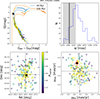 |
Fig. 3. Same as in the Fig. 1. but for OC NGC 5281 and HMXB HD 119682. |
| In the text | |
|
Fig. 4. Same as in the Fig. 1. but for OC NGC 6649 and HMXB NGC 6649 9. |
| In the text | |
Current usage metrics show cumulative count of Article Views (full-text article views including HTML views, PDF and ePub downloads, according to the available data) and Abstracts Views on Vision4Press platform.
Data correspond to usage on the plateform after 2015. The current usage metrics is available 48-96 hours after online publication and is updated daily on week days.
Initial download of the metrics may take a while.