


| Issue |
A&A
Volume 702, October 2025
|
|
|---|---|---|
| Article Number | A143 | |
| Number of page(s) | 8 | |
| Section | Catalogs and data | |
| DOI | https://doi.org/10.1051/0004-6361/202556678 | |
| Published online | 15 October 2025 | |
Update of the CODE catalogue and some aspects of the dynamical status of Oort Cloud comets
1
Astronomical Observatory Institute, Faculty of Physics and Astronomy, A. Mickiewicz University,
Słoneczna 36,
60-286
Poznań,
Poland
2
Centrum Badań Kosmicznych Polskiej Akademii Nauk (CBK PAN),
Bartycka 18A,
Warszawa,
Poland
★ Corresponding authors: This email address is being protected from spambots. You need JavaScript enabled to view it.
; This email address is being protected from spambots. You need JavaScript enabled to view it.
Received:
31
July
2025
Accepted:
25
August
2025
Abstract
Context. The outer Solar System is believed to host a vast reservoir of long-period comets (LPCs), but our understanding of their spatial distribution and dynamical history remains limited due to observational biases and uncertainties in orbital solutions for really observed comets.
Aims. We aim to provide a comprehensive and dynamically homogeneous orbital database of LPCs to support the study of their origin, evolution, dynamical status, and 6D distribution of orbital elements.
Methods. We updated the Catalogue of Cometary Orbits and their Dynamical Evolution (CODE) by computing original and future barycentric orbits and orbital parameters at previous and next perihelion using full Monte Carlo swarms of real comets for the uncertainty estimation and taking into account the planetary, Galactic, and passing stars’ perturbations according to the latest data and algorithms.
Results. This update of the CODE focuses on the dynamical status of near-parabolic comets. Using current stellar data, we formulated new constraints for dynamically new comets. Today, the CODE database includes 983 orbital solutions for 369 comets with full uncertainty estimates and dynamical classifications, covering nearly all comets with original semi-major axes exceeding 10 000 au and discovered before 2022, as well as all LPCs discovered beyond 10 au from the Sun during this period, and over 80% of the known LPCs with perihelion distances beyond 7 au.
Key words: catalogs / comets: general / Oort Cloud
© The Authors 2025
 Open Access article, published by EDP Sciences, under the terms of the Creative Commons Attribution License (https://creativecommons.org/licenses/by/4.0), which permits unrestricted use, distribution, and reproduction in any medium, provided the original work is properly cited.
This article is published in open access under the Subscribe to Open model. This email address is being protected from spambots. You need JavaScript enabled to view it. to support open access publication.
1 Introduction
Three-quarters of a century have passed since Oort (1950) proposed that the Solar System is surrounded by a distant, nearly spherical cloud of comets, now known as the Oort Cloud. According to this hypothesis, only a tiny fraction of these comets are occasionally perturbed towards the inner Solar System and become observable. Although the number of known Oort spike comets (i.e. those with original semi-major axes larger than 10 000 au) has grown significantly since Oort’s time – by more than a factor of 20 – our ability to characterise their true spatial distribution as a function of the heliocentric distance remains severely limited. This limitation arises not only from observational selection effects, but also from the need for precise orbital solutions and a reliable assessment of their dynamical histories. Therefore, the best possible cometary orbits must be continuously collected.
On 7 July 2008, the last (17th) edition of the Catalogue of Cometary Orbits was announced in IAU Circular No. 8958 (Marsden & Williams 2008). The IAU Minor Planet Center (MPC) continues to calculate and publish cometary orbits. To our knowledge, there are only two other massive alternative sources: the Jet Propulsion Laboratory (JPL) Small-Body Database Browser and Nakano (2025).
In all three places, the orbits of both short- and long-period comets are presented. At the JPL, they only offer the osculating orbit. MPC and Nakano also calculate the original and future semimajor axis reciprocal 1/a Only Nakano presents individual residuals for the observations used in the orbit determination. However, when searching for the source of long-period comets and asking what their dynamical age is, one needs a full set of the original orbital elements that allow propagation to the past. When we introduced the Catalogue of Cometary Orbits and their Dynamical Evolution (CODE)1,2 in Królikowska & Dybczyński (2020), we restricted ourselves to the near-parabolic comets, but we decided to offer much more information suitable for the LPC source region and origin studies.
The CODE provides a curated and dynamically consistent set of orbital solutions for near-parabolic comets, including those with varying levels of orbital precision. Each entry is accompanied by a quality assessment to support further analysis. For every comet, the catalogue includes both original (pre-entry) and future (post-planetary encounter) orbital elements, as well as orbits propagated to the previous and next perihelion passages, termed ‘previous’ and ‘next’ orbits. All orbital solutions are supplemented with comprehensive uncertainty estimates derived from dedicated numerical integrations of large virtual-comet (VC) swarms. This VC approach, introduced by Sitarski (1998) and subsequently applied in detail to LPCs in Królikowska (2001, 2004, 2006) and Królikowska & Dybczyński (2010) and later works, uses Monte Carlo-generated sets of orbital elements to propagate observational uncertainties in dynamical studies.
In addition, each comet is assigned a dynamical status based on its origin and its evolution towards the previous perihelion. The CODE is thus intended to serve as a robust foundation for studying the dynamical structure, source regions, and long-term evolution of the outer Solar System comet population.
The presented update represents a significant enhancement of the CODE catalogue in terms of the number of comets included and the richer functionality. The catalogue itself was thoroughly described in Królikowska & Dybczyński (2020), with a later update briefly announced in Królikowska & Dybczyński (2023). Here, the current strengths of the catalogue are illustrated, among other methods, through two samples of LPCs: comets with a large perihelion distance and comets discovered at a large heliocentric distance. Their activity has been observed more frequently in recent years as a result of growing capabilities in detecting increasingly faint objects. Moreover, with the upcoming operation of the Vera C. Rubin Observatory (see Inno et al. (2025), Jurić et al. (2023), and Ivezić et al. (2019) for an overview of the LSST capabilities) we expect a large-scale discovery of comets at substantial heliocentric distances.
A detailed description of the new elements in the CODE is provided in Sect. 2. Section 3 presents a comprehensive analysis of the distribution of original semi-major axes, taking into account not only the nominal orbits, but also the uncertainties in orbital determinations. Next, in Sect. 4, we describe the ‘previous’ and ‘next’ orbits, i.e. the orbits propagated to the previous and next perihelion passage. We also address the problem of accessing the dynamical status of all LPCs. In Sect. 5, we discuss a sample of comets discovered at heliocentric distances beyond 10 au, with particular attention to how well their dynamical status is currently known. Section 6 discusses the subset of comets with perihelion distances greater than 7 au, based on both the CODE catalogue and the JPL Small-Body Database.
2 New elements of the updated CODE
The current update is two-pronged. First, orbital solutions for 57 new LPCs have been added; the majority of them have original semi-major axes exceeding 10 000 au. This group includes the following:
The complete sample of 24 LPCs discovered in the years 2013–2017 with q < 3.1 au; data taken from the Minor Planet Center (MPC) database in January-February 20253
All LPCs discovered in 2021 except C/2021 A6 (PanSTARRS), which was already included in the previous version of the catalogue; these are 13 LPCs from the Oort spike and four with 100 < 1/aori < 300 au−64; positional data retrieved from the MPC database in January-March 2025
Seven LPCs discovered in 2022, including two LPCs with 100 < 1/aori < 300 au_6; data retrieved from the MPC database in March 2025
C/2025 D1 (Groeller) with the largest q among currently known LPCs (q = 14.1 au); this comet will pass its perihelion in May 2028; data taken from MPC in March 2025
Eight other comets previously not included in the CODE database for different reasons. For C/1958 R1 (Burnham-Slaughter) and C/1959 X1 (Mrkos), we found additional observations announced by van Biesbroeck (1961, 1962, 1966) and Kresák & Antal (1966). The third comet with measurements collected from the literature is C/1962 C1 (Seki-Line); for details, see its description in the CODE. The remaining five include C/2014 W10 (PANSTARRS), with a very poor previously known orbit, C/2020 H5 (Robinson), still observed when the previous update took place and simply missed by us; C/2004 YJ35 (LINEAR); C/2015 K7 (COIAS); and C/2019 N1 (ATLAS).
The second component of the update involves revisions to the previously included comets. We updated the orbital solutions for 20 LPCs discovered between 2016 and 2020, as well as for C/2021 A6. Additional observations for them were retrieved from the MPC database in the autumn of 2024. Some Oort spike comets discovered during that period still remain under observation.
These activities have led to two important enhancements to the catalogue. First, the CODE catalogue now appears to include a complete sample of LPCs discovered between 1900 and 2021 with original semi-major axes greater than 10 000 au, and a nearly complete sample with 100 < 1/aori < 300 au−6 (i.e. 3400 < aori < 10 000 au). Second, the catalogue now includes 80% of all known LPCs with perihelion distances greater than 7 au. As of March 2025, 56 such objects were known, of which only 12 are not included in the CODE; see Sect. 6. In summary, the CODE database now contains 983 orbital solutions for 369 LPCs, including 277 comets with an original 1/a in the [0, 100] au−6 range; numbers of comets as a function of their original 1/a are given in Table 1, whereas the overall distributions in 1/aori and q are shown in Fig. 1.
Characteristics of LPC sample in the CODE using ‘preferred’ orbits.
2.1 Why there are so many different orbits for some LPCs
It is a truism to state that, for each near-parabolic comet, it is worthwhile to determine an optimal orbital solution. However, implementing this idea is sometimes challenging, and a fully automated approach to orbit determination may overlook the highly individual characteristics of some comets. In the CODE, we chose to adopt a ‘preferred’ solution based on the full observational data arc (using the NG model of motion whenever possible). For comets that exhibit violent activity (such as out-bursts or disintegration), we instead relied on the longest possible data arc not covering the extremal activity interval (Królikowska & Dybczyński 2020). When NG effects significantly influence the orbital motion, orbital solutions inevitably depend on additional assumptions about gas sublimation. In such cases, it is sometimes more reliable (e.g. for past evolution studies) to avoid introducing these assumptions and instead restrict the data arc used for orbit determination to the pre-perihelion observations (see Królikowska & Dones (2023) and references therein).
More than 40% of all LPCs in the CODE exhibit detectable trends in the [O–C] distribution over time. Among comets with small perihelion distances (q < 3.35 au was assumed, see Sect. 3), this behaviour is observed in more than 60% of the cases. In the remaining comets, attempts to determine non-gravitational (NG) orbits did not yield results that were reliable enough for inclusion in the CODE catalogue.
As a result of various possible force models and alternative treatments of the available positional data, the CODE presents multiple orbital solutions for well-observed comets. Among them a ‘preferred’ orbit is indicated for each object. For a detailed discussion of the NG motion model used and numerous examples of the NG trends, see Królikowska et al. (2012), Królikowska (2020), Królikowska & Dybczyński (2020), and Królikowska & Dones (2023).
More than 40% of all ‘preferred’ orbits in the catalogue are NG orbits, for which the NG parameters of the best-fitting force model are explicitly listed. However, each NG model introduces restrictive assumptions, particularly regarding the type and mechanism of ice sublimation from the cometary nucleus. One key assumption is that the NG parameters remain constant throughout the entire observational data arc (Marsden et al. 1973; Królikowska 2020). Although this assumption is currently the only viable way to determine NG orbits for a large number of LPCs, it is quite limiting (Królikowska & Dones 2023).
It can be demonstrated that, for comets observed both long before and long after perihelion, it is possible to derive separate NG orbits that reveal different activity levels pre- and post-perihelion; see Królikowska et al. (2012) and Królikowska & Dones (2023). Furthermore, when sufficiently rich positional data are available at large distances on a pre-perihelion leg, purely gravitational orbits fitted to it may, in fact, better represent the comet’s past dynamical evolution and have the advantage of being free from additional assumptions about cometary activity.
Taking into account these factors, the CODE also marks some orbits as dedicated orbital solutions for backward dynamical evolution studies (hereafter PB solutions), which may differ from the ‘preferred’ orbits where appropriate. In the next section, we present the original 1/a distributions derived from both sets of orbital solutions. Similarly, the catalogue also provides dedicated orbits for forward evolution studies.
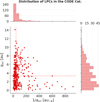 |
Fig. 1 Distribution 1/aori versus original perihelion distance for the sample of all LPCs in the CODE catalogue, excluding 17 LPCs with hyperbolic original orbits; shown are parameters for orbital solutions marked as ‘preferred for studies of the past motion’. Median values of |
2.2 Why there are two different models for ‘previous’ and ‘next’ orbit calculation
As was briefly announced in Królikowska & Dybczyński (2023) we changed the way of presenting ‘previous’ and ‘next’ orbit elements, i.e. orbital parameters one revolution to the past and to the future. Including these orbits is a unique property of the CODE; therefore, we focused on the best way to present them. Instead of showing one ‘previous’ and one ‘next’ orbit for each solution, we decided to offer the results of two different calculations: with and without the stellar perturbation taken into account.
There are two main reasons for presenting two different sets of ‘previous’ and ‘next’ orbits. First, the results obtained from a pure Galactic potential would not change much in the future since our knowledge about the local Galactic potential seems quite satisfactory (see Dybczynski & Breiter (2022) and references therein). In the case of stars, we expect to discover more stellar perturbers, especially multiple systems – work is in progress in this field (Dybczyński et al. 2024). As a result, the numbers resulting from the full dynamical model (Galaxy + stars) are subject to change, especially for smaller 1/aprev. For now, we base our work on the latest Gaia mission results (Gaia Collaboration 2023; Halbwachs et al. 2023), but it is expected that the new results will be published soon.
The second, and probably more important, aim of this change is to demonstrate how essential stellar perturbations are from the perspective of obtaining the previous perihelion distance and the resulting assessment of a comet’s dynamical status. It is discussed in detail in Sect. 4.
2.3 Changes in the CODE database interface
Several changes to the CODE database interface and content were already briefly announced in Królikowska & Dybczyński (2023). The most important aspect is a method of presenting the ‘previous’ and ‘next’ orbits. In contrast to the previous versions, we now present them as two separate variants: resulting from calculations that take into account both Galactic and stellar perturbations and, for the sake of comparison, from calculations where stellar perturbations were completely omitted (see previous section). Orbits of the second variant are named ‘previous_g’ and ‘next_g’. The reasons for such a presentation are discussed in Sect. 4. As the latest modification, we also added the possibility of searching for orbits separately among those obtained with and without stellar perturbations taken into account.
In the case of comets with rich observational material, we offer several different orbital solutions, as described in Sect. 2.1. Among them, there is always one solution referred to as ‘pre-ferred’. In the current CODE database release, we additionally, for some comets, distinguish the particular solution as the ‘best for comet past motion studies’ (PB) or ‘preferred for future motion analysis’. In the CODE interface, we clearly mark these ‘special purpose’ orbital solutions if they are different from the generally preferred orbits.
We also extended the search functionality of the CODE interface, allowing for a separated search among the previous and next orbits in both variants, i.e. with and without stellar perturbations included in their calculations. As a result, the search page offers seven different orbits for each orbital solution: previous_g, previous, original, osculating, future, next, and next_g. In each case, it is also possible to restrict the search results to a preferred orbit. All documentation of the CODE database is updated and extended, and all changes are listed in the Changelog.
Qualitative comparison between small-q and large-q samples of LPCs in the CODE catalogue.
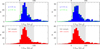 |
Fig. 2 Distributions 1/aori for two samples of LPCs: small perihelion comets (green line histogram in the upper panels) and large perihelion comets (full blue histogram in the upper panels) and the sum of all LPCs included in the CODE catalogue (full red histogram in the lower panels); swarms of 5001 VCs were used, with a bin width of 10 au−6. Left panels show statistics using the ‘preferred’ orbits, while the right panels show statistics based on PB solutions (i.e. orbits preferred for backward orbital evolution). |
3 Original 1/a distribution of LPCs from the CODE
Here, we divided the entire sample of LPCs in the CODE into small and large perihelion groups based on a value close to the median value of q for ‘preferred’ set of orbits in the range of [0,100] au−6 for the original 1/a. According to this criterion, we chose the value of qlim = 3.35 au, which gives 138 and 139 Oort spike comets on the original bound orbits in the small-q and large-q groups, respectively, while the full samples, including hyperbolas, consist of 182 and 187 comets in each group. Table 2 provides the comparative characteristics of both samples.
The distributions of 1/aori for LPCs with small perihelia (q < 3.35 au) and large perihelia (q ≥ 3.35 au) are shown in the upper left panel of Fig. 2, while the distribution for the entire LPC sample is presented in the lower left panel. Using the same threshold value of qlim, analogous statistics can be obtained for the PB orbital solutions. The results of this procedure are presented in the right panels of Fig. 2.
We note that all distributions shown in both panels are based on the full swarms of 5001 VCs, which ensures that orbital uncertainties are fully taken into account. The composite 1/aori distribution is obtained by summing the individual 1/aori distributions for all VCs of all comets in the considered samples, and divided by 5001 so that the vertical axis refers to the number of comets rather than the number of VCs; an example illustrating this procedure in detail, including the individual VC distributions, is presented in Dybczyński & Królikowska (2016), where these distributions were normalised to the number of clones instead of unity.
It should be noted that the distributions in the right panels – based on the PB solutions – are often based on shorter observational arcs (e.g. the pre-perihelion leg of the orbit). With respect to only this factor, the individual swarms of VCs in the right panels can be more dispersed than those shown in the left panel if only GR orbits were determined for a given comet. On the other hand, NG orbits used for the left panel distributions are often replaced by GR orbits fitted solely to distant pre-perihelion data in the right panel distributions (see Sect. 2.1). Accordingly, from a qualitative perspective, the effect of orbital uncertainties should be similar in both panels.
The situation may be different when the small-q and large-q distributions within each panel are compared separately. Due to the higher proportion of NG orbits (see Table 2) and typically shorter observational arcs, the small-q distributions may exhibit greater scatter than the large-q distributions; this effect is expected to influence both wings of the small-q distribution. Keeping this in mind, we identify the following features in both upper panels of Fig. 2:
For 1/aori < 20 au−6, small-perihelion Oort spike comets outnumber their large-perihelion counterparts by approximately 60%.
For 1/aori > 50 au−6, both distributions are generally similar in shape and number; however, in the [100,150] au−6 range, large perihelion LPCs outnumber small perihelion LPCs by a factor of two.
In the middle part (three bins between 20 and 50 au−6) of both distributions in both upper panels, one can observe remarkable differences that highlight the level of uncertainty that still persists in this region of the 1/aori distribution. However, the overall distributions in the lower panels are much more similar.
The way in which the above-mentioned features are reflected at three selected points in the 1/aori distribution (the tenth, 50th, and 90th percentiles) is presented in Table 3. It shows that the PB set of orbits yields more similar 10% and 90% deciles (compared to the ‘preferred’ orbit set), but also larger differences in medians. Furthermore, if we define the width of each distribution as the difference between these deciles, the small-q distribution in the PB set is about 3.7 au−6 wider than the large-q one. In contrast, for the ‘preferred’ orbits, the difference in width between the small-q and large-q distributions reaches about 7.6 au−6. We would like to conclude these considerations by highlighting our recommendation that, for studies of the original 1/a distribution, the PB orbital solutions are more appropriate.
Deciles for original 1/a distributions for two sets of preferred orbits presented in the CODE, where only comets in the range [0,100] au−6 for original 1/a are taken for statistics.
4 Previous orbits and a comet dynamical status
The idea of accessing the dynamical status of LPCs on the basis of their previous perihelion distance (i.e. one orbital revolution to the past) was first proposed by Królikowska & Dybczyński (2010). The justification for such an approach is simple: if the previous perihelion distance (qprev) was small, a comet might have been significantly perturbed by planets, and it might also have experienced weaker or stronger heating from the Sun. We can call such a comet dynamically (and to some extent, physically) old. Otherwise, if qprev is sufficiently large, we call a comet dynamically new. After analysing many cases, we finally (Dybczyński & Królikowska 2015) adopted the following threshold values for qprev: a comet is dynamically new if this parameter is greater than 20 au. If it is smaller than 10 au, we call a comet dynamically old, and for 10 au < qprev < 20 au we describe a comet’s status as uncertain. To account for the orbital data uncertainties, we propagate the nominal comet orbit and 5000 additional VCs to the past (and to the future). This approach has been used in CODE since the beginning, but now – as described in Sect. 2.2 – we present qprev statistics in two variants resulting from the use of different dynamical models, with and without stellar perturbations.
In Fig. 3, we present the dependence of the previous perihelion distance on the original value of the reciprocal semi-major axis. For both values, we take a median of the corresponding VCs’ parameter distributions. Here, we compare the qprev values obtained from two different dynamical models (with and without stellar perturbations) as a function of 1/aori. All the results presented in this section are based on the PB orbital solutions.
When constructing this figure, we only used 222 comets with a full swarm of VCs returning in both force models. This makes the statistics presented coherent and reliable; 27 comets with 1/aori > 200 au−6 are outside the frame, which makes the number of cases shown in Fig. 3 equal to 195.
The vertical dashed line at 55 au−6 divides the interval of 1/aori into two regions: to the right of it, the obtained qprev values do not reflect stellar perturbations – the results from the pure Galactic model (black crosses) are almost identical to those from the full model (red dots). In contrast, to the left of this line the inclusion of stellar perturbations results in significantly greater qprev values in almost all cases.
For all 222 fully returning comets, the median of the previous perihelion distance obtained with stellar perturbations omitted equals 6.9 au, but after including stars it becomes equal to 59.0 au. If we restrict this consideration to the left part of Fig. 3 (where 1/aori < 55 au−6, 118 comets), the median of qprev with stars excluded (black crosses) equals 12.7 au, while from the full model (red dots) it equals 643.1 au. From the point of view of a comet’s dynamical status and applying our 20 au threshold to these median qprev values in the left part of the figure, we have 115 new comets, none dynamically old and three uncertain cases (C/1890 F1, C/1941 K1, and C/2000 CT54, the three lowest red points in this part) when stellar perturbations are taken into account. Without stars, we obtain only 36 new comets with 1/aori < 55au−6.
Instead of referring to a particular comet as dynamically old or new on the basis of a median qprev value, in the CODE we present (for all its orbital solutions, not only for the PB ones) the statistics of the previous perihelion distance value. It is shown as the percentage of VCs having qprev < 10 au, in the range of [10,20] au or greater than 20 au.
Apart from the 222 comets with fully returning VCs swarms analysed above, we have 147 comets with VCs swarms of a ‘previous’ orbit partially or fully escaping. We set a threshold for the heliocentric distance of a comet equal to 120 000 au. The numerical integration of each VC motion into the past is stopped if a body moves further than this (and this VC is called escaping), otherwise it is stopped at the previous perihelion (and called returning). Among these 147 comets with mixed VCs swarms, only 11 are fully escaping, with only two comets (C/1995 Y1 and C/2012 V1) having all VCs in hyperbolic orbits. For the remaining 136 comets, we obtained VC swarms in two parts, returning and escaping, with a subset of hyperbolas in the latter. In these cases, we offer only partial statistics for the previous orbit parameters (see the CODE database documentation for more details). When stellar perturbations are included, 75 comets from this group of 136 comets have more than 80% of VCs returning; without stars, the same percentage is apparent for 71 comets. Therefore, the statistics of qprev and the resulting dynamical status assessments for these more than 70 comets are also quite reliable. There are only 21 comets with less than 50% of the VCs returning.
All of the above analysis leads to the conclusion that the widely used method of discriminating between dynamically old and new comets solely on the basis of the value of 1/aori often results in incorrect outcomes, especially with the threshold value of 1/aori = 100 au−6. If one cannot calculate qprev, which we offer in the CODE, the better approximate rule for a dynamically new comet is 1/aori < 55 au−6 (i.e. aori > 20 000 au), assuming that we take into account stellar perturbations. If only Galactic perturbations are used, the discrimination between old and new comets on the basis of only 1/aori seems problematic (see also Fig. 13 in Królikowska & Dybczyński 2017).
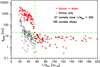 |
Fig. 3 Previous perihelion distance dependence on an original semi-major axis reciprocal, only 222 comets fully returning to previous perihelion are used. Crosses mark the Galactic influence, while red dots show both Galactic and stellar output. The horizontal dashed line depicts the assumed threshold for a dynamically new comet. The vertical dashed line divides the parameter space between an interval dominated by stellar and Galactic perturbations. |
Complete list of LPCs discovered before 2022 more than 10 au from the Sun or with pre-discovery detections beyond 10 au included in the CODE.
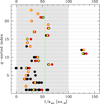 |
Fig. 4 Values of 1/aori for all solutions provided in CODE for LPCs listed in Table 4, excluding those based solely on the post-perihelion part of orbits. The vertical axis represents the ordinal number of a comet when sorted by q. The same number is in the final column of Table 4. The ‘preferred’ solutions with their uncertainties are shown in red, the PB solutions are marked by yellow points, and all remaining values are plotted in black. The green dashed vertical line indicates the same reference value as in Fig. 3. |
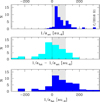 |
Fig. 5 Sample of 48 LPCs from the CODE with q > 7 au. The upper and lowest panels show original and future distribution of 1/a, respectively, while the middle panel gives the distribution of planetary perturbations during the passage through the planetary system. The light grey vertical band indicates the region occupied by Oort spike comets. The range of the horizontal axes is chosen to include the tails of the aori distribution. |
5 Comets discovered beyond 10 au and their dynamical status
Due to the increasing technical capabilities, for example those currently realised by the Vera Rubin Telescope, there is a growing interest in comets discovered from distances beyond the orbit of Saturn. In Table 4, we provide a list of 23 such comets. Only four have q below 3.35 au, and 17 of these 23 have 1/aori ranging from 10 to 55 au−6 (the threshold value discussed in Sect. 4), while the remaining six comets have original semi-major axes shorter than 20 000 au (see column [6]). Columns [7]–[8] show the dynamical status of these LPCs in two dynamical models: with and without stellar perturbations (see Królikowska & Dybczyński (2017) and Section 4 for a discussion).
One can see that 12 of these 23 comets seem to be dynamically new when only the Galactic tide is used; however, with the stellar perturbations included, the number of dynamically new comets grows to 17. We have only four dynamically old comets here, two with 1/aori > 100 au−6 (C/2016 Q2 and C/2021 Q4) and two with the original 1/a between 60–70 au−6 (C/2005 L3 and C/2014 B1). There are also two comets in both models classified as ‘uncertain’. They also have 1/aori between 60 and 70 au−6, but the previous perihelion distance for all their VCs lies between 10 au and 20 au (C/2010 U3 and C/2020 F2). More uncertain and dynamically old comets are in Column [7].
It is obvious that these estimates of dynamical status depend on our knowledge of the passing stars and may be subject to modification in the future for an individual object. However, the underlying statistical message that most near-parabolic comets detected so far at distances beyond 10 au are dynamically new does not appear to be changing.
For most comets listed in Table 4, we also present several different orbital solutions, as explained in Sect. 2.1. Although these are comets with large perihelion distances, reviewing the solutions in the CODE catalogue reveals that NG effects are evident in the motion of at least eight of them (Column [9]). Six of these comets (C/2005 L3, C/2006 S3, C/2008 S3, C/2010 U3, C/2012 LP26, and C/2015 D3) are the subject of a detailed discussion in Królikowska & Dones (2023), where it is shown that the motion of the comets is often measurably affected by NG forces at heliocentric distances further than 5 au from the Sun. The most spectacular example is C/2010 U3 (Boattini), with a perihelion distance of 8.45 au.
The CODE is the only existing catalogue that allows the user to investigate how different approaches to selecting the data arc for a model of motion (GR or NG) affect both the values of 1/aori and qprev. These values are crucial to assessing whether the comet studied is dynamically old or new. To assess the reliability of the conclusions drawn from Table 4, which is based on a single orbital solution (the orbits preferred for the past dynamics studies, PB solutions) Fig. 4 will be helpful.
This figure shows all available orbital solutions provided in the CODE, where the ‘preferred’ orbits are shown by red dots, and PB solutions are indicated by smaller yellow dots. One can see that both types of orbits are different for 11 LPCs; however, only the C/2001 Q4 (the first case with the smallest value of q) differs markedly. For the PB solution used in Table 4, this comet is classified as dynamically new in both models (slightly weaker when stellar perturbations are omitted). However, for the preferred orbit, it is dynamically old without stars. For the rest of the comet’s orbital solutions, the situation varies remarkably (see also Królikowska et al. 2012).
6 LPCs with a perihelion distance greater than 7 au
Figure 1 shows that the number of LPCs with perihelia beyond Jupiter’s orbit systematically decreases due to current observational limitations. Here, we describe the LPC sample with q above 7 au. The only such distant comet known before 2000 is C/1999 J2 (Skiff), with q = 7.11 au. Currently, we have found 56 such LPCs using the JPL Small Body Database Query (Jet Propulsion Laboratory 2025, as of May 2025). The JPL list includes 45 LPCs that are also present in the CODE, among which twelve are outside the Oort spike. It should be noted that the three Oort spike comets present in the CODE with q > 7 au are absent from the list of 56 comets mentioned above because they are classified in JPL as Chiron-type comets (C/2016 X1, 1/aori = 310.1 ± 1.2 au−6 and C/2017 AB5, 1/aori = 66.82 ± 2.33 au−6) or as JFCs (C/2007 D1, 1/aori = 43.96 ± 0.95 au−6).
Two of the 12 not included in the CODE have an original 1/a in the range of 100–200 au−6; the remaining ones have shorter semi-major axes. Together, this means that only about 20% of the known LPCs with q > 7 au have semi-major axes shorter than 5000 au. The smallest semi-major axis belongs to C/2024 E2 (Bok), with a = 51 au and an orbital period of 364 years.
Figure 5 shows the distributions of the original 1/a values for all LPCs with q > 7 au and present in the CODE. We used the full swarm of 5001 VCs for each comet to account for the orbit uncertainties, as in Fig. 2, and here we use the ‘preferred’ orbits to be consistent in the values of 1/afut −1/aori. In the lowest plot, two LPCs are outside the right border: C/2016 X1 with 1/afut = 503.8 ± 1.2 au−6 and C/2007 D1 with 1/afut = 738.4 ± 1.0 au−6. It appears that almost all of these LPCs have original a below 50 000 au, and the peak between 25 000 au and 50 000 au includes 34% of these comets (highest bin in the upper plot of Fig. 5).
Moving to shorter original semi-major axes, we observe a numerous group of comets between ~7000 au and 25 000 au, comprising about 54% of the sample given in the CODE, as well as a more dispersed population with original semi-major axes shorter than 7000 au. It is worth noting that moderate planetary perturbations (middle panel in Fig. 5) caused only 9 (<20%) of these comets to leave the inner part of the Solar System on hyperbolic orbits in the future.
7 Prospects and conclusions
For obvious reasons, maintaining a catalogue and a database such as CODE is a never-ending endeavour. Each year, we discover more and more comets; we observe them at larger distances and over longer time spans. Our individualised approach and careful model fitting make the orbit determination time consuming. Additionally, for a number of comets already discovered, we have to wait for more observations. All of this means that the CODE database is almost complete for older comets, but many comets discovered in 2022 and later will be included in the future.
The CODE offers the results of a long-term propagation of comet motion to the previous and next perihelion. This is necessary to discuss the comet’s dynamical status as well as the overall influence of planetary perturbations on the entire population of long-period comets. To achieve this, it is necessary to take into account perturbations caused by stars passing near the Sun during the comet’s previous or next orbit and the overall Galactic potential. To this end, we used modern, fast, and precise algorithms and data proposed by Dybczyński & Breiter (2022). Currently, it is based on a list of potential stellar perturbers taken from release 3.3 of the StePPeD5 database. Work is in progress to find more perturbers (Dybczyński et al. 2024), especially among multiple systems, so more or less significant changes to the previous and next orbits are expected in the future.
Our conclusion is that such an individualised approach to each comet, careful model fitting, various strategies for the selection of observational material, and the preparation of different, dedicated orbital solutions are our valuable contributions to the studies of LPCs’ source regions and origins. The message to the reader is quite straightforward: if one wants to study the origin of LPCs (or, e.g. the structure of the Oort cloud), one should restrict oneself to dynamically new comets. To discriminate between dynamically old and new comets, it is not sufficient to calculate 1/aori; rather, qprev is necessary. However, in calculating qprev, stellar perturbations might be essential. In the updated CODE, we offer all these parameters based on the best and current data.
Data availability
The data underlying this article are available at https://apollo.astro.amu.edu.pl/CODE or via https://code.cbk.waw.pl/. Additional material will be shared upon reasonable request to the corresponding author.
Acknowledgements
The CODE Catalogue has made use of the positional data of comets provided by the International Astronomical Union’s Minor Planet Center. We acknowledge the use of some data downloaded from Solar System Dynamics: https://ssd.jpl.nasa.gov as stated in the main text. We would like to thank the anonymous referee for constructive remarks.
References
- Dybczynski, P. A., & Breiter, S. 2022, A&A, 657, A65 [NASA ADS] [CrossRef] [EDP Sciences] [Google Scholar]
- Dybczynski, P. A., & Królikowska, M. 2015, MNRAS, 448, 588 [CrossRef] [Google Scholar]
- Dybczynski, P. A., & Królikowska, M. 2016, P&SS, 123, 77 [Google Scholar]
- Dybczynski, P. A., Królikowska, M., Bartczak, P., et al. 2024, A&A, 685, A171 [Google Scholar]
- Gaia Collaboration (Vallenari, A., et al.) 2023, A&A, 674, A1 [NASA ADS] [CrossRef] [EDP Sciences] [Google Scholar]
- Halbwachs, J.-L., Pourbaix, D., Arenou, F., et al. 2023, A&A, 674, A9 [NASA ADS] [CrossRef] [EDP Sciences] [Google Scholar]
- Inno, L., Scuderi, M., Bertini, I., et al. 2025, Icarus, 429, 116443 [Google Scholar]
- Ivezic, Z., Kahn, S. M., Tyson, J. A., et al. 2019, ApJ, 873, 111 [NASA ADS] [CrossRef] [Google Scholar]
- Jet Propulsion Laboratory 2025, JPL Small-Body Database, https://ssd.jpl.nasa.gov/tools/, accessed: 2024–2025 [Google Scholar]
- Juric, M., Lynne Jones, R., et al. 2023, in AAS Meeting Abstracts Kresák, L., & Antal, M. 1966, Contrib. Astron. Observ. Skalnate Pleso, 3, 113 [Google Scholar]
- Królikowska, M. 2001, A&A, 376, 316 [NASA ADS] [CrossRef] [EDP Sciences] [Google Scholar]
- Królikowska, M. 2004, A&A, 427, 1117 [NASA ADS] [CrossRef] [EDP Sciences] [Google Scholar]
- Królikowska, M. 2006, Acta Astron., 56, 385 [NASA ADS] [Google Scholar]
- Królikowska, M. 2020, A&A, 633, A80 [NASA ADS] [CrossRef] [EDP Sciences] [Google Scholar]
- Królikowska, M., & Dones, L. 2023, A&A, 678, A113 [NASA ADS] [CrossRef] [EDP Sciences] [Google Scholar]
- Królikowska, M., & Dybczynski, P. A. 2010, MNRAS, 404, 1886 [Google Scholar]
- Królikowska, M., & Dybczynski, P. A. 2017, MNRAS, 472, 4634 [CrossRef] [Google Scholar]
- Królikowska, M., & Dybczynski, P. A. 2020, A&A, 640, A97 [NASA ADS] [CrossRef] [EDP Sciences] [Google Scholar]
- Królikowska, M., & Dybczynski, P. A. 2023, arXiv e-prints [arXiv:2311.04063] [Google Scholar]
- Królikowska, M., Dybczynski, P. A., & Sitarski, G. 2012, A&A, 544, A119 [NASA ADS] [CrossRef] [EDP Sciences] [Google Scholar]
- Marsden, B. G., & Williams, G. V. 2008, IAU Circ., 8958 [Google Scholar]
- Marsden, B. G., Sekanina, Z., & Yeomans, D. K. 1973, AJ, 78, 211 [NASA ADS] [CrossRef] [Google Scholar]
- Minor Planet Center 2025, Minor Planet Center Database Search, https://minorplanetcenter.net/db_search, accessed: 2024–2025 [Google Scholar]
- Nakano, S. 2025, Nakano Notes – Minor Planet and Comet Circulars, http://www.oaa.gr.jp/~oaacs/nk.htm, accessed: 2024–2025 [Google Scholar]
- Oort, J. H. 1950, Bull. Astron. Inst. Nether., 11, 91 [NASA ADS] [Google Scholar]
- Sitarski, G. 1998, Acta Astron., 48, 547 [NASA ADS] [Google Scholar]
- van Biesbroeck, G. 1961, AJ, 66, 96 [Google Scholar]
- van Biesbroeck, G. 1962, AJ, 67, 422 [Google Scholar]
- van Biesbroeck, G. 1966, AJ, 71, 200 [Google Scholar]
These are mainly the observation sets for orbit determination we retrieved from the MPC database (Minor Planet Center 2025), except for rare cases when we supplement these sets with other observations. Since the observation sets of observable comets are continuously supplemented with new measurements in the MPC database, we also provide the time intervals when data were retrieved.
Following Królikowska & Dones (2023), we use the notation au−6 to denote 10−6 au−1 as the unit used in describing a semi-major axis reciprocal.
All Tables
Qualitative comparison between small-q and large-q samples of LPCs in the CODE catalogue.
Deciles for original 1/a distributions for two sets of preferred orbits presented in the CODE, where only comets in the range [0,100] au−6 for original 1/a are taken for statistics.
Complete list of LPCs discovered before 2022 more than 10 au from the Sun or with pre-discovery detections beyond 10 au included in the CODE.
All Figures
|
Fig. 1 Distribution 1/aori versus original perihelion distance for the sample of all LPCs in the CODE catalogue, excluding 17 LPCs with hyperbolic original orbits; shown are parameters for orbital solutions marked as ‘preferred for studies of the past motion’. Median values of |
| In the text | |
|
Fig. 2 Distributions 1/aori for two samples of LPCs: small perihelion comets (green line histogram in the upper panels) and large perihelion comets (full blue histogram in the upper panels) and the sum of all LPCs included in the CODE catalogue (full red histogram in the lower panels); swarms of 5001 VCs were used, with a bin width of 10 au−6. Left panels show statistics using the ‘preferred’ orbits, while the right panels show statistics based on PB solutions (i.e. orbits preferred for backward orbital evolution). |
| In the text | |
|
Fig. 3 Previous perihelion distance dependence on an original semi-major axis reciprocal, only 222 comets fully returning to previous perihelion are used. Crosses mark the Galactic influence, while red dots show both Galactic and stellar output. The horizontal dashed line depicts the assumed threshold for a dynamically new comet. The vertical dashed line divides the parameter space between an interval dominated by stellar and Galactic perturbations. |
| In the text | |
|
Fig. 4 Values of 1/aori for all solutions provided in CODE for LPCs listed in Table 4, excluding those based solely on the post-perihelion part of orbits. The vertical axis represents the ordinal number of a comet when sorted by q. The same number is in the final column of Table 4. The ‘preferred’ solutions with their uncertainties are shown in red, the PB solutions are marked by yellow points, and all remaining values are plotted in black. The green dashed vertical line indicates the same reference value as in Fig. 3. |
| In the text | |
|
Fig. 5 Sample of 48 LPCs from the CODE with q > 7 au. The upper and lowest panels show original and future distribution of 1/a, respectively, while the middle panel gives the distribution of planetary perturbations during the passage through the planetary system. The light grey vertical band indicates the region occupied by Oort spike comets. The range of the horizontal axes is chosen to include the tails of the aori distribution. |
| In the text | |
Current usage metrics show cumulative count of Article Views (full-text article views including HTML views, PDF and ePub downloads, according to the available data) and Abstracts Views on Vision4Press platform.
Data correspond to usage on the plateform after 2015. The current usage metrics is available 48-96 hours after online publication and is updated daily on week days.
Initial download of the metrics may take a while.