


| Issue |
A&A
Volume 703, November 2025
|
|
|---|---|---|
| Article Number | A191 | |
| Number of page(s) | 9 | |
| Section | Galactic structure, stellar clusters and populations | |
| DOI | https://doi.org/10.1051/0004-6361/202556481 | |
| Published online | 14 November 2025 | |
Abundance anomalies in low-mass field mergers as evidence of a merger origin for the second-generation stars in globular clusters
1
Sternberg Astronomical Institute, Lomonosov Moscow State University,
Universitetsky pr. 13,
119234
Moscow,
Russia
2
Max Planck Institute for Astronomy,
Königstuhl 17,
69117
Heidelberg,
Germany
3
Departamento de Física, Universidad Católica del Norte,
Avenida Angamos 0610,
Antofagasta,
Chile
★ Corresponding authors: This email address is being protected from spambots. You need JavaScript enabled to view it.
; This email address is being protected from spambots. You need JavaScript enabled to view it.
; This email address is being protected from spambots. You need JavaScript enabled to view it.
Received:
18
July
2025
Accepted:
17
September
2025
Abstract
Context. The canonical formation of second-generation (G2) stars in globular clusters (GCs) from gas enriched and ejected by G1 (primordial) polluters faces substantial challenges, namely (i) a mass-budget problem and (ii) uncertainty in the source(s) of the abundance anomaly of light elements (AALE) in G2 stars. The merger of G1 low-mass main-sequence (MS) binaries can overcome (i), but its ability to result in AALE remains unverified.
Aims. We present evidence of the merger process to explain AALE, based on highly probable merger remnants in the Galactic disc.
Methods. We focus on carbon-deficient red clump giants with low masses of 1.0 M⊙<M ≲ 2.0 M⊙, and hot He-intermediate subdwarfs of super-solar metallicity, both exhibiting G2-like AALE that are incompatible with a GC origin.
Results. The origin of such rare core He-burning stars as mergers of [MS star (MSS)]+[He white dwarf (HeWD)] binaries, which evolved from low-mass, high-mass ratio (MSS+MSS) binaries, is supported by models that evolve them to either horizontal branch (HB) stars or He subdwarfs via the red giant branch (RGB). Such binaries in the GC NGC 362 contain very young (∼4 Myr), extremely low-mass HeWDs, in contrast to much older (∼100 times) counterparts in open clusters. This agrees with the impact of the GC environment on the lifetime of hard binaries: (MSS+HeWD) systems merge there soon after forming from (MSS+MSS) binaries that have undergone the common envelope stage of evolution. Based on the number and lifetime of the (MSS+HeWD) binaries uncovered in NGC 362, the expected fraction of their progeny G2 RGB stars is estimated to be ≲ 10%.
Conclusions. The field merger remnants with G2-like AALE support the merger nature of at least a fraction of G2 stars in GCs. The specific channel [(MSS+MSS) – (MSS+HeWD) – merger product], supported by observations and models, is tentatively identified as the formation channel of the extreme G2 RGB component in GCs.
Key words: binaries: close / stars: chemically peculiar / stars: low-mass / globular clusters: general / open clusters and associations: general / globular clusters: individual: NGC 362
© The Authors 2025
 Open Access article, published by EDP Sciences, under the terms of the Creative Commons Attribution License (https://creativecommons.org/licenses/by/4.0), which permits unrestricted use, distribution, and reproduction in any medium, provided the original work is properly cited.
This article is published in open access under the Subscribe to Open model. This email address is being protected from spambots. You need JavaScript enabled to view it. to support open access publication.
1 Introduction
Globular clusters (GCs) are known to be composed of stellar populations that are not simple. Two sub-populations or generations of stars, a primordial (G1) and a secondary (G2), are typically distinguished in GCs (Carretta et al. 2009; Milone et al. 2017) with present-day masses exceeding a threshold level of about MGC ∼104 M⊙ (e.g. Carretta et al. 2010; Bragaglia et al. 2017; Simpson et al. 2017; Tang et al. 2021). The surface abundance patterns of G2 stars, mainly belonging to the red giant branch (RGB)1, exhibit anomalies in the abundance of light, proton-capture elements, such that N, Na, and (Al) are in excess and C, O, and (Mg) are in deficit. In contrast, G1 red giants and their field counterparts of the same metallicity are indistinguishable in this context. This phenomenon is referred to as multiplicity in GCs. The most common spectroscopic indicator of multiplicity in GCs is the Na-O anti-correlation among RGB stars (e.g. Carretta et al. 2009, and references therein)2. A particular point of interest is that the Na−O anti-correlation was primarily observed spectroscopically in GCs among the brighter stars, from the upper RGB down to the main-sequence (MS) turn-off point. It is not entirely clear whether the same Na−O anti-correlation is manifested by MS stars of lower luminosity or down to which limit it persists. The Mg−Al anti-correlation is more controversial, because it tends to disappear in most metalrich and/or least massive GCs (Pancino et al. 2017; Nataf et al. 2019). Most of the detections and quantitative studies of multiple populations in GCs, or in intermediate-age massive star clusters (particularly in distant ones) are based on photometric effects that primarily arise from the characteristic abundances of CNO elements.
Inference on multiple stellar populations in GCs broadly implies the canonical formation of G2 stars via the usual scenario: from the gas primarily ejected from G1 polluters (of any type) and possibly diluted with pristine gas. However, this remains a contradictory issue within the framework of the canonical approach. In fact, several lines of evidence have converged, indicating that this approach faces serious challenges. First, perhaps the most problematic is the so-called mass-budget problem: a deficit of the ejected, enriched gas necessary to form the observed fraction of G2 stars, especially in massive GCs, where the fraction of G2 stars on the RGB was found to be as high as 80%3. Second, the origin of the above-mentioned abundance anomaly in G2 stars remains uncertain. In principle, all conceivable polluters, the sources of the anomaly within the canonical framework for G2 star formation, have been identified (see more details on both issues in review papers by Bastian & Lardo 2018; Gratton et al. 2019; Milone & Marino 2022). However, a detailed model analysis by Bastian et al. (2015) shows that neither individual sources nor their combination are consistent with observations, particularly with respect to the He abundance. Moreover, typical Li abundance in G2 stars requires the dilution of the expelled, enriched (but Li-free) gas with the pristine gas (Prantzos et al. 2007).
Conversely, we have proposed (Kravtsov 2019, 2020; Kravtsov & Calderón 2021; Kravtsov et al. 2022; Dib et al. 2022; Kravtsov et al. 2024) an alternative explanation for the origin of G2 stars: the merger or collision of G1 low-mass MS stars, which is particularly relevant in the high-density GC environment4. Kravtsov et al. (2022) present empirical dependencies supporting this approach and estimated, in general terms, that it does not appear to suffer from the mass-budget problem. Kravtsov et al. (2024) investigate this scenario in greater detail. We demonstrate that a variety of data on close or hard binary systems, and their evolution in different environments, imply that high-mass-ratio hard binaries of low-mass MS stars are probably the main drivers of the merger process contributing to the formation of G2 stars. The fraction of G2 stars depends primarily on both the fraction of these merged binaries and the slope of the initial mass function (IMF) in its most relevant low-mass part and can vary widely with realistic fractions of merged binaries, even for a typical Milky Way-like IMF (Kravtsov et al. 2024).
The formation of G2 stars through the merger of low-mass G1 MS stars implies that abundance anomalies of proton-capture elements (AAPCEL) in such G2 stars are also caused by the merger process. However, the issue of low-mass mergers and their effect on AAPCEL in merger products or remnants is currently considered for GCs5. It is not only a poorly studied issue but also virtually omitted in the context of GC stellar populations, because the origin of AAPCEL in G2 stars is unambiguously associated with other sources that are fully relevant for the canonical formation of G2 stars, without any other alternative. Perhaps for this reason, the ability of the merger process to cause AAPCEL in GC G2 stars is typically challenged. This leads to a paradoxical situation. Indeed, such a causal relationship between the merger of low-to intermediate-mass stars and the emergence of G2-like AAPCEL in the resulting merger products has been studied in the context of the origin of certain field stars (and phenomena) and their elemental abundances. Surprisingly, this relationship is virtually never associated with GCs, where the specific merger rate is believed to be significantly higher than that in the field.
In this paper, we aim to highlight the accumulated supporting evidence that the highly probable low-mass merger remnants in the field exhibit G2-like AAPCEL and to show indications of a specific channel tentatively identified as leading to the merger formation of the so-called extreme G2 RGB component. We argue that the impact of mergers on the observed AAPCEL, or its photometric effects, cannot be negligible in GCs. Therefore, at least a fraction of RGB stars identified there as G2 stars exhibit AAPCEL caused by this process.
The present paper is organised as follows. In the next section (Section 2), we show that there are currently two views on the origin of field stars with G2-like abundance anomalies. In Section 3, which consists of five subsections, we describe the results of our overview and analysis of the published data on field stars with G2-like AAPCEL, as well as our proposal for a specific channel of the merger formation of G2 RGB stars. A summary and conclusions are presented in Section 4.
2 Two views on field stars with G2-like abundance anomalies
Based on the data available in the literature, we carefully selected data on the most probable low-mass stars that (i) do not originate from GCs, and (ii) exhibit G2-like AAPCEL, thereby separating them from similar stars that, according to their available characteristics, might have either escaped from existing GCs or previously belonged to disintegrated GCs. In reviewing the literature on low-mass stars with AAPCEL in the Galactic field, we reached, in addition to our main goal, an unexpected additional conclusion. Specifically, we identified two almost non-intersecting lines of investigations that both uncover field stars with G2-like AAPCEL but reach different conclusions regarding its origin.
One line aimed to detect stars in the Galactic field (in the bulge, disc, and halo) with G2-like AAPCEL. These are primarily characterised by CNO(Na) abundance anomalies, the origin of which is typically associated with loss from GCs. Hundreds of red giant stars with G2-like AAPCEL and metallicities [Fe/H] typical for Galactic GCs have been identified in the Galactic field, primarily from APOGEE survey data. In particular, using data from the Galactic bulge, Schiavon et al. (2017) discovered a population of field stars with high [N/Fe] ratios correlated with [Al/Fe] and anti-correlated with [C/Fe] ratios, typical of G2 stars, and a metallicity distribution function peaking around [Fe/H] ≈−1.0. Fernández-Trincado et al. (2021) isolated an even more metal-rich population of red giants, with G2-like AAPCEL and [Fe/H] ratio extending to slightly subsolar values. Moreover, Fernández-Trincado et al. (2017) report a small number of field red giants in the low-metallicity range (−1.8<[Fe/H]<−0.7), strongly enriched in N, Na, and Al, and depleted in C, O, and Mg. Fernández-Trincado et al. (2022) have identified a much larger sample of 149 N-rich ([N/Fe] ≳ +0.5) field red giant stars throughout the Galaxy (i.e. towards the bulge, metal-poor disc, and halo). Their G2-like abundance patterns show enrichment in [N/Fe] along with depletion in [C/Fe] ([C/Fe]<+0.15). These stars also cover a wide range of metallicities (−1.8<[Fe/H]<−0.7) typical of GCs. We refer the interested reader to Table 2 of Fernández-Trincado et al. (2022) for a summary of the information on the populations of the carbon-depleted, nitrogen-enriched stars revealed in the field and the corresponding publications.
The authors of these studies argue that field stars with G2-like AAPCEL have been stripped from existing GCs or from fully or partially destroyed GCs (Fernández-Trincado et al. 2021), given the similarities in AAPCEL between these field stars and GC G2 stars, including the metallicity range they occupy. Fernández-Trincado et al. (2022) note a diversity of kinematical and dynamical characteristics among the revealed N-rich field giants, which implies that they do not originate from the same birthplaces in the Galaxy. However, it has yet to be established how many of the revealed stars previously belonged to GCs. These findings cannot rule out the possibility that a fraction of these stars originally formed in situ in the field, rather than in GCs (excluding the assumption that any star with G2-like AAPCEL unequivocally originated from a GC). To distinguish between these two alternatives, additional information on key stellar characteristics is required, such as reliably (asteroseismically) derived masses, luminosities, and evolutionary status, i.e. whether they are shell H-burning RGB stars or core He-burning red clump or horizontal branch (HB) stars.
Another line of research focuses on stars (and phenomena) most probably formed in situ as field or open cluster constituents, exhibiting mass (e.g. Li et al. 2022) and/or abundance anomalies (i.e. G2-like AAPCEL), or peculiar locations in the colour-magnitude diagram of open clusters (e.g. Geller et al. 2017a,b; Matteuzzi et al. 2024). The availability of large databases, accumulated through advanced ground- and space-based surveys targeting spectroscopic, photometric, and astrometric characteristics of Galactic stars, allows a deeper investigation of various problems, including those of stellar astrophysics addressed here. Among these are the most feasible process(es) causing the observed anomalies. Specifically, interactions between stars in binary systems that lead to the formation of peculiar stars in the Galactic field and open clusters, either through mass transfer between the components or their mergers.
We pay special attention to stars with G2-like AAPCEL whose origin from GCs is improbable given their stellar characteristics. We primarily refer to the so-called carbon-deficient red clump giants (see details below), particularly the low-mass fraction with 1.0 M⊙<M ≲ 2.0 M⊙, which are expected to have passed through the He-flash at the end of the RGB, similar to (extended) HB stars in present-day GCs.
3 Results
We focus on published data accumulated on low-mass stars likely formed in situ in the field and exhibiting G2-like AAPCEL explained by mechanisms other than those proposed for G2 stars in GCs. We therefore separated these stars from those excluded from our consideration because they were suggested to have escaped from GCs.
3.1 Likely core He-burning low-mass merger remnants in the field
We primarily selected data on stars with reliably estimated stellar mass from asteroseismology and predominantly thin-disc kinematics. Although the [Fe/H] ratio is a less strict discriminating parameter compared to mass and kinematics, it is also quite useful in combination with them. We considered stars with metallicities biased towards solar and super-solar values. This further decreases the probability that such field stars with G2-like AAPCEL previously belonged to GCs. Although more than 200 GCs are known in the Milky Way, none have been found to have super-solar metallicity (Garro et al. 2024), and only a small fraction have slightly subsolar metallicity.
We focused on stars that, in terms of evolution, are core-He-burning stars with G2-like AAPCEL. These include red clump stars and hot He subdwarfs (He-sdOB). These stars most likely did not originate from GCs. Specifically, they are primarily metal-rich disc stars, particularly He-sdOB stars, which have super-solar metallicities. Their masses fall within the low-mass range; however, in the case of red clump stars, they are clearly higher than the typical present-day maximum stellar mass around the MS turn-off (MTO ≲ 0.9 M⊙) and on the lower RGB in GCs. This is unless they are the unlikely descendants of the rare massive blue stragglers that typically form and reside near the centres of GCs, deep within the cluster potential wells. Such particular field stars provide supporting evidence for the formation of G2-like stars in the field by mechanisms different from those proposed to explain the canonical formation of G2 stars in GCs.
3.2 Abundance pattern and origin of carbon-deficient red giants in the field
We primarily focus on the so-called carbon-deficient red giants (CDRGs) or ‘weak G-band stars’, a small, peculiar population of stars kinematically belonging mainly to the Galactic disc, first identified long ago (see, for example, a historical overview in Bond 2019). These stars have been studied for many decades, with their number gradually increasing (Maben et al. 2023b, and references therein), but until very recently they were thought to be subgiant branch (SGB) and RGB stars of intermediate mass (∼2.5−5.0 M⊙). However, based on a selected sample of these stars with complete available data (including photometry, asteroseismology, spectroscopy, and astrometry) Maben et al. (2023a) reached a different conclusion for a fraction of such stars. Specifically, they found that, in contrast to previous estimates, almost all of the selected CDRGs (with slightly subsolar mean metallicity) are core-He-burning stars (i.e. red clump stars) of low mass (≲ 2.0 M⊙) and varying luminosities. These authors concluded that the most likely origin of more luminous red clump stars among the selected CDRGs is the merger of a He white dwarf (HeWD) with an RGB star. For normal-luminosity red clump stars, it is not possible to distinguish between core He-flash pollution and lower-mass merger scenarios.
The ranges and mean values of metallicity ([Fe/H]), CNO abundances, and asteroseismologically derived masses of a sample of 15 low-mass CDRGs in the Galactic field are listed in Table 1. The presented values are based on and calculated from the elemental abundances and masses (MAVG) of the individual sample stars listed in Maben et al. (2023a). The MAVG values were obtained by averaging three separate asteroseismic estimates of each star’s mass, derived using three different formulae.
We also draw attention to the very recent results on CDRGs obtained by Holanda et al. (2024). From their comprehensive chemical analysis of four previously poorly studied CDRGs (HD 54627, HD 105783, HD 198718, and HD 201557), they derive indicative elemental abundances, particularly for CNO and Na. Furthermore, Holanda et al. (2023) report that the CDRG HD 16424 exhibits enrichment in N and depletion in C, with [N/Fe]=+0.97 and [C/Fe]=−0.57, respectively, typical of a CDRG. They also observed an overabundance of Na, a high abundance of Li-7, and a low mass (1.61 M⊙) for HD 16424. The kinematics and the absence of alpha-element enrichment (−0.12 ≤[α/Fe] ≤ 0.06 dex) indicate that these stars belong to the thin disc. In Table 2, as in Table 1, we present the range and mean values of metallicity ([Fe/H]), CNO and Na abundances, and masses (derived using a different method than the one based on asteroseismology) of the five aforementioned CDRGs studied by Holanda et al. (2023, 2024).
Bond (2019) shows that CDRGs lie at systematically larger distances from the Galactic plane than normal giants, possibly indicating a role of binary mass transfer and mergers. This study also summarises that the surfaces of CDRGs “are strongly contaminated with material that was once deep in the hydrogenburning core” (see references therein for publications on CNO abundance analyses of CDRGs).
One may conclude (e.g. Maben et al. 2023a, and references therein) that, in the first approximation and in terms of the G2-like anomalies of CNO and Na abundances (ignoring possible effects of metallicity and stellar mass), at least a fraction of CDRGs are virtually indistinguishable (within uncertainties) from GC G2 stars. They are also comparable to populations of giants isolated in the Galactic field whose origin is attributed to GCs.
Range and mean values of metallicity, CNO abundances, and asteroseismologically derived masses of 15 low-mass carbon-deficient giants in the Galactic field.
Range and mean values of metallicity, CNO and Na abundances, and masses of five carbon-deficient giants in the Galactic field.
3.3 He-intermediate-rich hot subdwarfs with G2-like abundance anomalies in the field
Hot subdwarf stars (sdOBs) are known to be low-mass core He-burning stars, similar to both HB or red clump stars, but with high temperatures spanning a wide range. Their thin atmospheres are typically composed of pure hydrogen, primarily due to gravitational settling. A fraction of sdOBs are He-rich, believed to form through two mechanisms: (i) the merger of two HeWDs or a HeWD with a low-mass carbon-oxygen WD; and (ii) a common-envelope (CE) or mass-transfer (MT) evolutionary stage in binaries (see, in particular, Heber 2016; Philip Monai et al. 2024, and references therein). The least numerous groups of hot sub-dwarfs, referred to as intermediate He-rich hot subdwarfs (iHe-sdOB), have a mixture of H and He in their atmospheres. It has been suggested that these stars are in a transitional evolutionary phase from the He-flash towards the HB. According to estimates by Arancibia-Rojas et al. (2024), most of the observed sdBs descend from low-mass progenitors with initial masses <1.5 M⊙.
Spectral analysis of sdOBs is complicated and ambiguous because their high gravity, strong magnetic fields, and high temperatures lead to a number of processes such as radiative levitation and gravitational settling, which affect the surface elemental abundances and their reliable determination. Consequently, considering their relatively low luminosities, the number of these stars with detailed and reliable elemental abundance measurements is limited. Dorsch et al. (2019) find that two iHe-sdOBs, HZ 44 and HD 127493, exhibit a strong CNO cycle pattern, with N notably enriched while C and O are depleted relative to solar values. The individual abundances of HZ 44 and HD 127493 are given in parentheses: Fe(0.18; 1.00), C(−1.06;−1.41), N(1.46; 1.41), O(−0.91;<−1.67), and Na(1.01;<1.68), as reported by Dorsch et al. (2019), who conclude that the CNO abundances of these two hot subdwarfs can be explained by hydrogen burning via the CNO cycle. They also note that despite the impact of atmospheric diffusion processes, “it is not plausible to assume that diffusion creates an abundance pattern of C, N, O, and Ne, which mimics the nucleosynthesis pattern so well.” Dorsch et al. (2019) also refers to the results of Jeffery et al. (2017) on a third iHe-sdOB, [CW83]0825 + 15 (UVO 0825 + 15), whose abundance pattern “is also similar to HZ44 and HD 127493 in that the CNO-cycle pattern is evident.”
We also note the results of a detailed abundance analysis of the He-rich sdO EC 20187-4939 reported by Scott et al. (2023). They report that this hot subdwarf, with a mass estimated to be ∼0.44 M⊙, also exhibits high N and low C and O, consistent with material processed by the CNO cycle. Based on their modelling, Scott et al. (2023) interpret EC 20187-4939 as a binary merger. However, because of the high abundance of He, both components of the binary should probably be HeWDs.
3.4 Appropriate models and a specific channel for the merger formation of G2 RGB stars
Zhang et al. (2017) propose and model the merger of a HeWD with a low-mass MS star (HeWD+MS) and show that this kind of merger can lead to the formation of some classes of hot subdwarfs or HB stars. From the detailed analysis of these models, Zhang et al. (2023) argue that the HeWD+MS merger can represent at least one formation channel of blue large-amplitude pulsators (BLAPs), hot low-mass stars exhibiting fast pulsational variability.
In the previous subsections, we highlight a variety of observational results obtained by different authors on low-mass field stars with G2-like AAPCEL in the Galactic disc, which are interpreted as probable mergers by appropriate modelling. Overall, these results provide important observational evidence supporting the ability of low-mass mergers to produce abundance anomalies similar to those of G2 stars in GCs.
However, actual observations and available models suggest only a particular, specific channel of merger formation for a (minor) fraction of G2 stars observed on the RGB. This channel corresponds to the aforementioned models (Zhang et al. 2017) of mergers between low-mass HeWDs and MS stars with masses comparable to those of upper MS stars in GCs, and to the systems uncovered by Dattatrey et al. (2023) in NGC 362. This channel is schematically illustrated in Figure 1. In the high-density environment of GCs, the initial transformation of a low-mass, high-mass-ratio binary composed of two upper MS stars (MSS+MSS) may result in a (MSS+HeWD) binary composed of an (extremely) low-mass HeWD and an upper MS star. This transformation likely involves a CE stage of binary evolution, during which the mass of the secondary companion may increase insignificantly and it remains on the MS, without becoming a blue straggler. This outcome is possible, particularly in high-stellar environments. Moreover, Parsons et al. (2018) find that M dwarfs in close binaries with WDs appear indistinguishable from other M dwarfs, implying that the CE stage of evolution has a negligible impact on their structure. The aforementioned transformation is supported by observations revealing (MSS+HeWD) binaries in open and globular clusters, known as blue lurkers (Leiner et al. 2019). These are typically located on the upper MS or around the MS turn-off in optical colour-magnitude diagram of star clusters (Nine et al. 2023; Dattatrey et al. 2023; Panthi & Vaidya 2024; Jadhav et al. 2024). An important detail is that the cooling age of HeWDs estimated in such binaries in open clusters ranges from a few tens of Myr to ∼1.0 Gyr or more, with an average of several hundred Myr (Nine et al. 2023; Leiner et al. 2025). In contrast to open clusters, the cooling ages of extremely low-mass and low-mass HeWDs in similar binaries uncovered in NGC 362 (Dattatrey et al. 2023) are much younger: two have ages less than 0.1 Myr and the others between 1.8 and 4 Myr. This significant difference (by a factor of about 100) between the timescales of (MSS+HeWD) binaries residing in the low- and high-density stellar environments of open clusters and GCs, respectively, is highly illustrative. Within our framework, this implies that hard (MSS+HeWD) systems merge much faster in the GC environment than in open clusters, following their transformation from (MSS+MSS) binaries. This agrees with the expected strong influence of the GC environment on the lifetime and fate of hard binaries. This remains a preliminary conclusion, as current data on (MSS+HeWD) binaries are very limited, especially in GCs, and the true situation may be more complex, with additional nuances. Nevertheless, a useful estimate can be made.
Zhang et al. (2017) point out that products of low-mass (MSS+HeWD) mergers are expected to be RGB-like stars that likely evolve differently from normal RGB stars, including in their RGB timescales. According to Zhang et al. (2017), the evolution of a model merger product from the (MSS+HeWD) binary merger until becoming a hot subdwarf or HB star takes a few tens of Myr. The masses of the components that make up the merger product that evolves to a hot subdwarf are, in particular, MMSS+MWD=(0.65+0.30) M⊙, although both MMSS and MWD can vary within a certain range. For merger products that evolve towards the HB, the tendency is that both MMSS and the ratio MMSS/MWD increase slightly as MWD decreases down to its limiting value MWD=0.25 M⊙ in the calculated models. At this limit, the model value of MMSS+MWD required to evolve to the HB falls within the range of values observed for the (MSS+HeWD) binaries found in NGC 362 (Dattatrey et al. 2023), namely between 1.00 and 1.12 M⊙, but with lower MMSS and higher MWD.
Considering the differences between the characteristics of the modelled and observed (MSS+HeWD) binaries, the RGB evolution timescale of RGB-like stars in NGC 362 may be somewhat longer than predicted by the model, owing to the lower masses of HeWDs in the (MSS+HeWD) binaries uncovered in NGC 362. We conservatively adopt a timescale of 30 Myr. Assuming a mean timescale of the (MSS+HeWD) binaries to be around 3 Myr, we would then expect to find ten times more RGBlike merger products on the RGB of NGC 362 than the number of (MSS+HeWD) binaries observed. We estimate the total number of RGB stars in NGC 362, from the RGB base to its tip (see the left panel of Figure 1), to be approximately 1800. This estimate is based on the RGB population data of NGC 362 from Kravtsov (2009) who used HST photometry from Piotto et al. (2002) for the central regions of Galactic GCs. The fraction of G2 RGB stars in NGC 362 is NG 2/NTOT=0.72, derived from the fraction of G1 RGB stars reported by Milone et al. (2017). Finally, we adopt a completeness of 3̃ 0% for the (MSS+HeWD) binaries detected in NGC 362 (i.e. in the upper MS, around the MS turn-off). From these assumptions, the fraction of RGB-like stars formed through (MSS+HeWD) mergers among G2 RGB stars in NGC 362 may be as high as 10%, although this should be regarded as an upper limit.
We conclude that the specific channel [(MSS+MSS) binary – (MSS+HeWD) binary – RGB-like merger product] can contribute up to ∼10%, with an uncertainty of the same order of magnitude, to the population of G2 RGB stars in NGC 362. We tentatively identify this as the formation channel of the so-called extreme G2 RGB component, isolated at a comparable fraction in GCs by Carretta et al. (2009), which exhibits the largest deviation from G1 stars in the Na-O anti-correlation.
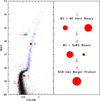 |
Fig. 1 Left panel: optical colour-magnitude diagram (CMD), F555W versus (F439W-F555W), of the globular cluster NGC 362 based on HST photometry from Piotto et al. (2002). Three filled red squares show the expected consecutive locations of an initial MS binary in its evolution towards and RGB-like merger remnant, schematically illustrated in the right panel. Blue points show stars along the RGB, covering its entire range from the base upwards. Right panel: schematic illustration of the main consecutive stages in the evolution of a hard binary initially composed of two MS stars (1), then transformed into a (MSS+HeWD) binary (2), which finally merges to form an RGB-like merger product (3) evolving along the cluster RGB. |
3.5 Evidence for low-mass mergers of non-compact stars in the field
We previously drew attention (Kravtsov et al. 2022) to optical transients, the so-called luminous red novae (LRNe) occurring, in particular, in the Galactic field due to low- or intermediate-mass mergers, as important evidence of numerous mergers of low-mass stars in GCs over their long history, where the conditions for stellar mergers and collisions are far more favourable in their dense central regions. This evidence has become more comprehensive and insightful owing to new results, especially those on the chemical composition of LRN remnants. In particular, Kamiński et al. (2023) find super-solar Li abundances in a number of Galactic LRN remnants thought to be caused by mergers involving non-compact low-mass stars such as (sub)giants and MS stars (see also Kaminski 2024, and references therein). Also important is that, as in the case of the abundance anomalies observed in the high-probability field merger products or remnants considered in the previous subsections, Tylenda et al. (2024) find ashes of hydrogen burning in the CNO cycles, and also in the MgAl chain, in the circumstellar gas of the remnant of the LRN CK Vul. Interestingly, D’Orazi & Gratton (2020) reach the conclusion that spectroscopic investigations of both G1 and G2 stars converge towards the need for Li production due to the processes responsible for the occurrence of G2 stars in GCs.
Another probable type of merger manifestation, the ringshaped ultraviolet nebula with a star at its centre (TYC 2597-735-1), is reported by Hoadley et al. (2020). From a detailed analysis of observations of a rare far-ultraviolet emitting object discovered earlier by the Galaxy Evolution Explorer, they argue that the best-fit models are those in which the merger of old (i.e. low-mass) stars in the Galactic disc occurs after the primary begins to evolve off the main sequence.
4 Summary and conclusions
In the framework of our approach (Kravtsov et al. 2022), we have tentatively identified (Kravtsov et al. 2024) low-mass G1 MS hard binaries of high mass ratio as probable progenitors of G2 stars in GCs. It is known that these binaries merge much more efficiently, and on a much shorter timescale, in the GC environment than in the field or in open clusters. The merger of G1 low-mass MS binaries can overcome the so-called massbudget problem, but its ability to result in the G2-like anomaly of light elements in low-mass star merger products has largely been omitted. We discuss the evidence that such an outcome occurs, relying on highly probable merger remnants in the Galactic disc. In the following, we summarise our results and conclusions.
We first recall that mergers of low-mass stars occur even in the low-density environment of the Galactic field and open clusters, despite their low efficiency. It was previously shown that the dynamical effects of tertiary companions in triple systems in the Galactic field lead to shorter periods (i.e. increased tightness) of the inner binaries compared to similar binaries without tertiary companions (Tokovinin et al. 2006; Tokovinin 2023). Currently, a growing body of evidence strengthens the understanding of the important role of hierarchical triple systems, particularly of low-mass (solar-like) stars, in the dynamical evolution of the inner binaries and in stimulating their final merger, leading to the formation of rare peculiar stars, such as the B-type star LS V+22 25 with mass 1.1 ± 0.5 M⊙ in the potential black hole binary LB-1 (Irrgang et al. 2020), and of compact objects up to a combination of triple WDs (e.g. Lagos-Vilches et al. 2024; Shariat et al. 2025; Aros-Bunster et al. 2025; Li et al. 2025, and references therein). In addition to this effect on the tightness of the inner binaries in hierarchical triple systems, CE evolution is also an important process that brings the binaries closer or leads them to merge (e.g. Ivanova et al. 2013; Postnov & Yungelson 2014, and references therein), especially in the low-density environment of the Galactic field. In turn, the formation of some classes of hot subdwarfs in the field is proposed (Zhang et al. 2017) to be due to the merger of a HeWD with a low-mass MS star, i.e. (HeWD+MS). It is also relevant to note that the issue of some fraction of Cepheids as possible inner binary mergers (particularly, between stars with individual masses below the Cepheids’ lower mass limit) in hierarchical triple systems in the field and in open clusters is also currently being studied in different contexts (Dinnbier et al. 2024; Espinoza-Arancibia & Pilecki 2025).
The high-density stellar environment in GCs is especially favourable for the mergers of low-mass stars. This is due to at least two factors: (i) frequent close encounters between stars and their integral dynamical effect on binaries, including their hardening; and (ii) the higher concentration of binary stars in the clusters’ centres, implying that a high fraction of binaries are involved in hardening and subsequent merger in systematically more dense, and therefore, more favourable environments. This process is expected to result in a much higher specific rate of low-mass mergers in GCs compared to that in the field and open clusters. The most probable outcome of the dynamical evolution of hard binaries in GCs is expected to be merger or collision, a result that has long been argued (Goodman & Hut 1993; Fregeau et al. 2004). In turn, Mastrobuono-Battisti et al. (2021) conclude that collisions between pairs of MS stars are the most common stellar encounters leading to mergers, based on modelling stellar encounters under conditions relevant to the Galactic nuclear star cluster.
The dynamical effect of tertiary companions in hierarchical triple systems, that they make inner binary systems closer compared to binaries with the same mass ratio but without such companions, strongly implies that initial binary stars in the dense environment of GCs should have formed systematically harder (i.e. closer) than in the field. Moreover, a larger initial fraction of low-mass binaries could have formed in GCs (Ivanova et al. 2005). These unique sites distinguish themselves not only by their high stellar density, but also by their high star formation efficiency at their birth, similar to that measured in massive clusters currently forming in the Milky Way (Dib et al. 2013). In addition to the dynamical effects that make hard binaries harder in the dense environment of GCs, other effects might potentially favour binary mergers. For example, Rozner & Perets (2022) suggest that the properties of binaries in the early GCs could have been affected by the gas produced by evolved G1 stars.
Owing to their unique characteristics, GCs are particular sites that are highly favourable for the merger of low-mass stars. Therefore, notable populations of low-mass merger products (G2 stars) should have formed and accumulated in GCs since their formation. This outcome and its implications are rarely considered in relation to the formation of G2 stars in GCs, because the occurrence of G2-like abundance anomalies is unequivocally associated with other proposed sources within the framework of the canonical G2 star formation scenario. Moreover, the ability of low-mass star mergers to cause AAPCEL in their merger products appears to have been neglected.
Here, we focus on this important issue. We highlight the increasing evidence that, in the Galactic disc, there are low-(1.0 M⊙<M ≲ 2.0 M⊙) to intermediate-mass red clump giants with thin-disc kinematics, slightly subsolar mean metallicity, and G2-like abundance anomalies, the so-called carbon-deficient giants, which could hardly have originated from GCs. Moreover, there are hot (He-intermediate-rich) subdwarfs with a similar anomaly at a super-solar metallically. These stars were interpreted in the original papers as highly probable remnants of stellar mergers. There is also strong observational evidence of non-compact low-mass stellar mergers occurring in the Galactic field. This evidence strongly implies that GCs should contain a substantial number of such stars, in contrast to the widely accepted formation of G2 stars from gas enriched by the evolved G1 stars. This raises the question of which objects can be identified with these stars in GCs. We argue that the totality of the evidence presented highlights the merger nature of at least a fraction of G2 stars in GCs. Both the available observations and models appropriate for GCs allow us to suggest a particular channel for the merger formation of a (minor) fraction of G2 stars observed on the RGB and more advanced evolutionary stages (more precisely, at and above the MS turn-off). We estimate that this channel [(MSS+MSS) binary – (MSS+HeWD) binary – RGB-like merger product] can contribute up to ∼10% of G2 RGB stars. We tentatively identify it as the channel of formation of the so-called extreme G2 RGB component isolated by Carretta et al. (2009) at a comparable fraction in Galactic GCs.
In this relation, we expect an anti-correlation [correlation] between the mean age of low-mass HeWDs in (MSS+HeWD) binaries and the encounter rate (mass) [the fraction of G1 RGB stars] of their parent GCs at a given metallicity.
The way G2 stars form in massive star clusters, in general, and in GCs, in particular, implies some expected effects that can be verified observationally. Here, we briefly review a number of them and compare their consistency with the formation mechanisms of G2 stars, either via the canonical way or via the merger of G1 low-mass MS binaries.
A substantial body of observational information about multiple populations detected outside of Galactic GCs has been obtained for the Magellanic Clouds’ massive star clusters (MCMSCs). Convergent evidence indicates that the onset of multiple populations in MCMSCs occurs at an age of about 2 Gyr (e.g. Hollyhead et al. 2017; Niederhofer et al. 2017; Hollyhead et al. 2018; Martocchia et al. 2018; Hollyhead et al. 2019; Milone et al. 2020; Li et al. 2021; Martocchia et al. 2021). There is also evidence that their onset on the MS can occur around 300−500 Myr earlier than on the RGB, that is, at approximately 1.7-1.5 Gyr (e.g. Li 2021; Cadelano et al. 2022). Moreover, it was concluded that (i) intermediate-age MCMSCs have a systematically higher fraction of G1 stars than GCs of the same present-day mass and (ii) the range of light-element abundance variation increases with the age of MCMSCs (see Martocchia et al. 2019; Salgado et al. 2022, and references therein). Although these manifestations, apart from those noted in the Abstract, are challenging for, or even inconsistent with, the canonical formation of G2 stars from the gas ejected by G1 polluters, they are in good agreement with a mechanism such as the merger of MS G1 stars, which may be extended in time and is expected to initially manifest in the MS and subsequently at more advanced stages of stellar evolution. The time delay of about 2 Gyr between the onset of multiple populations in MCMSCs and cluster formation may be interpreted, in principle, in the framework of the merger paradigm. For example, the time delay between mergers and collisions and the onset of changes in surface elemental abundances, particularly decreasing C and increasing N abundances in the products of low-mass MS star (0.6 M⊙+0.6 M⊙) mergers and collisions, was deduced from simulations by Sills et al. (2005) two decades ago. This delay is of the same order of magnitude, around 2 Gyr, and the elemental abundance changes increase for some time thereafter.
The binary fraction among G1 and G2 stars is also an important quantity and it provides a test of the merger scenario for G2 stars. We noted in our recent work (Kravtsov et al. 2024) that the merger formation of G2 stars implies that the G1 and G2 sub-populations in GCs should have notably different binary fractions, with a much smaller fraction among G2 stars. This is in agreement with observations showing that the binary fractions among G1 sub-populations in GCs are typically an order of magnitude higher than among G2 stars(see Gratton et al. 2019, and references therein). Recent results obtained by Bortolan et al. (2025) and Milone et al. (2025) on the occurrence of binaries among G1 and G2 stars in two distinct GCs, NGC 288 and 47 Tuc, confirm the general trend found in earlier observations, although with some differences. Specifically, the essential difference between the binary fractions among the sub-populations is observed in the outer parts of the GCs, whereas it is much smaller in the cluster centres. The authors interpret this dissimilarity in binary fractions as arising from distinct radial distributions of the sub-populations in the parent GCs, which result in differences in how G1 and G2 binaries are affected by dynamical effects. In contrast, we suggest that the much lower fractions of binary stars among G2 sub-populations in GCs, despite intervening dynamical effects, are primarily a natural consequence of the merger origin of G2 stars. Recent results obtained by Muratore et al. (2024) on binary star fractions among slow and fast MS rotators in three Magellanic star clusters are consistent with our merger scenario.
The manifestations of the multiple populations-phenomenon in low- and very low-mass MS stars also provide a valuable observational channel for understanding the nature of G2 stars. Several results on G1 and G2 sub-populations on the MS at very low stellar masses have been obtained in a series of papers based on HST photometry, published over the past decade. In particular, Milone et al. (2012, 2014, 2019); Dondoglio et al. (2022) studied multiple populations in the low MS in several GCs, including estimates of the fractions of G1 and G2 MS stars below the so-called MS knee (i.e. at MMS<0.3 M⊙) but above MMS ∼0.20 M⊙. Notably, there are interesting differences in the fraction of G1 and G2 stars in the RGB and the lower MS. While in NGC 6752 the fractions are reported to be the same within the error in both evolutionary sequences, in NGC 2808 and M4 they differ, particularly in NGC 2808. In the latter GC, the fraction of G1 stars (characterised by Milone et al. (2012) as having “primordial helium and enhanced carbon and oxygen abundance”) in this mass range of the MS has been estimated to be approximately 0.65, with G2 stars around 0.35. Later, Dondoglio et al. (2022) showed that it varies radially within the cluster, decreasing to ∼0.45, while G2 increases to approximately 0.55 in the cluster centre. However, it remains larger than the fraction of G1 RGB stars, which was estimated to be around 0.232 by Milone et al. (2017). In M4, the fractions of G1 stars in the same evolutionary sequences are ∼0.380 (Milone et al. 2014) and 0.285 (Milone et al. 2017), with the possible exception of the innermost region, according to Dondoglio et al. (2022). Interestingly, these differences in the fraction of G1 stars between the MS and RGB in the same GCs are consistent with the result of the present paper regarding the specific merger channel contributing to the formation of G2 RGB stars.
The process of merger of low-mass MS stars across a wide stellar mass range (0.1 M⊙<MMS<2.0 M⊙), and within a metallicity range relevant for GCs, is poorly studied, particularly with regard to its impact on the surface abundances of light elements in the merger products. It remains unclear how much typical oxygen enhancement is caused by such mergers in a GC, and whether it depends on the masses of the merged MS stars. In this context, the conclusions of the recent spectroscopic study by Marino et al. (2024b), that the difference in oxygen abundance between G1 and the most enhanced G2 stars in a sample of stars with masses of ∼0.4−0.5 M⊙ is similar to that observed among RGB stars in the GC 47 Tuc, are consistent with the canonical formation of G2 stars. The consistency or inconsistency with their merger formation remains unclear.
Finally, we point out an intriguing detail. The demonstrative observational test for our approach would be the edge effect at the low-mass extreme of the MS in GCs and massive clusters of different mass, metallicity, and age. In its most general form (without accounting for various factors), it exploits the core idea of our scenario. In the framework of the merger origin of G2 stars, including MS stars of the lowest mass, the low-mass limit of G2 MS stars should formally be at MMS ∼0.16 M⊙, corresponding to twice the low-mass limit of G1 MS stars (Mmin, MS ≈ 0.08 M⊙). At higher mass, the MS of a GC should comprise both sub-populations with certain fractions6. The absence of MS G2 stars is expected below the stellar mass MMS ∼0.16 M⊙. Therefore, the mass range of the MS consisting only of G1 stars is [0.08,0.16 M⊙] at best. We refer to this as the ‘bottom MS monopopulation tail’. In reality, the tail may be shorter. The mass of the merger product of a twin binary system composed of two stars with the minimal MS mass may be somewhat smaller than ∼0.16 M⊙ due to possible mass loss during the merger (e.g. at the CE evolution stage), making it less than the sum of the component masses. The most appropriate test would involve the most massive GCs, whose deep gravitational wells can prevent the essential loss of stars of the lowest mass, that is, the G1 stars forming the bottom MS mono-population tail. Reliable verification of such a test is a challenging observational task, even with today’s advanced facilities. Interestingly, based on JWST observations of 47 Tuc, one of the most massive Galactic GCs, Marino et al. (2024a) found a different low-mass extent for the G1 and G2 sub-sequences of the cluster MS. Although the G2 subsequence is more populated than its G1 counterpart in the higher-mass parts of the MS, it becomes sparser towards its low-mass limit and apparently disappears at MMS ∼0.10 M⊙. Marino et al. (2024a) noted “the narrow sequence of ultracool stars”, which “suggests a possible lack of very O-poor 2P stars among ultracool stars”. In contrast, the G1 subsequence extends to its tentatively identified hydrogen-burning limit at MMS ≈ 0.075 M⊙, below which brown dwarfs are likely to be present.
Taken together, the various manifestations of multiple populations observed in both Galactic GCs and the Magellanic Clouds’ massive star clusters show better consistency with the merger origin of G2 stars than with their canonical formation from enriched gas. However, many aspects of the merger scenario remain to be explored, and numerous closely related problems and questions must be addressed to achieve a greater understanding of the nature and origin of G2 stars.
Acknowledgements
The study was carried out under the state assignment of Lomonosov Moscow State University. The authors thank the anonymous referee for the expressed interest in the presented results and for the useful comments that improved the manuscript.
References
- Arancibia-Rojas, E., Zorotovic, M., Vučković, M., et al. 2024, MNRAS, 527, 11184 [Google Scholar]
- Aros-Bunster, C., Schreiber, M. R., Toloza, O., et al. 2025, A&A, 693, L11 [NASA ADS] [CrossRef] [EDP Sciences] [Google Scholar]
- Bastian, N., & Lardo, C., 2018, ARA&A, 56, 83 [Google Scholar]
- Bastian, N., Lamers, H. J. G. L. M., de Mink, S. E., et al. 2013, MNRAS, 436, 2398 [CrossRef] [Google Scholar]
- Bastian, N., Cabrera-Ziri, I., & Salaris, M., 2015, MNRAS, 449, 3333 [NASA ADS] [CrossRef] [Google Scholar]
- Bond, H. E., 2019, ApJ, 887, 12 [Google Scholar]
- Bortolan, E., Bruce, J., Milone, A. P., et al. 2025, A&A, 696, A220 [NASA ADS] [CrossRef] [EDP Sciences] [Google Scholar]
- Bragaglia, A., Carretta, E., D’Orazi, V., et al. 2017, A&A, 607, A44 [NASA ADS] [CrossRef] [EDP Sciences] [Google Scholar]
- Cadelano, M., Dalessandro, E., Salaris, M., et al. 2022, ApJ, 924, L2 [NASA ADS] [CrossRef] [Google Scholar]
- Carretta, E., Bragaglia, A., Gratton, R. G., et al. 2009, A&A, 505, 117 [NASA ADS] [CrossRef] [EDP Sciences] [Google Scholar]
- Carretta, E., Bragaglia, A., Gratton, R. G., et al. 2010, A&A, 516, A55 [NASA ADS] [CrossRef] [EDP Sciences] [Google Scholar]
- Dattatrey, A. K., Yadav, R. K. S., Kumawat, G., et al. 2023, MNRAS, 523, L58 [CrossRef] [Google Scholar]
- de Mink, S. E., Sana, H., Langer, N., Izzard, R. G., & Schneider, F. R. N., 2014, ApJ, 782, 7 [Google Scholar]
- Dib, S., Gutkin, J., Brandner, W., & Basu, S., 2013, MNRAS, 436, 3727 [NASA ADS] [CrossRef] [Google Scholar]
- Dib, S., Kravtsov, V. V., Haghi, H., Zonoozi, A. H., & Belinchón, J. A., 2022, A&A, 664, A145 [NASA ADS] [CrossRef] [EDP Sciences] [Google Scholar]
- Dinnbier, F., Anderson, R. I., & Kroupa, P., 2024, A&A, 690, A385 [NASA ADS] [CrossRef] [EDP Sciences] [Google Scholar]
- Dondoglio, E., Milone, A. P., Renzini, A., et al. 2022, ApJ, 927, 207 [NASA ADS] [CrossRef] [Google Scholar]
- D’Orazi, V., & Gratton, R., 2020, Mem. Soc. Astron. Italiana, 91, 98 [Google Scholar]
- Dorsch, M., Latour, M., & Heber, U., 2019, A&A, 630, A130 [NASA ADS] [CrossRef] [EDP Sciences] [Google Scholar]
- Espinoza-Arancibia, F., & Pilecki, B., 2025, ApJ, 981, L35 [Google Scholar]
- Fernández-Trincado, J. G., Zamora, O., García-Hernández, D. A., et al. 2017, ApJ, 846, L2 [Google Scholar]
- Fernández-Trincado, J. G., Beers, T. C., Queiroz, A. B. A., et al. 2021, ApJ, 918, L37 [CrossRef] [Google Scholar]
- Fernández-Trincado, J. G., Beers, T. C., Barbuy, B., et al. 2022, A&A, 663, A126 [NASA ADS] [CrossRef] [EDP Sciences] [Google Scholar]
- Fregeau, J. M., Cheung, P., Portegies Zwart, S. F., & Rasio, F. A., 2004, MNRAS, 352, 1 [CrossRef] [Google Scholar]
- Garro, E. R., Minniti, D., & Fernández-Trincado, J. G., 2024, A&A, 687, A214 [NASA ADS] [CrossRef] [EDP Sciences] [Google Scholar]
- Geller, A. M., Leiner, E. M., Bellini, A., et al. 2017a, ApJ, 840, 66 [NASA ADS] [CrossRef] [Google Scholar]
- Geller, A. M., Leiner, E. M., Chatterjee, S., et al. 2017b, ApJ, 842, 1 [NASA ADS] [CrossRef] [Google Scholar]
- Goodman, J., & Hut, P., 1993, ApJ, 403, 271 [Google Scholar]
- Gratton, R., Bragaglia, A., Carretta, E., et al. 2019, A&A Rev., 27, 8 [NASA ADS] [CrossRef] [Google Scholar]
- Heber, U., 2016, PASP, 128, 082001 [Google Scholar]
- Hoadley, K., Martin, D. C., Metzger, B. D., et al. 2020, Nature, 587, 387 [NASA ADS] [CrossRef] [Google Scholar]
- Holanda, N., Drake, N. A., & Pereira, C. B., 2023, MNRAS, 518, 4038 [Google Scholar]
- Holanda, N., Flaulhabe, T., Quispe-Huaynasi, F., Sonally, A., & Pereira, C. B., 2024, ApJ, 971, 152 [Google Scholar]
- Hollyhead, K., Kacharov, N., Lardo, C., et al. 2017, MNRAS, 465, L39 [NASA ADS] [CrossRef] [Google Scholar]
- Hollyhead, K., Lardo, C., Kacharov, N., et al. 2018, MNRAS, 476, 114 [CrossRef] [Google Scholar]
- Hollyhead, K., Martocchia, S., Lardo, C., et al. 2019, MNRAS, 484, 4718 [NASA ADS] [CrossRef] [Google Scholar]
- Irrgang, A., Geier, S., Kreuzer, S., Pelisoli, I., & Heber, U., 2020, A&A, 633, L5 [NASA ADS] [CrossRef] [EDP Sciences] [Google Scholar]
- Ivanova, N., Belczynski, K., Fregeau, J. M., & Rasio, F. A., 2005, MNRAS, 358, 572 [NASA ADS] [CrossRef] [Google Scholar]
- Ivanova, N., Justham, S., Chen, X., et al. 2013, A&A Rev., 21, 59 [NASA ADS] [CrossRef] [Google Scholar]
- Jadhav, V. V., Subramaniam, A., & Sagar, R., 2024, A&A, 688, A152 [NASA ADS] [CrossRef] [EDP Sciences] [Google Scholar]
- Jeffery, C. S., Baran, A. S., Behara, N. T., et al. 2017, MNRAS, 465, 3101 [NASA ADS] [CrossRef] [Google Scholar]
- Kaminski, T., 2024, arXiv e-prints [arXiv:2401.03919] [Google Scholar]
- Kamiński, T., Schmidt, M., Hajduk, M., et al. 2023, A&A, 672, A196 [NASA ADS] [CrossRef] [EDP Sciences] [Google Scholar]
- Kraft, R. P., 1979, ARA&A, 17, 309 [Google Scholar]
- Kravtsov, V. V., 2009, AJ, 137, 5110 [Google Scholar]
- Kravtsov, V., 2019, Bol. Asoc. Argentina Astron. Plata Argentina, 61, 122 [Google Scholar]
- Kravtsov, V. V., 2020, Bol. Asoc. Argentina Astron. Plata Argentina, 61C, 57 [Google Scholar]
- Kravtsov, V., & Calderón, F. A., 2021, AJ, 161, 7 [Google Scholar]
- Kravtsov, V., Dib, S., Calderón, F. A., & Belinchón, J. A., 2022, MNRAS, 512, 2936 [NASA ADS] [CrossRef] [Google Scholar]
- Kravtsov, V., Dib, S., & Calderón, F. A., 2024, MNRAS, 527, 7005 [Google Scholar]
- Lagos-Vilches, F., Hernandez, M., Schreiber, M. R., Parsons, S. G., & Gänsicke, B. T., 2024, MNRAS, 534, 3229 [NASA ADS] [CrossRef] [Google Scholar]
- Leiner, E., Mathieu, R. D., Vanderburg, A., Gosnell, N. M., & Smith, J. C., 2019, ApJ, 881, 47 [Google Scholar]
- Leiner, E. M., Gosnell, N. M., Geller, A. M., et al. 2025, ApJ, 979, L1 [Google Scholar]
- Li, C., 2021, ApJ, 921, 171 [Google Scholar]
- Li, C., Tang, B., Milone, A. P., et al. 2021, ApJ, 906, 133 [NASA ADS] [CrossRef] [Google Scholar]
- Li, Y., Bedding, T. R., Murphy, S. J., et al. 2022, Nat. Astron., 6, 673 [NASA ADS] [CrossRef] [Google Scholar]
- Li, Z., Lu, X., Lü, G., et al. 2025, ApJ, 979, L37 [Google Scholar]
- Maben, S., Campbell, S. W., Kumar, Y. B., Reddy, B. E., & Zhao, G. 2023a, ApJ, 957, 18 [CrossRef] [Google Scholar]
- Maben, S., Kumar, Y. B., Reddy, B. E., Campbell, S. W., & Zhao, G., 2023b, MNRAS, 525, 4554 [CrossRef] [Google Scholar]
- Marino, A. F., Milone, A. P., Legnardi, M. V., et al. 2024a, ApJ, 965, 189 [NASA ADS] [CrossRef] [Google Scholar]
- Marino, A. F., Milone, A. P., Renzini, A., et al. 2024b, ApJ, 969, L8 [Google Scholar]
- Martocchia, S., Niederhofer, F., Dalessandro, E., et al. 2018, MNRAS, 477, 4696 [NASA ADS] [CrossRef] [Google Scholar]
- Martocchia, S., Dalessandro, E., Lardo, C., et al. 2019, MNRAS, 487, 5324 [Google Scholar]
- Martocchia, S., Lardo, C., Rejkuba, M., et al. 2021, MNRAS, 505, 5389 [NASA ADS] [CrossRef] [Google Scholar]
- Mastrobuono-Battisti, A., Church, R. P., & Davies, M. B., 2021, MNRAS, 505, 3314 [Google Scholar]
- Matteuzzi, M., Hendriks, D., Izzard, R. G., et al. 2024, A&A, 691, A17 [NASA ADS] [CrossRef] [EDP Sciences] [Google Scholar]
- Milone, A. P., & Marino, A. F., 2022, Universe, 8, 359 [NASA ADS] [CrossRef] [Google Scholar]
- Milone, A. P., Marino, A. F., Cassisi, S., et al. 2012, ApJ, 754, L34 [NASA ADS] [CrossRef] [Google Scholar]
- Milone, A. P., Marino, A. F., Bedin, L. R., et al. 2014, MNRAS, 439, 1588 [NASA ADS] [CrossRef] [Google Scholar]
- Milone, A. P., Piotto, G., Renzini, A., et al. 2017, MNRAS, 464, 3636 [Google Scholar]
- Milone, A. P., Marino, A. F., Bedin, L. R., et al. 2019, MNRAS, 484, 4046 [NASA ADS] [CrossRef] [Google Scholar]
- Milone, A. P., Marino, A. F., Da Costa, G. S., et al. 2020, MNRAS, 491, 515 [NASA ADS] [CrossRef] [Google Scholar]
- Milone, A. P., Marino, A. F., Bernizzoni, M., et al. 2025, A&A, 698, A247 [NASA ADS] [CrossRef] [EDP Sciences] [Google Scholar]
- Muratore, F., Milone, A. P., D’Antona, F., et al. 2024, A&A, 692, A135 [NASA ADS] [CrossRef] [EDP Sciences] [Google Scholar]
- Nataf, D. M., Wyse, R. F. G., Schiavon, R. P., et al. 2019, AJ, 158, 14 [Google Scholar]
- Niederhofer, F., Bastian, N., Kozhurina-Platais, V., et al. 2017, MNRAS, 465, 4159 [NASA ADS] [CrossRef] [Google Scholar]
- Nine, A. C., Mathieu, R. D., Gosnell, N. M., & Leiner, E. M., 2023, ApJ, 944, 145 [NASA ADS] [CrossRef] [Google Scholar]
- Pancino, E., Romano, D., Tang, B., et al. 2017, A&A, 601, A112 [NASA ADS] [CrossRef] [EDP Sciences] [Google Scholar]
- Panthi, A., & Vaidya, K., 2024, MNRAS, 527, 10335 [Google Scholar]
- Parsons, S. G., Gänsicke, B. T., Marsh, T. R., et al. 2018, MNRAS, 481, 1083 [Google Scholar]
- Philip Monai, A., Martin, P., & Jeffery, C. S., 2024, MNRAS, 527, 5408 [Google Scholar]
- Piotto, G., King, I. R., Djorgovski, S. G., et al. 2002, A&A, 391, 945 [NASA ADS] [CrossRef] [EDP Sciences] [Google Scholar]
- Portegies Zwart, S. F., Makino, J., McMillan, S. L. W., & Hut, P., 1999, A&A, 348, 117 [NASA ADS] [Google Scholar]
- Postnov, K. A., & Yungelson, L. R., 2014, Living Rev. Relativ., 17, 3 [Google Scholar]
- Prantzos, N., Charbonnel, C., & Iliadis, C., 2007, A&A, 470, 179 [CrossRef] [EDP Sciences] [Google Scholar]
- Rozner, M., & Perets, H. B., 2022, ApJ, 931, 149 [NASA ADS] [CrossRef] [Google Scholar]
- Salgado, C., Da Costa, G. S., Yong, D., et al. 2022, MNRAS, 515, 2511 [NASA ADS] [CrossRef] [Google Scholar]
- Schiavon, R. P., Zamora, O., Carrera, R., et al. 2017, MNRAS, 465, 501 [Google Scholar]
- Scott, L. J. A., Jeffery, C. S., Farren, D., Tap, C., & Dorsch, M., 2023, MNRAS, 521, 3431 [Google Scholar]
- Shariat, C., Naoz, S., El-Badry, K., et al. 2025, ApJ, 978, 47 [Google Scholar]
- Sills, A., & Glebbeek, E., 2010, MNRAS, 407, 277 [NASA ADS] [CrossRef] [Google Scholar]
- Sills, A., Adams, T., & Davies, M. B., 2005, MNRAS, 358, 716 [NASA ADS] [CrossRef] [Google Scholar]
- Simpson, J. D., De Silva, G., Martell, S. L., Navin, C. A., & Zucker, D. B., 2017, MNRAS, 472, 2856 [NASA ADS] [CrossRef] [Google Scholar]
- Tang, B., Wang, Y., Huang, R., et al. 2021, ApJ, 908, 220 [NASA ADS] [CrossRef] [Google Scholar]
- Tokovinin, A., 2023, AJ, 165, 220 [Google Scholar]
- Tokovinin, A., Thomas, S., Sterzik, M., & Udry, S., 2006, A&A, 450, 681 [NASA ADS] [CrossRef] [EDP Sciences] [Google Scholar]
- Tylenda, R., Kamiński, T., & Smolec, R., 2024, A&A, 685, A49 [NASA ADS] [CrossRef] [EDP Sciences] [Google Scholar]
- Wang, L., Kroupa, P., Takahashi, K., & Jerabkova, T., 2020, MNRAS, 491, 440 [Google Scholar]
- Zhang, X., Hall, P. D., Jeffery, C. S., & Bi, S., 2017, ApJ, 835, 242 [NASA ADS] [CrossRef] [Google Scholar]
- Zhang, X., Jeffery, C. S., Su, J., & Bi, S., 2023, ApJ, 959, 24 [NASA ADS] [CrossRef] [Google Scholar]
These stars were studied first, most reliably, in large number of GCs.
Variations in the abundance of several light chemical elements and their molecules (e.g. CN, CH, and NH) among RGB stars within individual GCs have been known since the 1970s (see, for example, the review by Kraft 1979, and references therein).
As a possible exception, see the scenario proposed by Bastian et al. (2013) who invoked the so-called ‘tail-end’ accretion of low-velocity gas expelled from massive binaries by the discs of low-mass pre-mainsequence stars.
Note that we do not mean the merger or collision of massive stars, particularly in binaries, which is considered within the framework of canonical formation of G2 stars (e.g. Sills & Glebbeek 2010; Wang et al. 2020). Its incidence was probably high in early GCs (Portegies Zwart et al. 1999) and is also argued (de Mink et al. 2014) to be notable among field stars.
AAPCEL primarily refers to the abundances of CNO (and Na), which are the most indicative, especially photometrically, for G2 stars in GCs.
A qualitative formulation of our approach and a simple analytical formalism for estimating the fractions of G1 stars can be found in Kravtsov et al. (2024).
All Tables
Range and mean values of metallicity, CNO abundances, and asteroseismologically derived masses of 15 low-mass carbon-deficient giants in the Galactic field.
Range and mean values of metallicity, CNO and Na abundances, and masses of five carbon-deficient giants in the Galactic field.
All Figures
|
Fig. 1 Left panel: optical colour-magnitude diagram (CMD), F555W versus (F439W-F555W), of the globular cluster NGC 362 based on HST photometry from Piotto et al. (2002). Three filled red squares show the expected consecutive locations of an initial MS binary in its evolution towards and RGB-like merger remnant, schematically illustrated in the right panel. Blue points show stars along the RGB, covering its entire range from the base upwards. Right panel: schematic illustration of the main consecutive stages in the evolution of a hard binary initially composed of two MS stars (1), then transformed into a (MSS+HeWD) binary (2), which finally merges to form an RGB-like merger product (3) evolving along the cluster RGB. |
| In the text | |
Current usage metrics show cumulative count of Article Views (full-text article views including HTML views, PDF and ePub downloads, according to the available data) and Abstracts Views on Vision4Press platform.
Data correspond to usage on the plateform after 2015. The current usage metrics is available 48-96 hours after online publication and is updated daily on week days.
Initial download of the metrics may take a while.