


| Issue |
A&A
Volume 703, November 2025
|
|
|---|---|---|
| Article Number | A237 | |
| Number of page(s) | 6 | |
| Section | Planets, planetary systems, and small bodies | |
| DOI | https://doi.org/10.1051/0004-6361/202557400 | |
| Published online | 18 November 2025 | |
High-order mean-motion resonances in the main belt
Belgrade Astronomical Observatory,
11000,
Volgina 7,
Belgrade,
Serbia
★ Corresponding author: This email address is being protected from spambots. You need JavaScript enabled to view it.
Received:
24
September
2025
Accepted:
16
October
2025
Aims. In this paper, we present statistical research on a representative sample of asteroids captured in low- to high-order (resonant order q ≤ 100) two-body and three-body (q ≤ 10) mean motion resonances (MMRs) in the main belt to assess the fraction of resonant asteroids.
Methods. We took orbital elements from the Minor Planet Center database and NASA JPL. For this research we used the open-source package resonances for (1) numerical integrations of orbits for asteroids over 100000 years with planetary perturbations and (2) resonance identification. We identified all objects captured in two-body and three-body MMRs, as well as those captured in more than one resonance.
Results. The study reveals that 53.76% of asteroids in the studied sample are resonant. The subset of two-body resonances contains 40.07% resonant asteroids, while the three-body subset contains 23.72% resonant asteroids. The number of asteroids trapped in two-body MMRs is significantly higher (40.07% vs. 2.0-5.0%) than previously known because of the inclusion of high-order mean motion resonances. The highest amount of two-body resonant asteroids is found at order ≈ 36. Additionally, our results indicate that 25.57% of asteroids are involved in multiple MMRs, either through simultaneous trapping or through the phenomenon of resonance sticking, migrating from one resonance to another.
Conclusions. We conclude that resonances whose order is close to the mean of all those analyzed here trap the largest number of asteroids, and that about half of the analyzed main belt asteroids are resonant. Moreover, roughly one quarter of resonant asteroids undergo migration from one MMR to another. Taken together, these results highlight the significant role of MMRs in shaping asteroid dynamics.
Key words: methods: numerical / celestial mechanics / minor planets, asteroids: general
© The Authors 2025
 Open Access article, published by EDP Sciences, under the terms of the Creative Commons Attribution License (https://creativecommons.org/licenses/by/4.0), which permits unrestricted use, distribution, and reproduction in any medium, provided the original work is properly cited.
This article is published in open access under the Subscribe to Open model. This email address is being protected from spambots. You need JavaScript enabled to view it. to support open access publication.
1 Introduction
Although the orbital dynamics of asteroids continue to be investigated, it is well established that mean motion resonances (MMRs) play a crucial role in asteroid orbital evolution, producing significant modifications of their orbits (Moons & Morbidelli 1995; Morbidelli & Moons 1995; Gladman et al. 1997; Murray & Dermott 1999). Mean motion resonances occur when the orbital frequencies of the bodies involved are in integer ratios. A two-body resonance involves only an asteroid and one planet, whereas a three-body resonance includes an asteroid and two planets. Both two-body and three-body resonances are capable of producing substantial changes in asteroid dynamics.
The structure of the main belt is largely affected by resonances. They can serve as a source of dynamical chaos because of the overlapping of several resonances (Chirikov 1979; Murray & Holman 1997; Milani et al. 1997; Murray et al. 1998; Tsiganis 2010; Smirnov et al. 2017; Rosaev 2024), but may also serve as long-term protection mechanisms in certain cases (Morbidelli et al. 1995; Gallardo et al. 2011). Within a mean motion resonance, the asteroid’s semimajor axis undergoes periodic oscillations around the resonance center (Nesvorný & Morbidelli 1998; Minton & Malhotra 2010; Novaković et al. 2010). MMRs are capable of producing changes in asteroid orbital elements, especially in eccentricity and inclination (Bottke et al. 2002; Carruba et al. 2005; Novakovic et al. 2015; Christou et al. 2022). Resonances can drive asteroids into the near-Earth object region (Kováćová 2024; Smirnov 2025a), toward terrestrial planets orbits (Morbidelli & Nesvorný 1999) and also to the Centaur region (Kazantsev & Kazantseva 2021). One of the key functions of MMRs is to maintain orbital stability of asteroids in the presence of planetary perturbations, especially for orbits with high inclinations (Gallardo 2019). Also, stability of planets trapped in first order MMRs was studied in Matsumoto et al. (2012) and Petrovich et al. (2013).
An additional mechanism influencing the orbital evolution of asteroids is resonance sticking, a process involving temporary capture in one or more resonances over the object’s dynamical lifetime. Earlier works have shown the phenomenon of resonance sticking within trans-Neptunian objects (Lykawka & Mukai 2007; Bailey & Malhotra 2009). Duncan & Levison (1997) and Gladman et al. (2002) reported resonance sticking in their simulations of scattered disk objects. McEachern et al. (2010) reported resonance sticking in the Hungaria asteroid family. Smirnov (2025a) found that the near-Earth asteroid 2024 YR4 may experience resonance sticking in several two-body MMRs with Earth, Mars, and Jupiter. In this study, we aim to show that this phenomenon is also common throughout the entire main belt for both two- and three-body MMRs.
This study aims to identify the fraction of the high-order two-body and three-body mean-motion resonances in the main belt compared to the known data in Smirnov & Shevchenko (2013) and Smirnov et al. (2017) the MMRs of the resonant order q < 10 for two-body MMRs and q < 7 for three-body MMRs. The motivations of this research are (1) to assess whether the exponentially small high-order terms in the resonant Hamiltonian have any detectable effect on asteroid dynamics over integration timescales, (2) to confirm statistically that at least temporarily resonant objects constitute a large fraction of the main belt and that the actual resonant fraction is much higher than previously anticipated, and (3) to identify how many objects migrate from one resonance to another. Note that a similar study of the most observationally populated resonances, but among trans-Neptunian objects, was performed in Volk & Van Laerhoven (2024) and Smirnov (2025b).
The structure of the paper is as follows. In the methods section, we outline the construction of the main belt asteroid dataset, the selection of mean motion resonances, and the details of the numerical integrations performed. The statistical outcomes of these integrations are presented in the results section. The discussion section places these findings in a broader dynamical context. In the conclusion, we briefly summarize the scope of our study, the results obtained, and the corresponding conclusions.
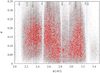 |
Fig. 1 Main-belt asteroid distributions in (a, e) space. Gray dots show objects from the Minor Planet Center database and red dots show the selected sample. Dotted black lines mark the twenty most populated two-body MMRs from Table 4: (1) 35S+4, (2) 23M-42, (3) 13M-24, (4) 3 3S-4, (5) 21M-40, (6) 14M+27, (7) 13J+4, (8) 24M-47, (9) 8S-1, (10) 16J+5, (11) 1M-2, (12) 7S-1, (13) 14J+5, (14) 14J+5, (15) 7M-16, (16) 27J-10, (17) 8J+3, (18) 13J-6, (19) 1M-3, and (20) 2J-1. Blue vertical lines indicate five most important Kirkwood gaps in this region. |
2 Methods
This research uses two sources for the initial asteroid data: (1) for the sample selection, we used the Minor Planet Center database1 because the database is updated very frequently (we took data from June 5th, 2025), (2) for the numerical integration, we used the initial data from the NASA Horizons service because it is utilized by the software used. We selected only the numbered main belt asteroids with eccentricity e < 0.35 to avoid unstable orbits as much as possible (and hence, being able to use faster integrators), with semimajor axes in the range (2.0, 3.5) AU and with observation arcs greater than 30 days (Figure 1).
In this way, the selected asteroids cover the whole interval of semimajor axes and adequately represent the main belt asteroids. The aim was to randomly select asteroids within each semimajor axis interval, with the number of selected objects depending on the local density: more asteroids were chosen in high-density regions, and fewer in low-density regions. As a result of this selection, our catalog contains only orbits of asteroids with inclinations less than ≈ 35° (Figure 2). In total, we had 8672 orbits of asteroids to identify which high-order mean motion resonances exist in the main belt and to determine what percentage of asteroids are actually located in them.
The orbits of the asteroids were integrated over a span of 100 000 yr using the package resonances (Smirnov 2023), which utilizes rebound (Rein & Liu 2012) for the integration, considering all perturbations from all planets, with initial epoch 2024-03-31. We used SABA(10,6,4) integrator.
The package resonances handled the first stages of the identification procedure: (1) finding and calculating all possible resonant angles, (2) identifying whether there is a libration of the resonant argument followed by a similar (in terms of frequency) libration of the semimajor axis, (3) producing images and data files. The total number of the resonant angle considered varied depending on the type of the resonance and the order q. Formally, we examined all possible combinations of two (two-body MMRs) or three (three-body MMRs) integers that are coprime, with the first integer always positive, and each integer and the resonant order were limited by 100 for two-body MMRs or 10 for three-body MMRs. Two or three integers were sufficient because only the primary sub-resonance was considered.
As an illustration of the actual values, for two-body MMRs, there is only one combination of the order q = 0 - Trojans (e.g., 1J-1 or 1M-1). For the order q = 1, there are 197 possible combinations, for q = 2, there are 198 possible combinations, and for q = 3, there are 393 possible combinations per planet. The number of combinations increases with order up to a certain point, but then decreases because of the threshold for the absolute value of each integer.
For three-body MMRs, the number of possible combinations is higher. For example, there are 70 possible options for q = 0, 193 options for q = 1, 153 options for q = 2, and 167 combinations for q = 3 per planet configuration (e.g., Jupiter and Saturn). Note that the overall number of possible combinations for three-body MMRs is even higher because there are more combinations of two planets than of single planets.
The possible outputs of the software for a given “asteroid— MMR” pair are: +2 - trapped in a resonance for the entire integration time, +1 - the resonant angle librates >20% of the time but there are some periods of circulation2, 0 - non-resonant, and −2 and −1 - the same as for +2 and +1, respectively, but the semimajor axis does not oscillate with the same frequency. For the full procedure and details, one can refer to the following papers: Smirnov & Shevchenko (2013) - the algorithm for the selection and identification of MMRs with Jupiter and Saturn, Smirnov et al. (2017) - the extended version for all planets, Smirnov (2023) - the description of the Python package and its inputs and outputs.
Besides the well-classified items, there were a few thousand controversial cases (status < 0), for which the package could not perform the exact classification. For example, there could be a libration of the resonant angle but no libration of the semimajor axis. Such cases were inspected manually by both authors.
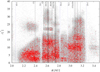 |
Fig. 2 Main-belt asteroid distributions in (a, i) space. Gray dots show objects from the Minor Planet Center database and red dots show the selected sample. Dotted black lines mark the twenty most populated three-body MMRs from Table 2: (1) 4J-2S-1, (2) 2M+2J-5, (3) 2M-7J-2, (4) 2J+2S-1, (5) 6J-1S-2, (6) 4J-3S-1, (7) 3M-5J-5, (8) 1M-9J+1, (9) 1M-9S-1, (10) 1J-9S-1, (11) 2M-10J-1, (12) 1J+4S-1, (13) 5J+7S-3, (14) 3J-1S-1, (15) 1J+3S-1, (16) 3J-2S-1, (17) 5J-7S-1, (18) 1M-2J-2, (19) 1M-5S-2, and (20) 5J-2S-2. Blue vertical lines indicate five most important Kirkwood gaps in this region. |
3 Results
The selected sample of main belt asteroids was analyzed. For each object, we inspected all possible MMRs based on the closeness of the semimajor axis value and determined the dynamical state in two steps: (1) automatically, using the resonances package, and (2) manually. Manual (visual) inspection was performed for all controversial cases (negative statuses; in total, 5518 items)3 and selectively (a random selection of 200 asteroids with positive statuses) for other cases. Both authors independently assessed the generated images and rated each controversial case. Whenever the authors were unable to reach an agreement, the status was kept negative: 78 “asteroid-MMR” pairs still have negative status.
The results are summarized in Table 1. In total, we found 4672 asteroids in the “resonant+controversial” state (status ≠ 0), corresponding to 53.87% of the studied sample. The number of the resonant asteroids (status ∈ {1,2}) is 4662 (53.76%), of which 103 objects (1.19%) are in pure libration (status = 2). Splitting by the resonance type, the two-body subset contains 3478 asteroids in the “reso-nant+controversial” category (40.11%), with 3475 resonant (40.07%) and 19 pure (0.22%). The three-body subset contains 2081 in the “resonant+controversial” category (24.00%), 2057 resonant (23.72%), and 84 pure (0.97%). Note that one asteroid can be trapped in several resonances, including both two-body and three-body types. Therefore, the total number of asteroids counted across two-body and three-body MMRs exceeds the overall number of resonant asteroids.
Figure 3 presents the distribution of resonant asteroids over the order q for two-body MMRs, while Figure 4 shows the analogous distribution for three-body MMRs. In both figures, the horizontal axis is the resonant order q, and the vertical axis is the number of resonant asteroids (statuses ∈ {1,2}).
The most populated individual three-body resonance is 5J-2S-2, which hosts 53 resonant asteroids, including 11 in pure libration. Other three-body resonances include 3J-2S-1 with 26 resonant and three pure objects, and 4J-2S-1 with 22 resonant and a comparatively high 14 pure. Within the two-body family, 1M-2 stands out with 39 resonant asteroids (of which two are pure), whereas 2J-1 shows a smaller total of 15 but a large fraction of pure cases (11).
Table 2 lists the 20 most populated three-body resonances by the number of resonant asteroids, together with the count in pure libration (these resonances are marked with dotted black lines, while five of the most important Kirkwood gaps in this region are marked with blue ones in Figure 2). Table 4 provides the analogous ranking for two-body resonances (these resonances are marked in Figure 1). Table 3 ranks the three-body MMRs by the number of pure librators, and Table 5 does the same for the two-body case.
Results of the identification procedure.
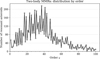 |
Fig. 3 Distribution of resonant asteroids over resonance order q for two-body MMRs. The horizontal axis shows the resonance order q, and the vertical axis indicates the number of resonant asteroids. The drops for odd orders are explained by the smaller number of possible integer combinations in the resonant argument: they must be coprime, and for odd values only even integers are possible; otherwise, the greatest common divisor exceeds two. |
Top 20 three-body MMRs ranked by the number of resonant asteroids.
4 Discussion
Let us first assess how our findings compare with previous results. We begin with the three-body resonances. Table 2 lists the most populated three-body MMRs. These results are in good agreement with both the pilot studies by Nesvorný & Morbidelli (1998) and Smirnov & Shevchenko (2013) (Jupiter and Saturn only) and the extended analysis by Smirnov et al. (2017) (involving all planets) devoted to the massive identification of three-body MMRs. In particular, the 5J-2S-2 resonance is one of the most populated in those works and remains so here, confirming their conclusions. The first six resonances in Table 4 were also recognized previously and appear in the corresponding ranked lists (Smirnov & Shevchenko 2013; Smirnov et al. 2017). Overall, our three-body statistics are consistent with earlier studies (Nesvorný & Morbidelli 1998; Smirnov & Shevchenko 2013; Smirnov et al. 2017).
At the same time, there are noteworthy extensions. The seventh entry in Table 2, the three-body resonance 2M-10J-1, is of the resonant order q = 9 that had not been investigated before, because previous surveys limited the resonance order for three-body terms to lower values (Smirnov & Shevchenko 2013; Smirnov et al. 2017). More broadly, Table 2 shows that resonances of order greater than six are common in the main belt, reinforcing the point already suggested by Nesvorný & Morbidelli (1998) and Smirnov & Shevchenko (2013) that the number of asteroids residing in higher-order three-body resonances can be substantial and need not monotonically decline with order.
Turning to two-body resonances, the picture is even more interesting. Table 4 lists the most populated two-body MMRs. Here the leading entry is the Martian resonance 1M-24, in line with Smirnov (2017); Smirnov & Dovgalev (2018), where this same resonance was found to be the most populated (when Trojan populations are excluded). However, in that work the next most common resonances were 3J-2 and then 8J-3; intrigu-ingly, neither appears in Table 4. Instead, the very top of our list is dominated by relatively high-order resonances. For example, 27J-10 (order q = 17) ranks second, while the top twenty include 14M+27 (q = 41) and 35S+4 (q = 39), each hosting sizable populations. Earlier two-body surveys typically considered orders ≤10 (Smirnov & Shevchenko 2013; Smirnov & Dovgalev 2018); if we restrict Table 4 to q ≤ 10, our rankings remain broadly consistent with those studies (Smirnov & Shevchenko 2013; Smirnov & Dovgalev 2018).
In aggregate, approximately 54% of the studied asteroids are resonant. This fraction is several times higher than prior estimates, primarily because, for the first time, our statistics include high-order resonances in a systematic way. High-order terms are the main drivers of the increased resonant fraction. Our result also aligns with recent findings in the trans-Neptunian region, where Smirnov (2025b) reported that ~49.1-65.3% of objects are resonant, through he limited the resonant order of the two-body MMRs by q ≤ 20 with the integer coefficients in the resonant argument |mi| ≤ 50; our main-belt fraction with q ≤ 100, |mi| ≤ 100 falls within this range, suggesting that meanmotion resonances - both two-body and three-body - are far more prevalent than previously appreciated. At least half of the population appears to be resonant, while a substantial part of the remainder may occupy even higher-order resonances or transiently experience resonance sticking (Lykawka & Mukai 2007; Bailey & Malhotra 2009).
Regarding resonant sticking, our analysis shows that a substantial fraction of asteroids are either simultaneously trapped in multiple MMRs or migrate from one resonance to another: 2217 objects (25.57%). In most cases, at least one of the involved resonances is of high order, which likely explains why this behavior was not recognized in earlier surveys. We also find numerous examples of asteroids occupying both two-body and three-body mean-motion resonances.
Our counts show roughly twice as many asteroids in two-body resonances as in three-body ones. This raw ratio should be interpreted with care: in the two-body case we surveyed orders up to q = 100, whereas the three-body census was limited to q ≤ 10. Expanding the three-body order range would likely reduce the gap and could yield comparable totals.
Although high-order resonant terms do not control the longterm dynamical evolution of asteroids in the main belt, they can still modulate local dynamics, as confirmed here by the correlated oscillations of the resonant angle and semimajor axis. Their role is localized, most visibly near separatrices and during temporary resonance sticking, where even exponentially small contributions can produce thin stochastic layers and short, aperiodic changes in semimajor axis. This explains why high-order resonances, while not dynamically dominant, are nevertheless statistically important and observable in our sample.
Finally, Figures 3 and 4 display the number of resonant asteroids versus resonance order, for two-body (0 ≤ q ≤ 100) and three-body (0 ≤ q ≤ 10) MMRs, respectively. For two-body MMRs we find a maximum around q ≈ 35-40, indicating that relatively high-order resonances are the most frequently occupied in the main belt. Beyond q ~ 40 the distribution declines but remains nonzero, implying a long tail: even very high orders can host resonant occupants, at least transiently. For three-body MMRs, the sample is necessarily sparser because of the q ≤ 10 cutoff, yet the counts at q = 7-10 remain appreciable - new information not available to earlier surveys that stopped at lower orders (Smirnov & Shevchenko 2013; Smirnov et al. 2017).
Top 20 two-body MMRs ranked by the number of resonant asteroids.
5 Conclusion
The results presented above demonstrate that the percentage of resonant asteroids is much higher than originally anticipated due to higher-order resonances. For the two-body MMRs, the fraction of resonant asteroids is 40.07% (even without Trojans) versus 2.0-5.0% obtained in earlier studies. The maximum in the distribution of the number of asteroids by resonant order is near q = 36, which was not previously anticipated also. For the three-body MMRs, though limited to resonant order q = 10 because of the necessity for manual inspection, we can confirm that there may be many asteroids temporarily trapped in highorder three-body MMRs because the number of asteroids trapped in high-order (8 ≤ q ≤ 10) three-body MMRs is still significant and does not drop. Also, a quarter of asteroids (25.57%) are trapped in several MMRs, either at the same time or through the phenomenon of resonance sticking, moving from one resonance to another, suggesting that this is a typical behavior.
The current research has a few limitations. First, we have studied a sample of asteroids from the main belt, not all of them. Although the sample is large enough and the overall results align with previous results, a full study is necessary to confirm the exact numbers. Second, the order of three-body MMRs was limited to ten. This limitation was introduced because of the high number of controversial cases that had to be analyzed visually. In this manuscript, even with these limitations, we inspected more than 5000 graphs. To increase this threshold, other methods of identification are required. There are several promising opportunities - using vision transformers (Carruba et al. 2025) or large language models (Smirnov 2024). However, both approaches are still in development and there are several outstanding issues (e.g., the cost of such a study in the case of large language models). Thus, this could be a task for future research.
Finally, we emphasize that this study has been limited to mean-motion resonances. We did not explicitly study other types of resonances (e.g., Kozai) within MMRs or the resonant multiplet. Nevertheless, some cases in our dataset show large coupled oscillations in eccentricity and inclination that may indicate Kozai-type dynamics inside MMRs, and some instances of multiple simultaneous resonances could be related to the underlying multiplet structure. A systematic exploration of different types of resonances therefore represents an important direction for future research.
Data availability
All data and code used in this study are publicly available. The resonances package source code is available at https://github.com/smirik/resonances. The validation datasets and example scripts are included in the package repository.
Acknowledgements
The authors explicitly state that they used ChatGPT (versions 5 and 5-pro), Claude 4.1 Opus, and Claude 4.0 Sonnet to check, correct, and paraphrase some paragraphs and verify the results and the code developed. After using these tools, the authors reviewed and edited the content as needed and hence, take full responsibility for the content of the published article. This research has made use of data and/or services provided by the International Astronomical Union’s Minor Planet Center. Our research was supported (for Ivana Milić Žitnik) by the Ministry of Science, Technological Development and Innovation of the Republic of Serbia through contract no. 451-03-136/202503/200002 made with Astronomical Observatory in Belgrade. We want to thank the anonymous reviewer for valuable comments that helped to improve the paper.
References
- Bailey, B. L., & Malhotra, R. 2009, Icarus, 203, 155 [Google Scholar]
- Bottke, W. F., Morbidelli, A., Jedicke, R., et al. 2002, Icarus, 156, 399 [NASA ADS] [CrossRef] [Google Scholar]
- Carruba, V., Michtchenko, T. A., Roig, F., Ferraz-Mello, S., & Nesvorný, D. 2005, A&A, 441, 819 [NASA ADS] [CrossRef] [EDP Sciences] [Google Scholar]
- Carruba, V., Aljbaae, S., Smirnov, E., & Carità, G. 2025, Icarus, 425, 116346 [Google Scholar]
- Chirikov, B. V. 1979, Phys. Rep., 52, 263 [NASA ADS] [CrossRef] [Google Scholar]
- Christou, A. A., Dermott, S. F., & Li, D. 2022, MNRAS, 516, 1428 [NASA ADS] [CrossRef] [Google Scholar]
- Duncan, M. J., & Levison, H. F. 1997, Science, 276, 1670 [Google Scholar]
- Gallardo, T. 2019, MNRAS, 487, 1709 [Google Scholar]
- Gallardo, T., Venturini, J., Roig, F., & Gil-Hutton, R. 2011, Icarus, 214, 632 [NASA ADS] [CrossRef] [Google Scholar]
- Gladman, B. J., Migliorini, F., Morbidelli, A., et al. 1997, Science, 277, 197 [NASA ADS] [CrossRef] [Google Scholar]
- Gladman, B., Holman, M., Grav, T., et al. 2002, Icarus, 157, 269 [Google Scholar]
- Kazantsev, A., & Kazantseva, L. 2021, MNRAS, 505, 408 [Google Scholar]
- Kovàcovà, M. 2024, A&A, 686, A107 [Google Scholar]
- Lykawka, P. S., & Mukai, T. 2007, Icarus, 192, 238 [NASA ADS] [CrossRef] [Google Scholar]
- Matsumoto, Y., Nagasawa, M., & Ida, S. 2012, Icarus, 221, 624 [Google Scholar]
- McEachern, F. M., Cuk, M., & Stewart, S. T. 2010, Icarus, 210, 644 [NASA ADS] [CrossRef] [Google Scholar]
- Milani, A., Nobili, A., & Knezevic, Z. 1997, Icarus, 125, 13 [Google Scholar]
- Minton, D. A., & Malhotra, R. 2010, Icarus, 207, 744 [NASA ADS] [CrossRef] [Google Scholar]
- Moons, M., & Morbidelli, A. 1995, Icarus, 114, 33 [NASA ADS] [CrossRef] [Google Scholar]
- Morbidelli, A., & Moons, M. 1995, Icarus, 115, 60 [Google Scholar]
- Morbidelli, A., & Nesvorny, D. 1999, Icarus, 139, 295 [NASA ADS] [CrossRef] [Google Scholar]
- Morbidelli, A., Thomas, F., & Moons, M. 1995, Icarus, 118, 322 [NASA ADS] [CrossRef] [Google Scholar]
- Murray, N., & Holman, M. 1997, AJ, 114, 1246 [NASA ADS] [CrossRef] [Google Scholar]
- Murray, C. D., & Dermott, S. F. 1999, Solar System Dynamics (Cambridge, UK: Cambridge University Press) [Google Scholar]
- Murray, N., Holman, M., & Potter, M. 1998, AJ, 116, 2583 [Google Scholar]
- Nesvorný, D., & Morbidelli, A. 1998, AJ, 116, 3029 [Google Scholar]
- Novaković, B., Tsiganis, K., & Knežević, Z. 2010, CeMDA, 107, 35 [Google Scholar]
- Novaković, B., Maurel, C., Tsirvoulis, G., & Knežević, Z. 2015, ApJ, 807, L5 [CrossRef] [Google Scholar]
- Petrovich, C., Malhotra, R., & Tremaine, S. 2013, AJ, 770, 24 [Google Scholar]
- Rein, H., & Liu, S.-F. 2012, A&A, 537, A128 [NASA ADS] [CrossRef] [EDP Sciences] [Google Scholar]
- Rosaev, A. 2024, CeMDA, 136, 41 [Google Scholar]
- Smirnov, E. 2017, Sol. Syst. Res., 51 [Google Scholar]
- Smirnov, E. 2023, Astr. Comp., 43, 100707 [Google Scholar]
- Smirnov, E. A. 2024, AJ, 996, 220 [Google Scholar]
- Smirnov, E. 2025a, A&A, 699, A26 [NASA ADS] [CrossRef] [EDP Sciences] [Google Scholar]
- Smirnov, E. 2025b, Icarus, 436, 116584 [Google Scholar]
- Smirnov, E. A., & Dovgalev, I. S. 2018, Sol. Syst. Res., 52, 347 [Google Scholar]
- Smirnov, E. A., & Shevchenko, I.I. 2013, Icarus, 222, 220 [Google Scholar]
- Smirnov, E., Dovgalev, I., & Popova, E. 2017, Icarus, 304 [Google Scholar]
- Tsiganis, K. 2010, Eur. Phys. Jour. Spec. Top., 186, 67 [Google Scholar]
- Volk, K., & Van Laerhoven, C. 2024, RNAAS, 8, 36 [NASA ADS] [Google Scholar]
All Tables
All Figures
|
Fig. 1 Main-belt asteroid distributions in (a, e) space. Gray dots show objects from the Minor Planet Center database and red dots show the selected sample. Dotted black lines mark the twenty most populated two-body MMRs from Table 4: (1) 35S+4, (2) 23M-42, (3) 13M-24, (4) 3 3S-4, (5) 21M-40, (6) 14M+27, (7) 13J+4, (8) 24M-47, (9) 8S-1, (10) 16J+5, (11) 1M-2, (12) 7S-1, (13) 14J+5, (14) 14J+5, (15) 7M-16, (16) 27J-10, (17) 8J+3, (18) 13J-6, (19) 1M-3, and (20) 2J-1. Blue vertical lines indicate five most important Kirkwood gaps in this region. |
| In the text | |
|
Fig. 2 Main-belt asteroid distributions in (a, i) space. Gray dots show objects from the Minor Planet Center database and red dots show the selected sample. Dotted black lines mark the twenty most populated three-body MMRs from Table 2: (1) 4J-2S-1, (2) 2M+2J-5, (3) 2M-7J-2, (4) 2J+2S-1, (5) 6J-1S-2, (6) 4J-3S-1, (7) 3M-5J-5, (8) 1M-9J+1, (9) 1M-9S-1, (10) 1J-9S-1, (11) 2M-10J-1, (12) 1J+4S-1, (13) 5J+7S-3, (14) 3J-1S-1, (15) 1J+3S-1, (16) 3J-2S-1, (17) 5J-7S-1, (18) 1M-2J-2, (19) 1M-5S-2, and (20) 5J-2S-2. Blue vertical lines indicate five most important Kirkwood gaps in this region. |
| In the text | |
|
Fig. 3 Distribution of resonant asteroids over resonance order q for two-body MMRs. The horizontal axis shows the resonance order q, and the vertical axis indicates the number of resonant asteroids. The drops for odd orders are explained by the smaller number of possible integer combinations in the resonant argument: they must be coprime, and for odd values only even integers are possible; otherwise, the greatest common divisor exceeds two. |
| In the text | |
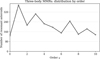 |
Fig. 4 Same as Figure 3, but for three-body mean-motion resonances. |
| In the text | |
Current usage metrics show cumulative count of Article Views (full-text article views including HTML views, PDF and ePub downloads, according to the available data) and Abstracts Views on Vision4Press platform.
Data correspond to usage on the plateform after 2015. The current usage metrics is available 48-96 hours after online publication and is updated daily on week days.
Initial download of the metrics may take a while.