


| Issue |
A&A
Volume 704, December 2025
|
|
|---|---|---|
| Article Number | A114 | |
| Number of page(s) | 5 | |
| Section | Galactic structure, stellar clusters and populations | |
| DOI | https://doi.org/10.1051/0004-6361/202556737 | |
| Published online | 09 December 2025 | |
The chemical DNA of the Magellanic Clouds
III. The first extragalactic Mg–K anticorrelation: The LMC globular cluster NGC 1786
1
Osservatorio Astrofisico di Arcetri,
Largo E. Fermi 5,
50125
Firenze,
Italy
2
Dipartimento di Fisica e Astronomia, Università degli Studi di Bologna,
Via Gobetti 93/2,
40129
Bologna,
Italy
3
INAF, Osservatorio di Astrofisica e Scienza dello Spazio di Bologna,
Via Gobetti 93/3,
40129
Bologna,
Italy
4
Universidad Andres Bello, Facultad de Ciencias Exactas, Departamento de Física y Astronomía – Instituto de Astrofísica,
Autopista Concepción-Talcahuano
7100,
Talcahuano,
Chile
5
INAF-OATs,
Via G.B. Tiepolo 11,
34143
Trieste,
Italy
★ Corresponding author: This email address is being protected from spambots. You need JavaScript enabled to view it.
Received:
4
August
2025
Accepted:
2
October
2025
Abstract
In this work we derived [K/Fe] and [Mg/Fe] abundance ratios for six stars of the old globular cluster NGC 1786 in the Large Magellanic Cloud. We employed high-resolution spectra acquired with the MIKE spectrograph mounted at the Magellan/Clay telescope. We find a clear Mg–K anticorrelation among the analyzed stars. In particular, the Mg-poor stars ([Mg/Fe] < 0.0 dex) are enriched by ~0.25 dex in [K/Fe] compared to the Mg-rich stars ([Mg/Fe] > 0.0 dex). This finding makes NGC 1786 the first globular cluster residing in an external galaxy in which such an extreme chemical anomaly has been detected. The observed trend is in line with those observed in Galactic globular clusters hosting Mg-poor stars, such as NGC 2808 and ω Centauri, suggesting that such a chemical anomaly is an ubiquitous feature of old, massive, and metal-poor stellar systems and does not depend on the properties of the parent galaxy in which the cluster formed. Na–O and Mg–Al anticorrelations were also detected among the stars of NGC 1786. The newly discovered Mg–K anticorrelation reinforces the idea that stars capable of activating the complete MgAl cycle are responsible for the observed chemical anomalies in these clusters. In this context, asymptotic giant branch stars seem to be a valuable model since they are able to produce K while becoming depleted in Mg. However, the precise and complete physics of this model remains a subject of debate.
Key words: stars: abundances / stars: general / stars: low-mass / Magellanic Clouds
© The Authors 2025
 Open Access article, published by EDP Sciences, under the terms of the Creative Commons Attribution License (https://creativecommons.org/licenses/by/4.0), which permits unrestricted use, distribution, and reproduction in any medium, provided the original work is properly cited.
This article is published in open access under the Subscribe to Open model. This email address is being protected from spambots. You need JavaScript enabled to view it. to support open access publication.
1 Introduction
In the last decade, potassium (K) has earned an important place in the restricted group of key chemical elements used to characterize the chemical evolution of globular clusters (GCs). The first evidence of an intrinsic K spread was discovered in the massive and metal-poor GC NGC 2419, where Mucciarelli et al. (2012) and Cohen & Kirby (2012) independently identified a clear-cut Mg–K anticorrelation. In this cluster, a subset of stars exhibits extremely low levels of magnesium (Mg) ([Mg/Fe] down to ∼ −1 dex) coupled with extremely high levels of K ([K/Fe] up to ∼ +2 dex). This feature, which is exceptionally pronounced in NGC 2419, was identified in only a handful of other GCs in the Milky Way, namely NGC 2808 (Mucciarelli et al. 2015), NGC 4833 (Carretta 2021), M 54 (Carretta 2022), and ω Centauri (Alvarez Garay et al. 2022). All these systems are among the most massive and/or metal-poor in the Galaxy, and some of them are distinguished by the presence of a subpopulation of Mg-poor stars ([Mg/Fe] < 0.0 dex). Other GCs (i.e., NGC 104, NGC 6752, and NGC 6809: Mucciarelli et al. 2017) without a Mg-poor subpopulation show small or null [K/Fe] spreads, suggesting that the high K is found only in Mg-poor stars. The presence of such a chemical signature is interpreted as the result of an extreme self-enrichment process.
The chemical inhomogeneities observed in GCs, involving (anti)correlations among light elements such as C, N, O, Na, Mg, Al, Si, and K, are widely interpreted as the signature of this self-enrichment history, where multiple populations of stars were born within the clusters (Bastian & Lardo 2018; Gratton et al. 2019; Milone & Marino 2022). The majority of theoretical models devoted to describing the formation and evolution of GCs posit that GCs experienced multiple episodes of star formation within the first 100–200 Myr of their life. In this scenario, a second population (2P) of stars was formed from gas enriched by a first population (1P) of massive stars. These 1P stars, born with a field-like chemical composition, processed material through the hot CNO cycle and its secondary NeNa and MgAl chains (e.g., Langer et al. 1993; Prantzos et al. 2007). This chemically altered material was then ejected at a low velocity into the intracluster medium, from which the 2P stars were born.
Different polluters have been proposed in the literature to explain the presence of different populations of stars in GCs (see, e.g., Renzini et al. 2015; Bastian & Lardo 2018; Milone & Marino 2022, for a full discussion). However, these self-enrichment models fail to reproduce all the chemical patterns observed so far. In particular, the Mg–K anticorrelation is important evidence for theoretical models, since the presence of such chemical feature points to very high-temperature hydrogen burning reactions (T > 108 K), where proton captures on argon (Ar) nuclei can synthesize K (Ventura et al. 2012; Iliadis et al. 2016; Prantzos et al. 2017). The analysis of Mg and K, therefore, places substantial constraints on the nature of the polluters responsible for the chemistry seen in GCs.
Key chemical signatures of self-enrichment, such as the Na–O and Mg–Al anticorrelations, have been confirmed in extragalactic GCs (Mucciarelli et al. 2009), suggesting they are a ubiquitous feature of old, massive stellar systems regardless of the parent galaxy. The Mg–K anticorrelation, however, has only been observed in a few massive, Milky Way clusters to date. This raises a fundamental question as to whether the manifestation of this extreme chemical feature is influenced by the formation environment of the host galaxy, or whether it depends solely on intrinsic GC properties, primarily mass and metallicity. The GC NGC 1786 represents an ideal benchmark through which to explore this question. This cluster belongs to the Large Magellanic Cloud (LMC), it is old, coeval to the Milky Way clusters (Brocato et al. 1996), metal-poor ([Fe/H]= –1.72 dex; Mucciarelli et al. 2021), and massive (5 × 10⁵ M⊙; Mackey & Gilmore 2003), and it harbors some rare Mg-poor stars (Mucciarelli et al. 2009). It provides a unique opportunity to check the existence of a Mg–K anticorrelation in a genuine extragalactic GC where Mg-poor stars exist.
This paper is organized as follows: In Sect. 2 we present the dataset; in Sect. 3 we describe the method we adopted to derive chemical abundances, and in Sect. 4 we present the results of our chemical analysis. Finally, in Sect. 5 we discuss and summarize our findings.
Sample stars of NGC 1786.
2 Observations
The sample stars used in this analysis were originally observed by Mucciarelli et al. (2009), who identified Na–O and Mg–Al anticorrelations in NGC 1786. The same stars were reanalyzed by Mucciarelli et al. (2021). In this work, we analyzed six out of the seven stars present in the original sample1. All these targets are located in the bright portion of the red giant branch. The stars were observed with the high-resolution MIKE spectrograph (Bernstein et al. 2003) at the Magellan/Clay telescope over two runs in November 2023 and October 2024 (Program IDs CN2023B-37 and CN2024B-53; PI: L. Monaco). The total integration time on each source ranged from 1800 s up to 4500 s, depending on the target magnitude. We adopted the 0.7′′ × 5′′ slit and 2 × 2 binning, resulting in a resolving power of 28×000 in the red arm (4900–9500 Å). The data were reduced with the CarPy MIKE pipeline (Kelson 2003). While Fe and Mg abundances for these stars were already present in the literature, these spectra allowed us to derive for the first time K abundances from the K I resonance line at 7699 Å. We checked for each target that the K line was not contaminated by telluric lines. Due to the high radial velocity of NGC 1786 (264.3 km s−1, σ = 5.7 km s−1; Mucciarelli et al. 2009), no telluric contamination is present in the K line of the analyzed stars. The final signal-to-noise ratio per pixel is ∼35 around 5700 Å and ∼65 around 7700 Å.
3 Chemical analysis
We employed for the target stars the atmospheric parameters (Teff, log g, and ξ) and their associated errors as derived by Mucciarelli et al. (2021). In particular, Teff values were obtained spectroscopically, by erasing any trend between the abundances and the excitation potential of the Fe I lines, and then corrected to bring them onto a photometric-based temperature scale – using Eq. (2) of Mucciarelli & Bonifacio (2020) – in order to remove biases affecting spectroscopic Teff in metal-poor giant stars (Frebel et al. 2013; Mucciarelli & Bonifacio 2020). All the relevant information about the observed targets (IDs, Gaia DR3 IDs, coordinates, and the adopted atmospheric parameters) is reported in Table 1.
Chemical abundances were determined via spectral synthesis. We employed for this purpose our in-house code SALVADOR (Alvarez Garay et al., in prep.), which performs a χ2 minimization between the observed line and a grid of suitable synthetic spectra calculated on the fly using the code SYNTHE (Kurucz 2005), in which only the abundance of the element under analysis is varied. In the calculation of the synthetic spectra we included all the atomic and molecular transitions available in the Kurucz-Castelli database2, and we adopted ATLAS9 model atmospheres. We calculated the total uncertainty associated with the abundances ([Mg/Fe] and [K/Fe]) following the procedure described in Mucciarelli et al. (2021), which takes into account both internal errors and errors arising from the adopted atmospheric parameters.
The Fe abundances for the target stars were adopted from the comprehensive analysis by Mucciarelli et al. (2021). However, as a sanity check, we performed an independent analysis by measuring Fe abundances from our spectra using a suitable line list of unblended and unsaturated lines at the MIKE resolution. The results of this check were fully consistent with the values reported by Mucciarelli et al. (2021); therefore, we decided to keep the Fe abundances that they derived. Mg abundances were already present in the literature, as obtained by Mucciarelli et al. (2009). However, in this case we decided to derive Mg again since the atmospheric parameters reported by Mucciarelli et al. (2009) were slightly different from those presented in Mucciarelli et al. (2021)3. We made use of the Mg lines at 5528, 5711, and 8806 Å. Corrections for the departure from local thermal equilibrium (LTE) were from the grids of corrections from Bergemann et al. (2017). We corrected the K abundances derived from the line at 7699 Å for the non-LTE effects by interpolating them into the grids of Reggiani et al. (2019). Finally, we adopted as reference solar abundances those computed by Lodders (2010) for Mg and by Caffau et al. (2011) for K. Table 2 lists the abundance ratios and the corresponding total uncertainties for all the stars observed in NGC 1786.
Derived elemental abundances for the NGC 1786 stars.
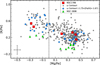 |
Fig. 1 Run of [K/Fe] as a function of [Mg/Fe] for the six stars of NGC 1786 here analyzed (red squares). As a comparison, the same trend is plotted for the stars belonging to ω Centauri (gray and blue circles; Alvarez Garay et al. 2022) and to NGC 2808 (green triangles; Mucciarelli et al. 2015). The blue circles represent the stars of ω Cen-tauri in the same metallicity range as NGC 1786. The vertical dashed line splits the Mg-poor and Mg-rich stars. The error bar in the bottom-left corner represents the typical error associated with the abundance ratios. |
4 Results
Figure 1 shows the distribution of the [K/Fe] abundance ratios as a function of [Mg/Fe] for the six stars of NGC 1786 analyzed in this study. A clear Mg–K anticorrelation is apparent despite the small size of the dataset. The four Mg-rich stars of NGC 1786 are characterized by ⟨[Mg/Fe]⟩ = +0.36 (σ = 0.09) dex and ⟨[K/Fe]⟩ = +0.26 (σ = 0.06) dex, whereas the two Mg-poor stars have ⟨[Mg/Fe]⟩ = −0.26 (σ = 0.02) dex and ⟨[K/Fe]⟩ = +0.50 (σ = 0.04) dex. Following the widely accepted nomenclature for GC stars, the four Mg-rich, K-normal stars belong to the 1P, while the two Mg-poor, K-rich stars belong to the 2P. The average [K/Fe] values of the two groups of stars are clearly not compatible with each other within the uncertainties. A Welch test of the two mean values provides a p-value of 0.02, ruling out the null hypothesis that the two values are compatible with each other.
We checked the statistical significance of the observed Mg–K anticorrelation. The Spearman correlation test provides a probability of 0.5% (with a ρ coefficient of –0.94) that the two abundance ratios are non-correlated.
Further evidence supporting our finding of a Mg–K anticor-relation in NGC 1786 is presented in Fig. 2. We display portions of the MIKE spectra around the Mg line at 5711 Å and the K line at 7699 Å for two stars of NGC 1786, superimposed with the best-fit synthetic spectra derived from the analysis. The figure clearly shows a difference in the lines’ depths, implying intrinsic differences in the derived Mg and K abundances, given that the stars have the same metallicity and similar atmospheric parameters.
While the amplitude of the anticorrelation in NGC 1786 is relatively weak (with a variation of ∼0.3 dex in [K/Fe] compared to an observed variation of ∼0.7 dex in [Mg/Fe]), the observed trend is analogous to those found in NGC 2808 and ω Centauri, two of the few GC-like systems hosting Mg-poor subpopulations (see Fig. 1). NGC 2808 is a genuine GC, one of the most massive (7.9 × 10⁵ M⊙; Baumgardt & Hilker 2018), and has a higher metallicity than NGC 1786 ([Fe/H]= –1.13 dex; Carretta 2015). It shows a Mg–K anticorrelation qualitatively similar to that of NGC 1786 but offset by 0.15 dex lower in [K/Fe] (Mucciarelli et al. 2015). This offset is likely attributable to the different non-LTE corrections adopted in the two studies or to the different metallicity regimes of the two clusters. Indeed, NGC 2808 is more metal-rich than NGC 1786, and the efficiency of the K enrichment scales with the metallicity, the MgAl cycle being more and more efficient toward the metal-poor regime. It is worth noting the comparison with ω Centauri, a complex stellar system that, in addition to showing a metal-licity spread typical of galaxies (Johnson & Pilachowski 2010; Mészáros et al. 2020), displays all the characteristic features of the self-enrichment processes seen in GCs (Norris & Da Costa 1995; Marino et al. 2011; Mészáros et al. 2020), including the Mg–K anticorrelation (Alvarez Garay et al. 2022). This GC-like system also exhibits a Mg–K anticorrelation that overlaps with that of NGC 1786, especially when only considering stars of similar metallicity. In fact, when we consider the sub-sample of 42 stars of ω Centauri in the same metallicity range as NGC 1786 (−1.75 < [Fe/H] < −1.67 dex), the stellar group with [Mg/Fe]>0.0 dex has ⟨[K/Fe]⟩ = +0.21 (σ = 0.13) dex, while the Mg-poor stars have ⟨[K/Fe]⟩ = +0.56 (σ = 0.15) dex. NGC 2419 is a different case, displaying a Mg–K anticorrelation that is completely off the scale defined by ω Centauri, NGC 2808, and NGC 1786. Finally, differences emerge when comparing NGC 1786 to NGC 4833 and M 54. In both of these GCs, the Mg–K anticorrelation is less extended than in NGC 1786 due to the lack of a subpopulation of Mg-poor stars (Carretta 2021, 2022).
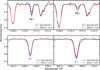 |
Fig. 2 Comparison between the spectra of NGC1786-978 (left panels) and NGC1786-2310 (right panels) around the Mg line at 5711 Å (upper panels) and the K line at 7699 Å (lower panels). The solid black lines represent the observed spectra, the solid red lines the best-fit synthetic spectra, and the dash-dotted blue lines the synthetic spectra with the abundances varied by ±0.2 dex with respect to the best values. In the bottom-right corners are the names of the stars and the corresponding [Mg/Fe] and [K/Fe] abundance ratios. |
5 Discussion and conclusions
This work presents the first clear evidence of the rare Mg–K anticorrelation in a GC residing in an external galaxy. This finding strongly suggests that the formation of this extreme chemical signature is independent of the host galaxy environment. The Mg–K anticorrelation appears instead to be a ubiquitous feature of any old, massive, and metal-poor GC that contains a subpopulation of Mg-poor stars. In fact, in NGC 1786, the [K/Fe] values of Mg-poor stars are higher by ∼ + 0.25 dex with respect to the Mg-rich stars, in perfect agreement with the findings in NGC 2808 and ω Centauri, both of which reside in the Milky Way. Once again, NGC 2419 proves to be a unique case among this limited group, with an extension of the Mg–K anticorrelation (Mucciarelli et al. 2012; Cohen & Kirby 2012) that is completely off the scale of other systems where it has been identified. In the asymptotic giant branch (AGB) scenario, the most common explanation for this peculiar system is that the 2P stars formed directly from the winds of the most massive AGB stars (M > 6 M⊙; Ventura et al. 2012, 2018), with a small or negligible dilution with pristine gas4. The model of a 2P formed from gas with a negligible dilution seems to be further supported by the fact that Di Criscienzo et al. (2015) showed that the horizontal branch of NGC 2419 can be explained only by the presence of a He-rich population, with Y > 0.35. Dilution with pristine gas, if any, must have been negligible in this case; otherwise, the helium content of these 2P stars would be lower, as a consequence of mixing of He-rich matter from the AGB winds.
The discovery of the Mg–K anticorrelation in NGC 1786 provides a crucial new piece of evidence that will help us understand the most extreme chemical enrichment processes in GCs. The detection of the Mg–K anticorrelation in an LMC cluster strongly suggests that this extreme chemical signature is a universal feature of a specific class of GC, independent of the host galaxy environment. This conclusion echoes previous findings for the Na–O and Mg–Al anticorrelations, which were also confirmed in other LMC GCs (Mucciarelli et al. 2009) and interpreted as evidence that the self-enrichment process is governed by the cluster’s intrinsic properties, primarily mass and metallicity, rather than its galactic environment.
However, explaining the mechanism that produces the Mg–K anticorrelation (coupled with all the other spectroscopic and photometric evidence of self-enrichment in GCs) remains a significant challenge for all the proposed models for multiple populations in GCs. In fact, K is produced through the reaction 36Ar(p,γ)37K(β+)37Ar(p,γ)38K(β+)38Ar(p,γ)39K. This reaction requires very high temperatures (T > 108 K) to activate proton-capture reactions on Ar nuclei while simultaneously depleting Mg (Ventura et al. 2012; Iliadis et al. 2016; Prantzos et al. 2017). Based on current theoretical models, the polluter scenario involving AGB and super-AGB stars appears to provide the most plausible framework for interpreting our results in NGC 1786, even though the model requires some degree of fine-tuning regarding the dilution of the ejected material with pristine gas present in the intracluster medium. This scenario is, at present, the only one that predicts both the strong Mg depletion and the production of K within the same stellar environment during the hot bottom burning phase (Ventura et al. 2012, 2018). In contrast, alternative models face significant difficulties in trying to explain the observed overabundance of K. Among the polluter candidates there are fast-rotating massive stars (Krause et al. 2013), interacting binaries (de Mink et al. 2009), and super-massive stars (M ∼1000M⊙; Denissenkov & Hartwick 2014). With different degrees of fine-tuning and adjustments of reaction rates, these models are able to activate the CNO cycle and the secondary chains in their interiors and reproduce some of the observed anticorrelations (Na–O and Mg–Al), but they fail to explain the Mg–K anticorrelation (see, e.g., Renzini et al. 2015, for a discussion). Novae (Maccarone & Zurek 2012; Denissenkov et al. 2014) have also been proposed as possible polluters able to produce K, although they too face significant challenges in reproducing the full chemical pattern observed so far. In the model of novae, elements such as Na, Al, Si, and S are systematically produced in amounts much larger than those observed in GCs. However, the study of nova nucleosynthesis products is not straightforward since the nova outburst is a multiparameter phenomenon that depends on the mass, temperature, and composition of the exploding dwarf, but also on the accretion rate and composition of the material of the companion star and many other parameters (see José 2017, for a discussion). A thorough investigation, therefore, of the large parameter space of novae is needed to better understand this model.
Even though the AGB and super-AGB stars are able to reproduce the observed Mg–K anticorrelation in those clusters where this feature is present, the model has flaws, especially regarding the precise physics and timing of the dilution process. Interestingly, however, in the model for the old and metal-poor Galactic GC NGC 2419 by Ventura et al. (2012), the oxygen abundance must be depleted by a huge factor in the Mg-poor stars. In NGC 1786, the two Mg-poor stars (NGC1786-2310 and NGC1786-2418) are classified as super-O-poor objects (Mucciarelli et al. 2009), reinforcing the notion that the AGB and super-AGB model best explains the multiple populations in this cluster.
In conclusion, NGC 1786 is an extragalactic GC in which all the chemical anticorrelations linked to the CNO cycle and the secondary chains NeNa and MgAl are clearly visible. Indeed, this system shows evident Na–O, Mg–Al (Mucciarelli et al. 2009), and Mg–K anticorrelations. These results suggest that this cluster experienced the complete self-enrichment process observed in other Galactic GCs, including NGC 2419, NGC 2808, and ω Centauri. The similarities of NGC 1786 with these Galactic GCs suggest that there is a global mass and/or metallicity threshold effect that allows only the most massive and/or metal-poor GCs to experience the complete phenomenon of multiple populations, independent of the environment in which these systems were born.
The link to cluster mass and metallicity is substantiated by comparing the GCs where Mg and K are known to be anticorrelated with those where it is not. In fact, clusters exhibiting this feature (or alternatively a spread in [K/Fe]), such as NGC 2419, NGC 2808, ω Centauri, M 54, and NGC 4833, are among the most massive systems known (Harris 2010; Baumgardt & Hilker 2018) and, with the exception of NGC 2808, are metal-poor. Conversely, extensive searches in less massive clusters like NGC 6752 and NGC 6809, or in the massive but more metal-rich NGC 104, did not reveal a Mg–K anticorrelation (Mucciarelli et al. 2017) nor significant K spread, suggesting that both a high mass and a low metallicity are necessary conditions to trigger this extreme nucleosynthetic path. The finding of the Mg–K anti-correlation in NGC 1786 fits within this framework, suggesting that the self-enrichment phenomena in clusters formed in the LMC (and in general in other environments) are shaped the same way as in our Galaxy.
Acknowledgements
Funded by the European Union (ERC-2022-AdG, “Star-Dance: the non-canonical evolution of stars in clusters”, Grant Agreement 101093572, PI: E. Pancino). Views and opinions expressed are, however, those of the author(s) only and do not necessarily reflect those of the European Union or the European Research Council. Neither the European Union nor the granting authority can be held responsible for them. A.M. acknowledges support from the project “LEGO – Reconstructing the building blocks of the Galaxy by chemical tagging” (PI: A. Mucciarelli) granted by the Italian MUR through contract PRIN 2022LLP8TK_001. L.M. gratefully acknowledges support from ANID-FONDECYT Regular Project no. 1251809.
References
- Alvarez Garay, D. A., Mucciarelli, A., Lardo, C., Bellazzini, M., & Merle, T. 2022, ApJ, 928, L11 [NASA ADS] [CrossRef] [Google Scholar]
- Bastian, N., & Lardo, C. 2018, A&A, 56, 83 [Google Scholar]
- Baumgardt, H., & Hilker, M. 2018, MNRAS, 478, 1520 [Google Scholar]
- Bergemann, M., Collet, R., Amarsi, A. M., et al. 2017, ApJ, 847, 15 [NASA ADS] [CrossRef] [Google Scholar]
- Bernstein, R., Shectman, S. A., Gunnels, S. M., Mochnacki, S., & Athey, A. E. 2003, SPIE Conf. Ser., 4841, 1694 [NASA ADS] [Google Scholar]
- Brocato, E., Castellani, V., Ferraro, F. R., Piersimoni, A. M., & Testa, V. 1996, MNRAS, 282, 614 [NASA ADS] [CrossRef] [Google Scholar]
- Caffau, E., Ludwig, H. G., Steffen, M., Freytag, B., & Bonifacio, P. 2011, Sol. Phys., 268, 255 [Google Scholar]
- Carretta, E. 2015, ApJ, 810, 148 [Google Scholar]
- Carretta, E. 2021, A&A, 649, A154 [NASA ADS] [CrossRef] [EDP Sciences] [Google Scholar]
- Carretta, E. 2022, A&A, 666, A177 [NASA ADS] [CrossRef] [EDP Sciences] [Google Scholar]
- Cohen, J. G., & Kirby, E. N. 2012, ApJ, 760, 86 [Google Scholar]
- de Mink, S. E., Pols, O. R., Langer, N., & Izzard, R. G. 2009, A&A, 507, L1 [NASA ADS] [CrossRef] [EDP Sciences] [Google Scholar]
- Denissenkov, P. A., & Hartwick, F. D. A. 2014, MNRAS, 437, L21 [Google Scholar]
- Denissenkov, P. A., Truran, J. W., Pignatari, M., et al. 2014, MNRAS, 442, 2058 [NASA ADS] [CrossRef] [Google Scholar]
- Di Criscienzo, M., Tailo, M., Milone, A. P., et al. 2015, MNRAS, 446, 1469 [NASA ADS] [CrossRef] [Google Scholar]
- Frebel, A., Casey, A. R., Jacobson, H. R., & Yu, Q. 2013, ApJ, 769, 57 [NASA ADS] [CrossRef] [Google Scholar]
- Gaia Collaboration (Prusti, T., et al.) 2016, A&A, 595, A1 [NASA ADS] [CrossRef] [EDP Sciences] [Google Scholar]
- Gaia Collaboration (Vallenari, A., et al.) 2023, A&A, 674, A1 [NASA ADS] [CrossRef] [EDP Sciences] [Google Scholar]
- Gratton, R., Bragaglia, A., Carretta, E., et al. 2019, A&A Rev., 27, 8 [Google Scholar]
- Harris, W. E. 2010, arXiv e-prints [arXiv:1012.3224] [Google Scholar]
- Iliadis, C., Karakas, A. I., Prantzos, N., Lattanzio, J. C., & Doherty, C. L. 2016, ApJ, 818, 98 [Google Scholar]
- Johnson, C. I., & Pilachowski, C. A. 2010, ApJ, 722, 1373 [NASA ADS] [CrossRef] [Google Scholar]
- José, J. 2017, in 14th International Symposium on Nuclei in the Cosmos (NIC2016), eds. S. Kubono, T. Kajino, S. Nishimura, et al., 010501 [Google Scholar]
- Kelson, D. D. 2003, PASP, 115, 688 [NASA ADS] [CrossRef] [Google Scholar]
- Krause, M., Charbonnel, C., Decressin, T., Meynet, G., & Prantzos, N. 2013, A&A, 552, A121 [NASA ADS] [CrossRef] [EDP Sciences] [Google Scholar]
- Kurucz, R. L. 2005, Mem. Soc. Astron. Ital. Suppl., 8, 14 [Google Scholar]
- Langer, G. E., Hoffman, R., & Sneden, C. 1993, PASP, 105, 301 [NASA ADS] [CrossRef] [Google Scholar]
- Lodders, K. 2010, in Astrophysics and Space Science Proceedings, 16, Principles and Perspectives in Cosmochemistry, eds. A. Goswami, & B. E. Reddy, 379 [Google Scholar]
- Maccarone, T. J., & Zurek, D. R. 2012, MNRAS, 423, 2 [NASA ADS] [CrossRef] [Google Scholar]
- Mackey, A. D., & Gilmore, G. F. 2003, MNRAS, 338, 85 [Google Scholar]
- Marino, A. F., Milone, A. P., Piotto, G., et al. 2011, ApJ, 731, 64 [Google Scholar]
- Mészáros, S., Masseron, T., García-Hernández, D. A., et al. 2020, MNRAS, 492, 1641 [Google Scholar]
- Milone, A. P., & Marino, A. F. 2022, Universe, 8, 359 [NASA ADS] [CrossRef] [Google Scholar]
- Mucciarelli, A., & Bonifacio, P. 2020, A&A, 640, A87 [NASA ADS] [CrossRef] [EDP Sciences] [Google Scholar]
- Mucciarelli, A., Origlia, L., Ferraro, F. R., & Pancino, E. 2009, ApJ, 695, L134 [NASA ADS] [CrossRef] [Google Scholar]
- Mucciarelli, A., Bellazzini, M., Ibata, R., et al. 2012, MNRAS, 426, 2889 [Google Scholar]
- Mucciarelli, A., Bellazzini, M., Merle, T., et al. 2015, ApJ, 801, 68 [Google Scholar]
- Mucciarelli, A., Merle, T., & Bellazzini, M. 2017, A&A, 600, A104 [NASA ADS] [CrossRef] [EDP Sciences] [Google Scholar]
- Mucciarelli, A., Massari, D., Minelli, A., et al. 2021, Nat. Astron., 5, 1247 [NASA ADS] [CrossRef] [Google Scholar]
- Norris, J. E., & Da Costa, G. S. 1995, ApJ, 447, 680 [Google Scholar]
- Prantzos, N., Charbonnel, C., & Iliadis, C. 2007, A&A, 470, 179 [CrossRef] [EDP Sciences] [Google Scholar]
- Prantzos, N., Charbonnel, C., & Iliadis, C. 2017, A&A, 608, A28 [NASA ADS] [CrossRef] [EDP Sciences] [Google Scholar]
- Reggiani, H., Amarsi, A. M., Lind, K., et al. 2019, A&A, 627, A177 [EDP Sciences] [Google Scholar]
- Renzini, A., D’Antona, F., Cassisi, S., et al. 2015, MNRAS, 454, 4197 [Google Scholar]
- Ventura, P., D’Antona, F., Di Criscienzo, M., et al. 2012, ApJ, 761, L30 [Google Scholar]
- Ventura, P., D’Antona, F., Imbriani, G., et al. 2018, MNRAS, 477, 438 [NASA ADS] [CrossRef] [Google Scholar]
During the new run of observations, one star was incorrectly targeted due to a pointing error. This resulted in the observation of the wrong star, and therefore we obtained a final sample of six stars.
The newly derived [Mg/Fe] abundance ratios are ∼0.02 dex lower than those presented in Mucciarelli et al. (2009) and, thus, fully consistent with their values.
With this assumption it is possible to explain the presence of stars with very low/high levels of Mg/K.
All Tables
All Figures
|
Fig. 1 Run of [K/Fe] as a function of [Mg/Fe] for the six stars of NGC 1786 here analyzed (red squares). As a comparison, the same trend is plotted for the stars belonging to ω Centauri (gray and blue circles; Alvarez Garay et al. 2022) and to NGC 2808 (green triangles; Mucciarelli et al. 2015). The blue circles represent the stars of ω Cen-tauri in the same metallicity range as NGC 1786. The vertical dashed line splits the Mg-poor and Mg-rich stars. The error bar in the bottom-left corner represents the typical error associated with the abundance ratios. |
| In the text | |
|
Fig. 2 Comparison between the spectra of NGC1786-978 (left panels) and NGC1786-2310 (right panels) around the Mg line at 5711 Å (upper panels) and the K line at 7699 Å (lower panels). The solid black lines represent the observed spectra, the solid red lines the best-fit synthetic spectra, and the dash-dotted blue lines the synthetic spectra with the abundances varied by ±0.2 dex with respect to the best values. In the bottom-right corners are the names of the stars and the corresponding [Mg/Fe] and [K/Fe] abundance ratios. |
| In the text | |
Current usage metrics show cumulative count of Article Views (full-text article views including HTML views, PDF and ePub downloads, according to the available data) and Abstracts Views on Vision4Press platform.
Data correspond to usage on the plateform after 2015. The current usage metrics is available 48-96 hours after online publication and is updated daily on week days.
Initial download of the metrics may take a while.