


| Issue |
A&A
Volume 704, December 2025
|
|
|---|---|---|
| Article Number | A330 | |
| Number of page(s) | 16 | |
| Section | Extragalactic astronomy | |
| DOI | https://doi.org/10.1051/0004-6361/202557106 | |
| Published online | 19 December 2025 | |
The radial acceleration relation at the EDGE of galaxy formation
Testing its universality in low-mass dwarf galaxies
1
Leibniz-Institut für Astrophysik Potsdam (AIP), An der Sternwarte 16, D-14482 Potsdam, Germany
2
Institut für Physik und Astronomie, Universität Potsdam, Karl-Liebknecht-Straße 24/25, D-14476 Potsdam, Germany
3
University of Surrey, Physics Department, Guildford GU2 7XH, UK
4
School of Astronomy and Space Science, Nanjing University, Nanjing, Jiangsu 210023, China
5
Instituto de Astrofísica e Ciências do Espaço, Universidade do Porto, CAUP, Rua das Estrelas, 4150-762 Porto, Portugal
6
Departamento de Física e Astronomia, Faculdade de Ciências, Universidade do Porto, Rua do Campo Alegre 687, 4169-007 Porto, Portugal
7
European Southern Observatory, Karl-Schwarzschild-Straße 2, 85748 Garching, Germany
8
Leiden Observatory, Leiden University, P.O. Box 9513 2300 RA Leiden, The Netherlands
9
University of Bath, Department of Physics, Claverton Down, Bath BA2 7AY, UK
10
Lund Observatory, Division of Astrophysics, Department of Physics, Lund University, Box 43 SE-221 00 Lund, Sweden
★ Corresponding author: This email address is being protected from spambots. You need JavaScript enabled to view it.
Received:
4
September
2025
Accepted:
3
October
2025
Abstract
A tight correlation between the baryonic and observed acceleration of galaxies has been reported over a wide mass range (108 < Mbar/M⊙ < 1011 M⊙); this is known as the radial acceleration relation (RAR). This has been interpreted as evidence that dark matter is actually a manifestation of a modified, weak-field gravity theory. In this work, we studied the radially resolved RAR of 12 nearby dwarf galaxies, with baryonic masses in the 104 < Mbar/M⊙ < 107.5 M⊙ range, using a combination of literature data and data from the MUSE-Faint survey. We used stellar line-of-sight velocities and the Jeans modelling code GRAVSPHERE to infer the mass distributions of these galaxies, allowing us to compute the RAR. We compare the results with the EDGE simulations of isolated dwarf galaxies with similar stellar masses in a Λ cold dark matter cosmology. We find that most of the observed dwarf galaxies lie systematically above the low-mass extrapolation of the RAR. Each galaxy traces a locus in the RAR space that can have a multi-valued observed acceleration for a given baryonic acceleration, while there is significant scatter from galaxy to galaxy. Our results indicate that the RAR does not apply to low-mass dwarf galaxies, and that the inferred baryonic acceleration of these dwarfs does not contain enough information, on its own, to derive the observed acceleration. The simulated EDGE dwarfs behave similarly to the real data, with a higher observed acceleration at a fixed baryonic acceleration than the extrapolated RAR. We show that, in the context of modified, weak-field gravity theories, these results cannot be explained by differential tidal forces from the Milky Way or by the galaxies being far from dynamical equilibrium, since none of the galaxies in our sample seem to experience strong tides. As such, our results provide further evidence of the need for invisible dark matter in the smallest dwarf galaxies.
Key words: techniques: imaging spectroscopy / stars: kinematics and dynamics / galaxies: dwarf / galaxies: kinematics and dynamics / dark matter
© The Authors 2025
 Open Access article, published by EDP Sciences, under the terms of the Creative Commons Attribution License (https://creativecommons.org/licenses/by/4.0), which permits unrestricted use, distribution, and reproduction in any medium, provided the original work is properly cited.
This article is published in open access under the Subscribe to Open model. This email address is being protected from spambots. You need JavaScript enabled to view it. to support open access publication.
1. Introduction
A key puzzle of galaxy formation in the standard Λ-cold dark matter (ΛCDM) cosmology is the apparently tight correlation between the distribution of baryonic matter in galaxies and their observed dynamics, even in systems where the dark matter dominates (see, e.g. Bullock & Boylan-Kolchin 2017 for a review). These correlations have been known since the 1970s and include the Tully-Fisher relation (Tully & Fisher 1977), which links the luminosity to the peak rotation velocity for rotationally-supported galaxies, and the Faber-Jackson relation (Faber & Jackson 1976), which links stellar mass and stellar velocity dispersion for pressure-supported systems. More recently, the mass-discrepancy acceleration relation, which relates the distribution of baryonic matter with the observed acceleration of a galaxy (McGaugh 2004), and the radial acceleration relation (RAR; McGaugh et al. 2016 and Lelli et al. 2017), which relates the observed dynamical radial acceleration with the acceleration expected from the visible baryons in galaxies, were discovered.
To establish the RAR, McGaugh et al. (2016) used the Spitzer Photometry and Accurate Rotation Curves (SPARC) database (Lelli et al. 2016) to determine the observed and the baryonic acceleration of over 150 late-type galaxies. These covered a wide range of morphological types (S0 to Irr), surface brightnesses (∼4 dex), and luminosities (∼5 dex), corresponding to baryonic masses over the 108 < Mbar/M⊙ < 1011 M⊙ range. This relation is surprisingly tight, with an observed scatter of just 0.13 dex, which is mostly driven by observational errors. In Lelli et al. (2017), it was confirmed that early-type galaxies and classical dwarf spheroidals (dSphs) followed the same relation as the one in McGaugh et al. (2016), within the uncertainties at that time. Furthermore, the residuals are well described by a Gaussian with a width of 0.11 dex and did not show any correlation with galaxy properties, such as baryonic mass, gas fraction, or radius. Freundlich et al. (2022) showed that ultra-diffuse galaxies in the Coma cluster also follow the RAR. Mistele et al. (2024) used kinematic and gravitational-lensing data to derive the RAR over a wide dynamic range. They found that the RAR inferred from weak-lensing data smoothly continues the trend inferred from kinematic data towards lower accelerations by about 2.5 dex. They also found that early- and late-type galaxies lie on the same joint RAR when a sufficiently strict isolation criterion is adopted. Recently, Varasteanu et al. (2025) used resolved HI kinematics from the MIGHTEE-HI survey (Jarvis et al. 2018) to extend the RAR down to accelerations of log gbar ∼ −12 m s−2 and found that gas-rich galaxies continue to follow the same relation over several orders of magnitude (M★ ∼ 108 − 1010 M⊙) up to z = 0.08. Taken together, these works suggested that the RAR could be a fundamental relation obeyed by all galaxies. However, for very low- and high-mass systems, and when considering distinct radii within galaxies, cracks begin to show in the idea that the RAR is universal. At high masses, both the brightest galaxies in galaxy clusters, and galaxy clusters themselves, appear to obey an RAR, but one distinct from the galactic RAR (Tian et al. 2020, 2024; Li et al. 2023). At low masses, Lelli et al. (2017) showed preliminary evidence that dSph galaxies tend to scatter above the low-mass extrapolation of the RAR, with large galaxy-to-galaxy scatter (though within the quoted observational uncertainties at that time). Read et al. (2019) showed that two of the satellites of the Milky Way (MW), Draco and Carina, have similar baryonic mass distributions and similar orbits around their host, but distinct dynamical mass distributions, which is inconsistent with a universal RAR. Finally, individual galaxies can deviate from the RAR deep in the centre. For example, some galaxies at lower accelerations trace a curved locus in the RAR space, with two different observed accelerations for the same baryonic acceleration (Eriksen et al. 2021), but this is less frequent in observations than in simulations (Mercado et al. 2024). As such, it is yet unclear if the RAR is truly a one-to-one map from baryonic to observed accelerations.
Several theoretical studies have attempted to explain the RAR in a ΛCDM cosmology (e.g. Ludlow et al. 2017; Tenneti et al. 2018; Garaldi et al. 2018). These studies found that a correlation between the total and the baryonic accelerations can arise in ΛCDM as well, which is perhaps not surprising – more massive galaxies contain more gas and form more stars (e.g. Wang et al. 2015). However, matching the RAR in detail has proven more challenging. For instance, the relation found in Ludlow et al. (2017) using galaxies with stellar masses ranging from 105 M⊙ to 1012 M⊙, has a significantly higher characteristic acceleration scale as compared to the measured RAR. Similarly, Tenneti et al. (2018) find, for galaxies with stellar masses of > 1012 M⊙, a linear correlation, without any trace of an acceleration scale. In fact, as pointed out by Li et al. (2022), comparing the intrinsic scatter of the observed RAR with that from simulated galaxies is not straightforward (see also Keller & Wadsley 2017; Garaldi et al. 2018; Dutton et al. 2019), because it requires the modelling of observational errors, rotation-curve sampling, and the covariance between the total and the baryonic acceleration. As such, it remains unclear whether the emergence of the RAR can be understood in the standard cosmology or not.
If galaxy-formation simulations in ΛCDM continue to struggle to reproduce the RAR in detail, then it could be that the RAR indicates a need for new physics. One such set of models that could explain the RAR is modified Newtonian dynamics (MOND, Milgrom 1983). This is a modified, weak-field gravitational-force law hypothesised as an alternative to dark matter. In MOND, the classical laws of Newtonian dynamics are modified at low accelerations instead of by adding dark matter, directly coupling the observed baryonic mass distribution to the observed galaxy dynamics (e.g. Li et al. 2018). As such, MOND naturally reproduces the RAR with, formally, zero scatter (e.g. Lelli et al. 2017). However, it predicts deviations from the RAR for satellite galaxies, which is opposite to what is observed (Lelli et al. 2017). MOND does not follow the equivalence principle, so the internal dynamics of satellite galaxies orbiting in the tidal field of their host galaxy experience an ‘external field effect’ (EFE; e.g. Milgrom 1983; Bekenstein & Milgrom 1984; Famaey & McGaugh 2012). This effectively lowers the MOND acceleration scale, causing the internal dynamics of the satellite to behave more like that of the Newtonian gravity case. This, in turn, causes satellites orbiting in strong tidal fields to scatter systematically below the RAR (McGaugh & Milgrom 2013; Pawlowski & McGaugh 2014; Pawlowski et al. 2015; McGaugh et al. 2016; Müller et al. 2019; Chae et al. 2020, 2021; Freundlich et al. 2022), which is opposite to what is observed for dSph satellites in the Local Group (Lelli et al. 2017). More modern relativistic alternative gravity theories show promise (e.g. Skordis & Złośnik 2021) and have weak-field behaviour that is rich and distinct from MOND (e.g. Durakovic & Skordis 2024). It remains to be seen if these more complete theories can explain the latest data.
Given that the deviations from the RAR lack a full explanation in both the standard-cosmology and modified-gravity theories, it is interesting to further explore its extremities with observational data. In this work, we used stellar line-of-sight velocities from the literature for the classical dSph satellite galaxies of the MW, combined with MUSE-Faint velocities of ultra-faint dwarfs, in order to study the radially resolved RAR at much lower accelerations than has previously been possible. Moving to a regime one-to-two orders of magnitude lower in baryonic mass than the SPARC sample, we probed the internal acceleration profiles of each dwarf galaxy and the scatter between them. We discuss how the EFE impacts our results, given that many galaxies in our sample orbit within the MW, and we compare our findings to the RAR calculated for simulated dwarf galaxies in ΛCDM taken from the ‘Engineering Dwarfs at Galaxy Formation’s Edge’ (EDGE) project (Agertz et al. 2020). Our goal is to determine whether the RAR really is a one-to-one map from the baryonic-to-observed acceleration in galaxies. If so, the RAR could indicate the need for new physics at low accelerations. If not, the RAR is more likely to be an emergent phenomenon – a challenge for modern galaxy-formation theories to solve.
This paper is organised as follows. In Sect. 2, we describe the data we used to measure the RAR (2.1) and describe the EDGE simulations that we compare our results to (Sect. 2.2). In Sect. 3, we briefly describe the mass-modelling method we used in this work to compute the baryonic and observed accelerations of these galaxies (GRAVSPHERE; Sect. 3.2), and we tested its recovery of the RAR using mock data drawn from the EDGE simulations (Sect. 3.4). We present our results in Sect. 4, where we show the RAR for our galaxy sample (Sect. 4.1) and compare this to the EDGE simulations (Sect. 4.2). Finally, we discuss our results in Sect. 5 and present our conclusions in Sect. 6. For completeness, we provide supplementary material and relevant code modifications in support of the results that we discuss in the main text in Appendices A, B, C, D, and E. Throughout this paper, all logarithms are base 10; i.e., log ≡ log10.
2. Data
2.1. Observational data
Our data sample comprises 12 dwarf galaxies, with eight of them being the classical dSphs of the MW, and the other four being faint and ultra-faint dwarfs of the MW and beyond, taken from the MUSE-Faint survey (Zoutendijk et al. 2021a). Figure 1 shows their structural properties, described in Table 1, and the structural properties of the EDGE simulated dwarfs for comparison, described in Table 2 of Sect. 2.2.
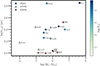 |
Fig. 1. Stellar mass, M★, against the half-light radius, r1/2, for our galaxy sample. The circles indicate the classical dSphs, and the triangles represent the dwarfs from MUSE-Faint. Objects are colour-coded by the number of stars with velocities available for each object. The red stars represent the EDGE simulated dwarfs. |
Parameters adopted from the literature.
Properties of simulated EDGE dwarf galaxies at redshift z = 0 used in this paper.
2.1.1. Dwarf spheroidals
Our sample of dSphs is comprised of Carina (Car), Draco (Dra), Fornax (For), Leo I, Leo II, Sextans (Sexts), Sculptor (Sculp), and Ursa Minor (UMi). For all of these galaxies, we have kinematics for ≳190 stars, and their photometric light profiles are well measured (see Read et al. 2019 for an extensive analysis).
For the photometric data, we used the Panoramic Survey Telescope and Rapid Response System (Pan-STARRS) DR1 catalogue (Flewelling et al. 2020) for Draco, Leo I, Leo II, Sextans, and Ursa Minor; the VLT/ATLAS DR1 catalogue (as re-processed by Koposov et al. 2014) for Fornax and Sculptor; and a catalogue derived from observations with the Dark Energy Camera by McMonigal et al. (2014) for Carina. For the kinematic data, we adopted spectroscopic data samples from Walker et al. (2009) for Carina, Fornax, Sculptor and Sextans; from Mateo et al. (2008) for Leo I; from Spencer et al. (2017) for Leo II; from Spencer et al. (2018) for Draco; and from Read et al. (2019) for Ursa Minor. For a comprehensive description of the selection of member stars for all dwarfs, see Read et al. (2019). All of the dwarfs have tidal radii today that are significantly larger than their stellar half-light radii (Pace et al. 2022; see also Sect. 5.3), though some could have experienced stronger tidal forces in the past (e.g. Genina et al. 2022).
2.1.2. MUSE-Faint dwarfs
Our sample of faint dwarfs comprises the ultra-faint dwarfs of the MW Eridanus II (EriII), Grus 1 and Leo T, and the faint dwarf Antlia B (AntB), which is associated with NGC 3109. We used mock photometry catalogues with 10 000 sample photometric positions drawn from the best-fit exponential profiles found for each dwarf (see Zoutendijk et al. 2021a for further details).
We used spectroscopic observations from the MUSE-Faint survey, a survey of ultra-faint dwarfs conducted using the Multi Unit Spectroscopic Explorer, for these objects. The extensive data reduction and analysis for these objects can be found in Zoutendijk et al. (2020) for Eridanus II, in Zoutendijk et al. (2021a) and Vaz et al. in prep for Grus 1, in Júlio et al. (2023) for Antlia B, and in Vaz et al. (2023) for Leo T. For these dwarfs, we have from 14 (for Grus 1) to 127 stars (for Antlia B). As with the classical dwarfs, our faint dwarfs also have tidal radii far larger than their stellar light profiles (Pace et al. 2022; see also Sect. 5.3).
2.2. EDGE simulation data
The EDGE project is described in detail in Agertz et al. (2020). We briefly summarise the key features of the simulations here for the reader’s convenience. The simulations we used were first published in Orkney et al. (2021) and Gray et al. (2025) and are summarised in Table 2.
The Engineering Dwarfs at Galaxy Formation’s Edge is a suite of high-resolution cosmological zoom simulations of isolated dwarf galaxies in a ΛCDM cosmology (Ωm = 0.309, ΩΛ = 0.691, Ωb = 0.045, and  ; Planck Collaboration VI 2020). It uses the adaptive mesh refinement hydrodynamics code RAMSES (Teyssier 2002); a maximum spatial resolution of 3 pc; and a mass resolution of Mgas = 18 M⊙, M★ = 300 M⊙, and MDM = 117 M⊙ for the higher resolution simulations we present here (Orkney et al. 2021). We also compare these with lower resolution simulations that have Mgas = 161 M⊙, M★ = 300 M⊙, and MDM = 945 M⊙ to test numerical convergence (Rey et al. 2019, 2020). For Halo 383, there is no higher resolution version available, so we only used the lower resolution one (Gray et al. 2025). The galaxy formation model includes subgrid prescriptions for star formation, stellar feedback, cosmic reionisation, and gas cooling. Star formation occurs when the gas temperature falls below TSF = 100 K and the gas density rises above ρSF = 300 atoms/cc. Stars are then formed stochastically at a rate of
  , where εff = 0.1 is the star formation efficiency and tff is the local gas free-fall time. Each star particle has a mass of ∼300 M⊙ and represents a single stellar population that has a Kroupa (2001) initial stellar mass function. Energy from supernovae (Type Ia and Type II) is injected purely thermally and if the cooling radius is resolved (which is the case > 90% of the time). If not, some additional momentum is also injected to compensate for gas over-cooling (see Agertz et al. 2020 for details). Stellar winds from massive stars (> 5 M⊙) continuously inject energy, mass, and metals into the interstellar medium, as in Agertz et al. (2013). These EDGE simulations do not include radiative-transfer (photo-ionisation or photo-heating) from young stars (such physics is included in EDGE2, without significant changes to stellar masses and sizes; Rey et al. 2025). Finally, reionisation is modelled as a uniform, time-dependent, heat source (Haardt & Madau 1995; Rey et al. 2020).
3. Methods
In this section, we describe our methodology. In Sect. 3.1, we explain how we estimated the baryonic and total, ‘observed’, acceleration for our sample of galaxies. In Sect. 3.2, we describe the mass modelling tool, GRAVSPHERE (Read & Steger 2017; Read et al. 2018; Genina et al. 2020; Read et al. 2019; Collins et al. 2021), which we used to determine the cumulative mass profiles of our sample of galaxies from their photometric and kinematic data.
3.1. The radial relation acceleration
Throughout this paper, we assume that our sample of dwarf galaxies is in dynamical pseudo-equilibrium (meaning that while they may deviate from strict equilibrium due to tidal or internal processes, their overall kinematics are sufficiently stable for equilibrium methods to apply), which is a good assumption given that they all orbit in a weak tidal field1 (Pace et al. 2022 and see Sect. 5.3). Furthermore, we assumed spherical symmetry. This is not likely to be valid for our sample of galaxies (e.g. Orkney et al. 2023; Goater et al. 2024). However, bias due to triaxiality, for the number of kinematic tracers we used in this work, is expected to be small. Read & Steger (2017) applied GRAVSPHERE to a triaxial mock with axis ratios 1:0.8:0.6, which is consistent with standard cosmology expectations (e.g. Orkney et al. 2023). They showed that the assumption of spherical symmetry in GRAVSPHERE leads to bias when applied to triaxial mock data, but, for ∼1000 tracer stars, this is typically smaller than their quoted 95% confidence intervals. This conclusion is further supported by Genina et al. (2020) and Nguyen et al. (2025). They applied GRAVSPHERE to mock satellites drawn from cosmological simulations APOSTLE and FIRE, respectively. In both cases, GRAVSPHERE provides an excellent recovery of the truth within its quoted uncertainties. This demonstrates that our results will not be significantly biased by realistic departures from spherical symmetry or tidal forces from the MW.
Assuming spherical symmetry, the observed acceleration then follows as
 (1)
(1)
where G is the gravitational constant and Mtot(< r) is the total cumulative mass at radius r. The baryonic acceleration follows similarly from the baryonic mass:
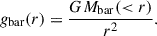 (2)
(2)
where Mbar(< r) = M★(< r)+Mgas(< r) is the cumulative baryonic mass (i.e. the sum of the cumulative stellar and gas masses).
Lelli et al. (2017) argued that one cannot estimate the gravitational field as a function of radius for dSph galaxies because of a well-known degeneracy between the projected stellar velocity dispersion, σLOS(R), and the velocity dispersion anisotropy, β(r) – known as the mass-anisotropy degeneracy. However, we now have line-of-sight velocities for many individual stars in each dwarf we model in this paper, and we have a mass modelling method, GRAVSPHERE, that can break the mass-anisotropy degeneracy by using information about the shape of the velocity distribution function (Read & Steger 2017, Read et al. 2018, Genina et al. 2020, Read et al. 2019, Collins et al. 2021). We describe how we used GRAVSPHERE to estimate both Mtot(< r) and M★(< r) at each radius, r, in the next section.
3.2. GRAVSPHERE
To measure the mass profiles of our sample, we used the updated version of the GRAVSPHERE Jeans modelling code2. A detailed explanation of the code can be found in Read & Steger (2017), Read et al. (2018), Genina et al. (2020), and Collins et al. (2021). We briefly summarise this here for the reader’s convenience.
GRAVSPHERE solves the Jeans equation (Jeans 1922) for our member stars while assuming that the stellar system is spherical, non-rotating, and in a steady state. It is given by
 (3)
(3)
here, the velocity anisotropy profile β(r) is defined as
 (4)
(4)
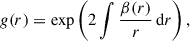
where σt and σr are the tangential and radial velocity dispersions respectively, and σr is given by (van der Marel 1994; Mamon & Lokas 2005)
 (5)
(5)
with
 (6)
(6)
and M(< r) is the total cumulative mass as a function of the radius, r. The tracer number density, ν★, characterises the radial density profile of a population of massless tracers (in our case, stars moving in a galaxy) that move in the gravitational potential of its cumulative mass distribution, M(< r), modelled either3 with a sum of NP Plummer spheres (Plummer 1911),
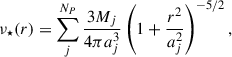 (7)
(7)
where Mj and aj are the mass and scale length of each individual component, or with the generic αβγ profile initially proposed by Zhao (1996) and parametrised by Bañares-Hernández et al. (2025); this is given by a double power-law model:
 (8)
(8)
where three exponent variables, α, β, γ, and the scale radius, rc, and density, ρc, were introduced.
This allowed us to recover the density profile, ρ(r), and the velocity anisotropy profile, β(r), of the studied stellar systems (Read & Steger 2017). These are modelled as
 (9)
(9)
where β0 and β∞ are the values of the anisotropy profile at r = 0 and r = ∞, r0 is a transition radius, and ν is the steepness of the transition. To avoid infinities, GRAVSPHERE uses a symmetrised version of β(r):
 (10)
(10)
where  and
and  correspond to a fully tangential and a fully radial distribution, respectively. GRAVSPHERE harnesses higher order moments of the velocity distribution via the fourth-order virial shape parameters (VSPs) (Merrifield & Kent 1990; Richardson & Fairbairn 2014; Read & Steger 2017), given by
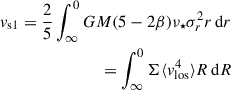 (11)
(11)
and
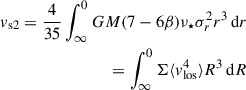 (12)
(12)
to break the mass-anisotropy degeneracy. The cumulative mass distribution, M(< r), is modelled with a cNFWt profile (Read et al. 2018). This is based on the Navarro-Frenk-White profile (NFW; Navarro et al. 1996) fitted to pure dark-matter simulations:
 (13)
(13)
To account for the possibility of cored profiles, as is observed in many dwarf galaxies (see e.g. McGaugh et al. 2001 and Marchesini et al. 2002), and the possibility of mass loss beyond the tidal radius for satellite dwarfs (e.g. Read et al. 2006), the cNFWt modifies the NFW profile at both small and large radii. The density profile of this model is given by
 (14)
(14)
where MNFW is the mass profile of the NFW model and the function fn determines how cuspy the halo is below a core-size parameter, rc:
![Mathematical equation: $$ \begin{aligned} f^n = \left[\tanh \left(\frac{r}{r_c}\right)\right]^n. \end{aligned} $$](/articles/aa/full_html/2025/12/aa57106-25/aa57106-25-eq20.gif) (15)
(15)
The cumulative mass of the cNFWt model is then given by
![Mathematical equation: $$ \begin{aligned} \begin{split} M_{\rm cNFWt}(<r) = {\left\{ \begin{array}{ll} M_{\rm NFW}(<r)f^n, r < r_t \\ M_{\rm NFW}(r_t)f^n + \\ 4\pi \rho _{\rm cNFWt}(r_t)\frac{r_t^3}{3-\delta } \left[\left(\frac{r}{r_t}\right)^{3-\delta }-1\right], r > r_t \end{array}\right.}\!\!\!\!\!, \end{split} \end{aligned} $$](/articles/aa/full_html/2025/12/aa57106-25/aa57106-25-eq21.gif) (16)
(16)
where rt and δ model the effect of tidal stripping beyond rt, with rt being the tidal stripping radius and δ the density slope beyond rt.
To assign the data to bins of the projected radius, R, we used an algorithm called BINULATOR (Collins et al. 2021). After running the BINULATOR routine, we ran GRAVSPHERE to determine the cumulative mass profile. GRAVSPHERE solves the Jeans equation for the projected velocity dispersion. It also fits the two VSPs, as determined from the stellar kinematic data by the BINULATOR. GRAVSPHERE uses the ensemble sampler EMCEE (Foreman-Mackey et al. 2013) to fit the model to the data. Each Markov chain (walker) communicates with the other walkers at each step. We used the default number of walkers Nwalkers = 250 and steps Nsteps = 50000, since these values were sufficient to achieve convergence. The first half of the steps generated are always discarded as a conservative burn-in criterion.
3.3. Priors
We kept the GRAVSPHERE priors to their default values, which we summarise here for convenience. We used priors on the symmetrised velocity anisotropy of  ,
,  , −1 < log10(r0/kpc) < 0, and 1 < η < 3. We used a flat prior on the baryonic mass of 0.75M★ < Mbar < 1.25M★, where M★ corresponds to the measured stellar mass described in Table 1. In cases where gas is also present, we added it to the stellar mass and used the total value as the prior for the baryonic mass.
For the cNFWt model, we fitted the following free parameters: the halo mass, M200, and concentration parameter before infall, c200; the dark-matter core-size parameter, rc; the tidal stripping radius, rt, and the logarithmic density slope beyond rt, δ. We assumed flat priors of 107.5 M⊙ < M200 < 1011.5 M⊙ and 1 < c200 < 50 (see Júlio et al. 2023 for a discussion of these choices), −2 < log10(rc/kpc) < 0.5, 0.3 < log10(rt/R1/2) < 1 and 3.5 < δ < 5 on these parameters. Our results are not sensitive to these choices (refer to Zoutendijk et al. 2021b; Júlio et al. 2023 for a comprehensive discussion on the robustness of the results obtained using GRAVSPHERE in MUSE-Faint data).
Finally, it is important to note that the Jeans equations, which GRAVSPHERE solves, assume only that weak-field gravity is described by a scalar field, and that the gravitational force follows from the gradients of this scalar field. The Poisson equation was not considered when deriving the observed accelerations. It would only be considered if we chose to interpret the observed acceleration as owing to some enclosed dark-matter mass. This is an important point because it means that we can directly compare our observed accelerations, derived using GRAVSPHERE, to alternative gravity models such as MOND.
3.4. Recovering the RAR from mock data
In this section, we test how well we can recover the RAR by applying GRAVSPHERE to mock data taken from the simulated EDGE dwarfs. For this test, we used all of the simulated star particles to fit the photometric light profile and a random 1000 stars to measure the line-of-sight velocity dispersion profile up to 1 kpc (broadly representative of our observed dwarfs; see Table 1). In addition, to reproduce the observational uncertainties in our mock data, we imposed velocity errors of 2 km s−1 on the individual stars. These data were passed to the BINULATOR and then to GRAVSPHERE, as described in Sect. 3.2. The results are shown in Figure 2. Based on an empirical rotation estimator applied to all galaxies, we find that the observed dwarfs are consistent with being non-rotating, while the EDGE dwarfs display significant rotation. To account for this behaviour in GRAVSPHERE, we introduced a new rotation parameter, which is described in Appendix A. We note that the true acceleration, directly determined from the simulations, matches within the 68% confidence bands determined by GRAVSPHERE.
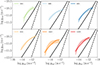 |
Fig. 2. Test of our recovery of RAR by applying GRAVSPHERE to mock data drawn from simulated EDGE dwarfs. For this test, we used all of the simulated star particles to fit the photometric light profile and a random 1000 stars to measure the line-of-sight velocity dispersion profile (similar to our more poorly sampled observed dwarfs; see Table 1). The shaded band marks the 68% confidence intervals. The true answer (as determined directly from the simulations, using Equations (1) and (2), assuming spherical symmetry) is marked by the solid lines. The solid black line marks the RAR derived by McGaugh et al. (2016) for SPARC local spiral galaxies. The dashed black line marks gobs = gbar. |
4. Results
By using GRAVSPHERE, described in Sect. 3.2, and the equations described in Sect. 3.1, in this section, we estimate the observed and baryonic accelerations for both our observed (Sect. 2.1) and simulated (Sect. 2.2) data. In Sect. 4.1, we present the resulting RAR of our observations. In Sect. 4.2, we present the same for the simulated EDGE dwarf galaxies.
4.1. RAR of the observations
Figure 3 shows the RAR we obtain for our sample of 12 dwarf galaxies. We plot the gobs − gbar relation as a function of radius within each galaxy, where each colour corresponds to a different galaxy, the shaded bands mark the 68% confidence intervals, the lines show the median values, and the dotted lines show extrapolations outside the data range to larger radii. We compare this with the RAR derived by McGaugh et al. (2016) (solid black line). We highlight that, with the exception of Fornax (light green), all of the dwarf galaxies systematically lie above the low-mass extrapolation of the RAR from McGaugh et al. (2016). This deviation becomes stronger for the galaxies with lower baryonic masses (i.e. lower gbar). Fornax stands out as an outlier in our sample, lying below the classical RAR, in contrast to the other dwarfs. Its substantially higher stellar mass and extended star formation history (e.g. de Boer et al. 2012) distinguish it from both the other observed dwarfs and the EDGE galaxies. These properties make Fornax particularly susceptible to repeated gas cooling and stellar feedback, which is expected to produce a dark-matter core (e.g. Read & Gilmore 2005; Pontzen & Governato 2012; Di Cintio et al. 2014). Indeed, there is already dynamical evidence for such a core reported in the literature (e.g. Goerdt et al. 2006; Cole et al. 2012; Pascale et al. 2018; Read et al. 2019; however, see Genina et al. 2022). Cored dwarfs occupy a distinct locus in the RAR compared to those with a central cusp, behaving more similarly to MOND predictions (Eriksen et al. 2021). If Fornax is uniquely cored amongst our sample, then this provides a natural explanation for its more MOND-like locus in the RAR. However, more detailed work, left for future studies, will be needed to fully understand this difference.
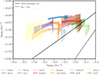 |
Fig. 3. Radial acceleration relation (RAR) for our sample of dwarf galaxies. Each colour corresponds to a different galaxy, where the shaded area corresponds to the 68% confidence interval and the solid line marks the median value. The dotted lines correspond to extrapolations beyond the kinematic data range. The solid black line marks the RAR derived by McGaugh et al. (2016) for SPARC local spiral galaxies. The dashed black line marks gobs = gbar. |
Furthermore, in some galaxies the radially resolved data exhibit upward or downward ‘hooks’ in the RAR plane. These features are similar to those described in Li et al. (2022) and Mercado et al. (2024): low-mass galaxies with cuspy dark-matter-halo profiles should have upward-bending hook features that deviate from the observed RAR; while, conversely, downward hooks arise due to the non-monotonic behaviour of the total acceleration profile in the presence of a feedback-induced core, leading to multiple observed accelerations, gobs, for a given baryonic acceleration, gbar. Given the uncertainties, several of our systems allow for both scenarios, or even for a more monotonic relation. However, for most of them, there is no one-to-one map from gbar to gobs, neither within each dwarf nor between them as populations.
4.2. RAR of the EDGE simulations
Figure 4 shows the for the EDGE simulated galaxies. The low- and high-resolution results are in good agreement for all of the simulated dwarfs, though the higher resolution simulations (right panel) slightly deviate from the lower resolution ones (left panel) at low and high gbar4. Furthermore, as most observed dwarfs, the EDGE dwarfs systematically lie above the RAR from McGaugh et al. (2016).
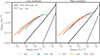 |
Fig. 4. Radial acceleration relation for EDGE simulated dwarf galaxies. The colours show each simulation as marked in the legend. The solid black line corresponds to the RAR derived by McGaugh et al. (2016) for SPARC local spiral galaxies. The black dashed line marks gobs = gbar. Left: RAR of lower resolution simulations. Right: RAR of higher resolution simulations. |
None of the EDGE dwarfs scatter below the McGaugh et al. (2016) RAR line, and so none look similar to the data for Fornax. However, notice that the EDGE dwarfs are ∼10 times less massive than Fornax (see Figure 1), and so this does not (at least not yet) constitute a mismatch between theory and data.
In Figure 5, we quantitatively compare the EDGE simulated RAR with our observed dwarf galaxy sample. For this comparison, we only plot the higher resolution simulations (except for Halo 383, for which we only have the lower resolution version). The median and 68% scatter in the observed gobs − gbar relations are marked by the solid grey lines and shaded regions, respectively. The relations estimated directly from the simulations are represented by solid red lines. Notice that the agreement between the two is remarkably good, both in terms of the median relation and its scatter. Also shown, in blue, is the RAR for classical dSphs derived at their half-light radii from Lelli et al. (2017). These measurements, although noisier and more sparsely sampled, are broadly consistent with both our results and the simulations, further reinforcing the conclusion that the standard ΛCDM cosmology reproduces the observed behaviour of galaxies in the RAR plane on the dwarf galaxy scale.
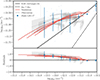 |
Fig. 5. Quantitative comparison of the EDGE simulated RAR with our observed dwarf galaxy sample. The black solid line corresponds to the RAR derived by McGaugh et al. (2016) for SPARC local spiral galaxies. The median and 68% scatter in the observed gobs − gbar relations are marked by the grey solid lines and shaded regions, respectively. The gobs − gbar relations estimated directly from the simulations are represented by solid red lines. The blacked dashed line marks gobs = gbar. The small blue points mark the positions of the dSphs on this relation Lelli et al. (2017), while the blue circles indicate the mean and 1σ scatter of the binned data. At the bottom, the residuals relative to the McGaugh et al. (2016) relation (black solid line) are represented for the observed, the simulated, and the Lelli et al. (2017) data. |
5. Discussion
5.1. The origin of scatter in the RAR of low-mass dwarf galaxies
One may reasonably ask what the origin of the scatter in the EDGE simulated RAR is. As stated in Rey et al. (2019) and Kim et al. (2024), the EDGE dwarfs show significant scatter in M* at a given M200 (∼0.5 dex (1σ) at a halo mass of ∼109 M⊙). This owes to reionisation combined with scatter in dwarf galaxy assembly histories. At fixed M200, dwarfs that form earlier form more stars before reionisation quenching, leading to a higher M* today. As such, variations in the M* − M200 relation of low-mass dwarfs in ΛCDM naturally generate scatter in the gbar − gobs plane.
To illustrate this explicitly, in Figure B.1 of Appendix B we show the ‘genetically modified’ versions of Halo 1459, in which only reionisation and early assembly history were varied. These runs (MX02 and MX03) share the same halo mass, but differ in their stellar mass, and exhibit gbar − gobs tracks offset by an amount comparable to the scatter between distinct EDGE dwarfs.
That said, the scatter in EDGE is smaller than in the observational data (see Figure 5). Even after including observational uncertainties in the mock data (discussed in Sect. 3.4), the EDGE scatter does not reach the full amplitude seen in the Local Group dwarfs (see Figure B.2 in Appendix B). This does not necessarily indicate a problem for ΛCDM, since additional sources of scatter are expected in the observed sample. The Local Group dwarfs are satellites, whereas EDGE dwarfs are isolated galaxies, and quenching on infall (e.g. Read & Erkal 2019) and tidal effects (e.g. Read et al. 2006) can both increase the scatter. Moreover, the observed dwarfs span a wider range of pre-infall halo masses than our EDGE comparison sample. This is particularly relevant for Fornax, which is among the most discrepant galaxies in the data and likely originates from a substantially more massive progenitor. While the EDGE scatter alone falls short of matching the data, the combination of reionisation, assembly history, observational uncertainties, satellite-specific processes, and a broader halo-mass range might explain the observed dispersion in the dwarf galaxy RAR within ΛCDM.
5.2. Comparing isolated EDGE dwarfs to observed satellite dwarfs
Our simulated EDGE dwarfs are isolated, whereas our sample of observed dwarfs all orbit in the tidal field of a larger host galaxy. As such, we may worry that the two populations may not be directly comparable. We selected our observed dwarf galaxies such that they orbit in a weak tidal field today, with a tidal radius that lies far beyond their stellar light profile (Pace et al. 2022; see Table 1 and Sect. 5.3). As such, the tidal field of the host galaxy is not likely to significantly influence the stellar light profiles of our sample of dwarfs (Read et al. 2006; Goater et al. 2024). However, it is likely that some of our observed dwarfs – particularly the more massive ones such as Fornax – had their star formation shut down by ram pressure from their host galaxy’s hot gaseous corona (e.g. Gatto et al. 2013). This lowers their total stellar mass compared to a similar but isolated counterpart, lowering gbar for a given gobs and inducing more scatter in the RAR plane. As such, we can consider the scatter that we see in the RAR plane for our EDGE dwarfs as a lower bound on the scatter expected for satellite dwarfs in a ΛCDM cosmology.
5.3. The external field effect
We show that our observed dwarf galaxies do not follow any simple RAR (see Figure 3). However, as discussed in Sect. 1, alternative weak-field gravity theories including MOND are typically non-linear, leading to an ‘external field effect’. Since our sample of dwarfs all orbit in the tidal field of a larger host galaxy, we may worry that the scatter in the RAR is actually expected in MOND – a result of each dwarf experiencing a distinct EFE.
To test this idea, we followed the approach in McGaugh & Milgrom (2013) to estimate the relative size of the internal, ain, and external, aex, acceleration (the EFE) for each dwarf in our observational sample. To determine the internal field, which depends only on the baryonic properties of the dwarf, we followed McGaugh & Milgrom (2013), which derived
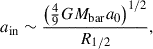 (17)
(17)
which is valid for MOND. We assume here that a0 = 1.2 × 10⁻¹⁰m s−2 (McGaugh & Milgrom 2013).
The EFE (aex) depends on the total baryonic mass of the host galaxy and, similarly to Pawlowski et al. (2015), we adopted the empirical MW model of McGaugh (2008) using aex = VMW2/D, where VMW is the circular velocity of the MW and D is the galactocentric distance of the object (this is reported in Table 1). Ant B is not a satellite galaxy of the MW, but is instead a satellite of NGC 3109. As such, for this specific case, we used a circular velocity of 52 km s−1 (Huchtmeier 1973) and a distance of D = 72 kpc (Sand et al. 2015).
We report our values for ain and aex, derived as described above, in Table 3. A system is considered to be in the MOND regime if aex < ain ≪ a0, and in the EFE regime if aex > ain. As can be seen, five of our dwarfs are clearly in the MOND regime (Fornax, Leo I, Leo II, Ant B, Leo T), five are clearly in the EFE regime (Carina, Draco, Sextans, Ursa Minor, Grus I) and the remainder are at the boundary (Sculptor, Eri II). This means that we do indeed expect scatter in the RAR for these dwarf galaxies in MOND. However, galaxies in the EFE regime should scatter below the RAR, while the opposite is what we see. Furthermore, we see no systematic trend between galaxies in the MOND or EFE regimes. Draco and Carina are a particularly illustrative example, as was already pointed out by Read et al. (2019). Both galaxies are in the EFE regime on very similar orbits around the MW. Both have very similar baryonic mass distribution and, therefore, similar gbar. Yet, as can be seen in Figure 3, they have very different gobs at high statistical significance. This difference might be due to their distinct evolutionary paths: Draco is a quenched system with a predominantly old stellar population and very slow chemical enrichment, consistent with a system that ceased star formation early, likely around the epoch of reionisation (Cohen & Huang 2009; Weisz et al. 2014). Its high dark-matter content makes it strongly dark-matter-dominated at all radii (Read et al. 2019). Carina, by contrast, experienced extended and bursty star formation episodes with multiple distinct episodes of enrichment (de Boer et al. 2014), which likely drove repeated gas outflows and feedback events. Such processes can reduce the central dark-matter density, producing a lower observed acceleration at fixed baryonic content (Read et al. 2019). These contrasting star formation and feedback histories naturally produce the observed offset in their RARs within ΛCDM. However, this suggests that the scatter in the RAR observed in our sample of dwarf galaxies poses a challenge for a MOND-like explanation, since galaxies with the same baryonic mass distribution and external field should fall on the same RAR. It remains to be seen if other alternative gravity theories that show different non-linear weak-field behaviour could explain these data.
MOND internal and external accelerations of our observed sample of dwarf galaxies.
5.4. Challenges to interpretation
During our analysis with GRAVSPHERE, we assume that the systems under study have spherical symmetry. As previously pointed out, this might not be valid for our sample. Even though it was shown that the expected departures from spherical symmetry bias GRAVSPHERE mass models by less than their quoted 95% confidence intervals for stellar kinematic samples of up to ∼1000 stars, for some systems – namely for the MUSE-Faint dwarfs – we have fewer than 100 stars. Furthermore, for these particular dwarfs, the data are mostly concentrated inside their half-light radius, so the baryonic distribution is extrapolated from their surface brightness profile in the outskirts. As a result of the undersampling, both in the number of stars and the radius range in which they are concentrated, the RAR of these galaxies should be interpreted cautiously. However, within their error bars, they mostly agree with the dSphs for which we have a significant amount of data across a large range of radii. Moreover, our overall results remain unchanged even when these systems are excluded from the analysis – their inclusion simply amplifies the observed trends.
As shown in Table 1, Antlia B and Leo T have gas. We assumed, for simplicity, that the gas content of Antlia B and Leo T follows the same mass distribution as the stars, and this assumption underlies the results presented in Figure 3. We show in Appendix E, in Figure E.1, how the RAR of these two galaxies change when we exclude their gas content. As expected, since we assumed that the gas and stars follow the same mass distribution, omitting the gas leads to a uniform decrease in the baryonic acceleration at all radii, effectively shifting the RAR to the left. While this approach provides a useful first-order approximation, it is important to note that, in reality, the gas content of a galaxy can be significantly more extended than its stellar distribution. This would increase the baryonic content of the galaxy at large radii, resulting in increased baryonic and total accelerations in the outer regions. Nonetheless, this would not change our conclusions.
Another potential caveat is the impact of binary stars, which can artificially increase the observed stellar velocity dispersions, leading to overestimated dynamical masses and elevated gobs at fixed gbar (e.g. Pianta et al. 2022; Gration et al. 2025). In our analysis, we do not explicitly correct for binaries. However, the MUSE-Faint data were obtained over multiple epochs and combined into period-averaged velocities, which reduces the binary contamination (discussed for Leo T in Vaz et al. 2025; and for the remaining MUSE-Faint UFDs in Vaz et al., in prep.). For the classical dSphs, binaries have only a minor impact on the velocity dispersion at the current levels of precision (e.g. McConnachie & Côté 2010; Wang et al. 2023). In these cases, we rely on the published membership catalogues, which in many instances make use of multi-epoch data to identify and remove likely binaries (e.g. Walker et al. 2006) Furthermore, for the more massive dwarfs, the higher intrinsic dispersions further suppress the contribution from binaries. We therefore expect that while binaries may introduce some additional scatter, it is unlikely that their contamination alters our main results.
Finally, tidal interactions may have influenced the past evolution of some systems. Yet, since all of our galaxies orbit in relatively weak present-day tidal fields, we do not expect tides to significantly affect our main conclusions. Moreover, our estimates of the tidal radius are based on the dynamical masses from Pace (2025), which were derived within the 3D half-light radius using the dynamical mass estimator in Wolf et al. (2010). This likely underestimates the true masses of some dwarfs, and therefore also underestimates their tidal radii, making them appear more susceptible to tides than they actually are. In that sense, our assumption is conservative. Given that even heavily disrupted systems such as the Small Magellanic Cloud can still be reliably mass modelled (De Leo et al. 2020, 2024), we expect our main results to remain robust despite the possible influence of tides.
6. Conclusions
We used literature line-of-sight velocities for the classical dSphs of the MW, combined with MUSE-Faint velocities of ultra-faint dwarfs, to measure the radially resolved radial acceleration relation of galaxies down to baryonic accelerations log gbar ∼ −14 m s−2, for the first time. We estimated the baryonic and observed accelerations, gbar and gobs, using the GRAVSPHERE Jeans mass-modelling code, assuming that our galaxies are spherical, non-rotating, and in a steady state. We tested these assumptions by applying GRAVSPHERE to mock data for simulated dwarf galaxies taken from the EDGE project, showing that we can successfully recover the RAR of these mock dwarfs within our quoted uncertainties.
We then applied our method to real data for 12 nearby dwarfs. Our dynamical analysis reinforced previous results that in the lowest mass galaxies, the gobs − gbar relation does not follow the RAR calibrated on higher mass galaxies (McGaugh et al. 2016), but is systematically higher. Furthermore, we found significant scatter from galaxy to galaxy, while, when considering distinct radii within individual galaxies, we found that some galaxies can have two different values of gobs at the same gbar.
We considered whether these results could be explained by the EFE that can occur in non-linear, weak-field gravity theories such as MOND. However, we show that the EFE has the wrong sign, causing galaxies to scatter below the RAR, which is opposite to what is observed. Furthermore, we found no correlation between galaxies in the EFE regime as compared to galaxies outside it. Moreover, we show that galaxy ‘twins’ exist, such as Carina and Draco, that have a similar EFE, similar orbits around the MW, and similar baryonic-mass distribution (gbar), yet statistically significantly distinct gobs. Our results demonstrate that the RAR for low-mass dwarf galaxies is not universal and that the baryonic acceleration does not contain enough information, on its own, to derive the observed acceleration for these objects.
Finally, we compared our results with the RAR predicted in high-resolution simulations of isolated dwarf galaxies in a ΛCDM cosmology, taken from the EDGE project. We show that the higher and lower resolution versions of these simulations agreed well with one another, demonstrating good numerical convergence. We then showed that the simulated dwarfs behave similarly to our observed sample in lying systematically above the low-mass extrapolation of the RAR from McGaugh et al. (2016). However, the scatter in EDGE, which is caused by a combination of reionisation and the scatter in dark-matter-halo assembly histories (Kim et al. 2024), is smaller than that seen in the Local Group dwarfs. While part of this difference can be attributed to additional dispersion introduced by GRAVSPHERE and observational uncertainties, further contributions are expected from the fact that the Local Group dwarfs are satellites rather than isolated dwarfs, and from their broader range of pre-infall halo masses. This makes the low-mass end of the RAR a powerful probe of both cosmology and the complex evolutionary paths of dwarf galaxies.
The Small Magellanic Cloud is undergoing heavy tidal disruption (De Leo et al. 2020), much more extreme than any of the galaxies we studied here. Yet, it can still be successfully mass modelled (De Leo et al. 2024).
The newest version of this code is available to download at https://github.com/justinread/gravsphere (Collins et al. 2021).
The estimate of the baryonic acceleration is highly sensitive to the accuracy of the fitted ν★(r), so we fitted both profiles for each galaxy and adopted the one that best reproduces the observed distribution. The impact of adopting these different profiles on the inferred RAR is illustrated in Appendix D for the case of Grus I, the least well-sampled system, showing that our results are robust against the choice of tracer density profile.
Acknowledgments
MPJ and MSP acknowledge funding via a Leibniz-Junior Research Group (project number J94/2020). OA acknowledges support from the Knut and Alice Wallenberg Foundation, the Swedish Research Council (grant 2019-04659), the Swedish National Space Agency (SNSA Dnr 2023-00164), and the LMK Foundation. Based on observations made with ESO Telescopes at the La Silla Paranal Observatory under programme IDs 0100.D-0807, 0101.D-0300, 0102.D-0372 and 0103.D-0705. This research has made use of Astropy (Astropy Collaboration 2018), corner.py (Foreman-Mackey 2016), matplotlib (Hunter 2007), NASA’s Astrophysics Data System Bibliographic Services, NumPy (Harris et al. 2020), SciPy (Virtanen et al. 2020). Based on observations made with the NASA/ESA Hubble Space Telescope, and obtained from the Hubble Legacy Archive, which is a collaboration between the Space Telescope Science Institute (STScI/NASA), the Space Telescope European Coordinating Facility (ST-ECF/ESA) and the Canadian Astronomy Data Centre (CADC/NRC/CSA). JIR would like to acknowledge support from STFC grants ST/Y002865/1 and ST/Y002857/1.
References
- Agertz, O., Kravtsov, A. V., Leitner, S. N., & Gnedin, N. Y. 2013, ApJ, 770, 25 [NASA ADS] [CrossRef] [Google Scholar]
- Agertz, O., Pontzen, A., Read, J. I., et al. 2020, MNRAS, 491, 1656 [Google Scholar]
- Astropy Collaboration (Price-Whelan, A. M., et al.) 2018, AJ, 156, 123 [Google Scholar]
- Bañares-Hernández, A., Calore, F., Martin Camalich, J., & Read, J. I. 2025, A&A, 693, A104 [NASA ADS] [CrossRef] [EDP Sciences] [Google Scholar]
- Bekenstein, J., & Milgrom, M. 1984, ApJ, 286, 7 [NASA ADS] [CrossRef] [Google Scholar]
- Bellazzini, M., Gennari, N., Ferraro, F. R., & Sollima, A. 2004, MNRAS, 354, 708 [NASA ADS] [CrossRef] [Google Scholar]
- Bellazzini, M., Gennari, N., & Ferraro, F. R. 2005, MNRAS, 360, 185 [NASA ADS] [CrossRef] [Google Scholar]
- Bonanos, A. Z., Stanek, K. Z., Szentgyorgyi, A. H., Sasselov, D. D., & Bakos, G. A. 2004, AJ, 127, 861 [Google Scholar]
- Bullock, J. S., & Boylan-Kolchin, M. 2017, ARA&A, 55, 343 [Google Scholar]
- Carrera, R., Aparicio, A., Martínez-Delgado, D., & Alonso-García, J. 2002, AJ, 123, 3199 [NASA ADS] [CrossRef] [Google Scholar]
- Chae, K.-H., Lelli, F., Desmond, H., et al. 2020, ApJ, 904, 51 [NASA ADS] [CrossRef] [Google Scholar]
- Chae, K.-H., Desmond, H., Lelli, F., McGaugh, S. S., & Schombert, J. M. 2021, ApJ, 921, 104 [NASA ADS] [CrossRef] [Google Scholar]
- Chiti, A., Simon, J. D., Frebel, A., et al. 2022, ApJ, 939, 41 [Google Scholar]
- Clementini, G., Cignoni, M., Contreras Ramos, R., et al. 2012, ApJ, 756, 108 [NASA ADS] [CrossRef] [Google Scholar]
- Cohen, J. G., & Huang, W. 2009, ApJ, 701, 1053 [NASA ADS] [CrossRef] [Google Scholar]
- Cole, D. R., Dehnen, W., Read, J. I., & Wilkinson, M. I. 2012, MNRAS, 426, 601 [Google Scholar]
- Collins, M. L. M., Read, J. I., Ibata, R. A., et al. 2021, MNRAS, 505, 5686 [NASA ADS] [CrossRef] [Google Scholar]
- Crnojevic, D., Sand, D. J., Zaritsky, D., et al. 2016, ApJ, 824, L14 [Google Scholar]
- de Boer, T. J. L., Tolstoy, E., Hill, V., et al. 2012, A&A, 544, A73 [NASA ADS] [CrossRef] [EDP Sciences] [Google Scholar]
- de Boer, T. J. L., Tolstoy, E., Lemasle, B., et al. 2014, A&A, 572, A10 [NASA ADS] [CrossRef] [EDP Sciences] [Google Scholar]
- De Leo, M., Carrera, R., Noël, N. E. D., et al. 2020, MNRAS, 495, 98 [Google Scholar]
- De Leo, M., Read, J. I., Noël, N. E. D., et al. 2024, MNRAS, 535, 1015 [NASA ADS] [CrossRef] [Google Scholar]
- Di Cintio, A., Brook, C. B., Macciò, A. V., et al. 2014, MNRAS, 437, 415 [Google Scholar]
- Durakovic, A., & Skordis, C. 2024, JCAP, 2024, 040 [CrossRef] [Google Scholar]
- Dutton, A. A., Macciò, A. V., Obreja, A., & Buck, T. 2019, MNRAS, 485, 1886 [NASA ADS] [CrossRef] [Google Scholar]
- Eriksen, M. H., Frandsen, M. T., & From, M. H. 2021, A&A, 656, A123 [NASA ADS] [CrossRef] [EDP Sciences] [Google Scholar]
- Faber, S. M., & Jackson, R. E. 1976, ApJ, 204, 668 [Google Scholar]
- Famaey, B., & McGaugh, S. S. 2012, Liv. Rev. Relativity, 15, 10 [NASA ADS] [CrossRef] [Google Scholar]
- Flewelling, H. A., Magnier, E. A., Chambers, K. C., et al. 2020, ApJS, 251, 7 [NASA ADS] [CrossRef] [Google Scholar]
- Foreman-Mackey, D. 2016, JOSS, 1, 24 [NASA ADS] [CrossRef] [Google Scholar]
- Foreman-Mackey, D., Hogg, D. W., Lang, D., & Goodman, J. 2013, PASP, 125, 306 [Google Scholar]
- Freundlich, J., Famaey, B., Oria, P.-A., et al. 2022, A&A, 658, A26 [NASA ADS] [CrossRef] [EDP Sciences] [Google Scholar]
- Garaldi, E., Romano-Díaz, E., Porciani, C., & Pawlowski, M. S. 2018, PRL, 120, 261301 [Google Scholar]
- Gatto, A., Fraternali, F., Read, J. I., et al. 2013, MNRAS, 433, 2749 [NASA ADS] [CrossRef] [Google Scholar]
- Genina, A., Read, J. I., Frenk, C. S., et al. 2020, MNRAS, 498, 144 [NASA ADS] [CrossRef] [Google Scholar]
- Genina, A., Read, J. I., Fattahi, A., & Frenk, C. S. 2022, MNRAS, 510, 2186 [Google Scholar]
- Goater, A., Read, J. I., Noël, N. E. D., et al. 2024, MNRAS, 527, 2403 [Google Scholar]
- Goerdt, T., Moore, B., Read, J. I., Stadel, J., & Zemp, M. 2006, MNRAS, 368, 1073 [Google Scholar]
- Gration, A., Hendriks, D. D., Das, P., Heber, D., & Izzard, R. G. 2025, MNRAS, 543, 1120 [Google Scholar]
- Gray, E. I., Read, J. I., Taylor, E., et al. 2025, MNRAS, 539, 1167 [Google Scholar]
- Haardt, F., & Madau, P. 1995, ApJ, 461, 20 [Google Scholar]
- Hargis, J. R., Albers, S., Crnojević, D., et al. 2020, ApJ, 888, 31 [NASA ADS] [CrossRef] [Google Scholar]
- Harris, C. R., Millman, K. J., van der Walt, S. J., et al. 2020, Nature, 585, 357 [NASA ADS] [CrossRef] [Google Scholar]
- Huchtmeier, W. 1973, A&A, 22, 27 [Google Scholar]
- Hunter, J. D. 2007, CiSE, 9, 90 [Google Scholar]
- Irwin, M., & Hatzidimitriou, D. 1995, MNRAS, 277, 1354 [NASA ADS] [CrossRef] [Google Scholar]
- Jarvis, M., Taylor, R., Agudo, I., et al. 2018, Proceedings of MeerKAT Science: On the Pathway to the SKA -, PoS(MeerKAT2016), 277, 006 [Google Scholar]
- Jeans, J. H. 1922, MNRAS, 82, 122 [NASA ADS] [CrossRef] [Google Scholar]
- Júlio, M. P., Brinchmann, J., Zoutendijk, S. L., et al. 2023, A&A, 678, A38 [NASA ADS] [CrossRef] [EDP Sciences] [Google Scholar]
- Keller, B. W., & Wadsley, J. W. 2017, ApJ, 835, L17 [Google Scholar]
- Kim, S. Y., Read, J. I., Rey, M. P., et al. 2024, ArXiv e-prints [arXiv:2408.15214] [Google Scholar]
- Koposov, S. E., Irwin, M., Belokurov, V., et al. 2014, MNRAS, 442, L85 [NASA ADS] [CrossRef] [Google Scholar]
- Koposov, S. E., Belokurov, V., Torrealba, G., & Evans, N. W. 2015, ApJ, 805, 130 [NASA ADS] [CrossRef] [Google Scholar]
- Kroupa, P. 2001, MNRAS, 322, 231 [NASA ADS] [CrossRef] [Google Scholar]
- Lee, M. G., Yuk, I.-S., Park, H. S., Harris, J., & Zaritsky, D. 2009, ApJ, 703, 692 [NASA ADS] [CrossRef] [Google Scholar]
- Lelli, F., McGaugh, S. S., & Schombert, J. M. 2016, AJ, 152, 157 [Google Scholar]
- Lelli, F., McGaugh, S. S., Schombert, J. M., & Pawlowski, M. S. 2017, ApJ, 836, 152 [Google Scholar]
- Li, P., Lelli, F., McGaugh, S., & Schombert, J. 2018, A&A, 615, A3 [NASA ADS] [CrossRef] [EDP Sciences] [Google Scholar]
- Li, P., McGaugh, S. S., Lelli, F., et al. 2022, ApJ, 927, 198 [NASA ADS] [CrossRef] [Google Scholar]
- Li, P., Tian, Y., Júlio, M. P., et al. 2023, A&A, 677, A24 [NASA ADS] [CrossRef] [EDP Sciences] [Google Scholar]
- Ludlow, A. D., Benítez-Llambay, A., Schaller, M., et al. 2017, PRL, 118, 161103 [Google Scholar]
- Mamon, G. A., & Lokas, E. L. 2005, MNRAS, 362, 95 [Google Scholar]
- Marchesini, D., D’Onghia, E., Chincarini, G., et al. 2002, ApJ, 575, 801 [NASA ADS] [CrossRef] [Google Scholar]
- Martin, N. F., Jong, J. T. A. d., & Rix, H. W. 2008, ApJ, 684, 1075 [NASA ADS] [CrossRef] [Google Scholar]
- Mateo, M., Olszewski, E. W., & Walker, M. G. 2008, ApJ, 675, 201 [NASA ADS] [CrossRef] [Google Scholar]
- McConnachie, A. W., & Côté, P. 2010, ApJ, 722, L209 [NASA ADS] [CrossRef] [Google Scholar]
- McGaugh, S. S. 2004, ApJ, 609, 652 [NASA ADS] [CrossRef] [Google Scholar]
- McGaugh, S. S. 2008, ApJ, 683, 137 [NASA ADS] [CrossRef] [Google Scholar]
- McGaugh, S., & Milgrom, M. 2013, ApJ, 766, 22 [NASA ADS] [CrossRef] [Google Scholar]
- McGaugh, S. S., Rubin, V. C., & de Blok, W. J. G. 2001, AJ, 122, 2381 [NASA ADS] [CrossRef] [Google Scholar]
- McGaugh, S. S., Lelli, F., & Schombert, J. M. 2016, PRL, 117, 201101 [Google Scholar]
- McMonigal, B., Bate, N. F., Lewis, G. F., et al. 2014, MNRAS, 444, 3139 [NASA ADS] [CrossRef] [Google Scholar]
- Mercado, F. J., Bullock, J. S., Moreno, J., et al. 2024, MNRAS, 530, 1349 [NASA ADS] [CrossRef] [Google Scholar]
- Merrifield, M. R., & Kent, S. M. 1990, AJ, 99, 1548 [NASA ADS] [CrossRef] [Google Scholar]
- Milgrom, M. 1983, ApJ, 270, 365 [Google Scholar]
- Mistele, T., McGaugh, S., Lelli, F., Schombert, J., & Li, P. 2024, JCAP, 2024, 020 [Google Scholar]
- Müller, O., Famaey, B., & Zhao, H. 2019, A&A, 623, A36 [Google Scholar]
- Navarro, J. F., Frenk, C. S., & White, S. D. M. 1996, ApJ, 462, 563 [Google Scholar]
- Nguyen, T., Read, J., Necib, L., et al. 2025, MNRAS, 541, 2707 [Google Scholar]
- Orkney, M. D. A., Read, J. I., Rey, M. P., et al. 2021, MNRAS, 504, 3509 [NASA ADS] [CrossRef] [Google Scholar]
- Orkney, M. D. A., Taylor, E., Read, J. I., et al. 2023, MNRAS, 525, 3516 [NASA ADS] [CrossRef] [Google Scholar]
- Pace, A. B. 2025, Open J. Astrophysics, 8 [Google Scholar]
- Pace, A. B., Erkal, D., & Li, T. S. 2022, ApJ, 940, 136 [NASA ADS] [CrossRef] [Google Scholar]
- Pascale, R., Posti, L., Nipoti, C., & Binney, J. 2018, MNRAS, 480, 927 [Google Scholar]
- Pawlowski, M. S., & McGaugh, S. S. 2014, MNRAS, 440, 908 [NASA ADS] [CrossRef] [Google Scholar]
- Pawlowski, M. S., McGaugh, S. S., & Jerjen, H. 2015, MNRAS, 453, 1047 [NASA ADS] [CrossRef] [Google Scholar]
- Pianta, C., Capuzzo-Dolcetta, R., & Carraro, G. 2022, ApJ, 939, 3 [NASA ADS] [CrossRef] [Google Scholar]
- Pietrzynski, G., Gieren, W., Szewczyk, O., et al. 2008, AJ, 135, 1993 [Google Scholar]
- Pietrzynski, G., Górski, M., Gieren, W., et al. 2009, AJ, 138, 459 [Google Scholar]
- Planck Collaboration VI. 2020, A&A, 641, A6 [NASA ADS] [CrossRef] [EDP Sciences] [Google Scholar]
- Plummer, H. C. 1911, MNRAS, 71, 460 [Google Scholar]
- Pontzen, A., & Governato, F. 2012, MNRAS, 421, 3464 [NASA ADS] [CrossRef] [Google Scholar]
- Read, J. I., & Erkal, D. 2019, MNRAS, 487, 5799 [Google Scholar]
- Read, J. I., & Gilmore, G. 2005, MNRAS, 356, 107 [NASA ADS] [CrossRef] [Google Scholar]
- Read, J. I., & Steger, P. 2017, MNRAS, 471, 4541 [Google Scholar]
- Read, J. I., Wilkinson, M. I., Evans, N. W., Gilmore, G., & Kleyna, J. T. 2006, MNRAS, 367, 387 [NASA ADS] [CrossRef] [Google Scholar]
- Read, J. I., Walker, M. G., & Steger, P. 2018, MNRAS, 481, 860 [NASA ADS] [CrossRef] [Google Scholar]
- Read, J. I., Walker, M. G., & Steger, P. 2019, MNRAS, 484, 1401 [NASA ADS] [CrossRef] [Google Scholar]
- Rey, M. P., Pontzen, A., Agertz, O., et al. 2019, ApJ, 886, L3 [Google Scholar]
- Rey, M. P., Pontzen, A., Agertz, O., et al. 2020, MNRAS, 497, 1508 [NASA ADS] [CrossRef] [Google Scholar]
- Rey, M. P., Taylor, E., Gray, E. I., et al. 2025, MNRAS, 541, 1195 [Google Scholar]
- Richardson, T., & Fairbairn, M. 2014, MNRAS, 441, 1584 [Google Scholar]
- Sand, D. J., Spekkens, K., Crnojević, D., et al. 2015, ApJ, 812, L13 [NASA ADS] [CrossRef] [Google Scholar]
- Skordis, C., & Złośnik, T. 2021, Phys. Rev. Lett., 127, 161302 [NASA ADS] [CrossRef] [Google Scholar]
- Spencer, M. E., Mateo, M., Walker, M. G., & Olszewski, E. W. 2017, ApJ, 836, 202 [NASA ADS] [CrossRef] [Google Scholar]
- Spencer, M. E., Mateo, M., Olszewski, E. W., et al. 2018, AJ, 156, 257 [NASA ADS] [CrossRef] [Google Scholar]
- Tenneti, A., Mao, Y.-Y., Croft, R. A. C., et al. 2018, MNRAS, 474, 3125 [Google Scholar]
- Teyssier, R. 2002, A&A, 385, 337 [CrossRef] [EDP Sciences] [Google Scholar]
- Tian, Y., Umetsu, K., Ko, C.-M., Donahue, M., & Chiu, I.-N. 2020, ApJ, 896, 70 [NASA ADS] [CrossRef] [Google Scholar]
- Tian, Y., Ko, C.-M., Li, P., McGaugh, S., & Poblete, S. L. 2024, A&A, 684, A180 [NASA ADS] [CrossRef] [EDP Sciences] [Google Scholar]
- Tully, R. B., & Fisher, J. R. 1977, A&A, 54, 661 [NASA ADS] [Google Scholar]
- van der Marel, R. P. 1994, MNRAS, 270, 271 [NASA ADS] [CrossRef] [Google Scholar]
- Varasteanu, A. A., Jarvis, M. J., Ponomareva, A. A., et al. 2025, MNRAS, 541, 2366 [Google Scholar]
- Vaz, D., Brinchmann, J., Zoutendijk, S. L., et al. 2023, A&A, 678, A59 [NASA ADS] [CrossRef] [EDP Sciences] [Google Scholar]
- Vaz, D., Brinchmann, J., Kamann, S., et al. 2025, A&A, submitted [Google Scholar]
- Virtanen, P., Gommers, R., Oliphant, T. E., et al. 2020, Nat. Methods, 17, 261 [Google Scholar]
- Walker, M. G., Mateo, M., Olszewski, E. W., et al. 2006, AJ, 131, 2114 [Google Scholar]
- Walker, M. G., Mateo, M., & Olszewski, E. W. 2009, AJ, 137, 3100 [CrossRef] [Google Scholar]
- Wang, L., Dutton, A. A., Stinson, G. S., et al. 2015, MNRAS, 454, 83 [NASA ADS] [CrossRef] [Google Scholar]
- Wang, W., Zhu, L., Jing, Y., et al. 2023, ApJ, 956, 91 [Google Scholar]
- Weisz, D. R., Dolphin, A. E., Skillman, E. D., et al. 2014, ApJ, 789, 147 [Google Scholar]
- Wolf, J., Martinez, G. D., Bullock, J. S., et al. 2010, MNRAS, 406, 1220 [NASA ADS] [Google Scholar]
- Zhao, H. 1996, MNRAS, 278, 488 [Google Scholar]
- Zoutendijk, S. L., Brinchmann, J., Boogaard, L. A., et al. 2020, A&A, 635, A107 [NASA ADS] [CrossRef] [EDP Sciences] [Google Scholar]
- Zoutendijk, S. L., Brinchmann, J., Bouché, N. F., et al. 2021a, A&A, 651, A80 [NASA ADS] [CrossRef] [EDP Sciences] [Google Scholar]
- Zoutendijk, S. L., Júlio, M. P., Brinchmann, J., et al. 2021b, ArXiv e-prints [arXiv:2112.09374] [Google Scholar]
Appendix A: Adding rotation to GravSphere
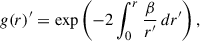 (A.1)
(A.1)
where
 (A.2)
(A.2)
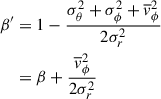
accounts for the mean streaming motion in the plane,  . This, therefore, accounts for any unmodelled rotation.
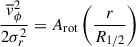
We roughly parameterise the effect of β′ using a dimensionless ‘rotation parameter’, Arot, such that the streaming motion rotation rises linearly with radius:
 (A.3)
(A.3)
where R1/2 is the projected half radius. This way, Arot = 0 corresponds to no rotation while Arot = 1/2 corresponds to an equal balance of rotation and 1D pressure support at R1/2.
Using the above simplified model for  , Equation A.1 becomes:
 (A.4)
(A.4)
We note that this is just a lower limit of the rotation, since we do not account for the inclination of a galaxy.
Appendix B: Additional sources of scatter
Here, we aim to clarify both the physical and observational contributions to scatter in the RAR.
Figure B.1 shows results of the genetically modified (GM) versions of the EDGE Halo 1459 extended down to r = 0.01 kpc, which were designed to vary only the formation time relative to reionisation. This demonstrates that differences in assembly history at fixed halo mass can induce scatter in the gbar–gobs relation comparable to that seen between different EDGE dwarfs. This supports the interpretation that the scatter in EDGE primarily arises from a combination of reionisation and assembly history effects.
Figure B.2 illustrates the additional dispersion introduced by our mass-modelling pipeline GRAVSPHERE and observational uncertainties, quantified by re-running the modelling on mock data. This shows that observational effects can increase the apparent scatter in the RAR. Once accounting for observational uncertainties, the scatter in the EDGE simulations and the real data is comparable for lower baryonic accelerations (gbar < −13.5 m s−2). At higher baryonic accelerations, however, the data show larger scatter than the simulations. This could be explained by the fact that the simulations are of isolated dwarfs while the data are for satellite dwarfs that span a wider range of pre-infall masses than EDGE (Read & Erkal 2019; Rey et al. 2025). We will explore this in more detail in future work.
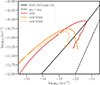 |
Fig. B.1. gobs − gbar relations for genetically modified versions of Halo 1459 (MX02, MX03) extended down to r = 0.01 kpc. The black solid line marks the RAR derived by McGaugh et al. (2016) for SPARC local spiral galaxies. The blacked dashed line marks gobs = gbar. |
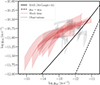 |
Fig. B.2. Effect of the mass-modelling pipeline and observational uncertainties on the RAR. The 68% scatter obtained for the observed and for the mocks from the simulated gobs − gbar relations are marked by the grey and red shaded regions, respectively. The black solid line marks the RAR derived by McGaugh et al. (2016) for SPARC local spiral galaxies. The blacked dashed line marks gobs = gbar. |
Appendix C: GravSphere fits
This appendix presents the GRAVSPHERE model fits to our observational data, allowing an assessment of how well the models reproduce the key dynamical and photometric properties of the galaxies. Figures C.1, C.2, and C.3 show the results for each galaxy in our sample. For each object, we display the line-of-sight velocity dispersion profile (left column), the surface brightness profile (centre column), and the cumulative mass profile (right column).
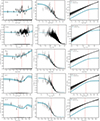 |
Fig. C.1. GRAVSPHERE fits for the velocity dispersion profile (left), surface brightness profile (centre), and mass profile (right) of the observed dwarf galaxies under study. The vertical red line in each plot represents the half-light radius. |
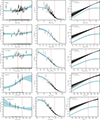 |
Fig. C.2. Continuation. |
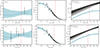 |
Fig. C.3. Continuation. |
Appendix D: Tracer density profile
Figure D.1 illustrates how the RAR of Grus I, the UFD with the fewest tracers (14 stars), is affected by changing the assumed tracer density profile ν★(r). The blue represents the case where a Plummer profile (Equation 7) is adopted, while the green correspond to an alternative αβγ profile (Equation 8). Despite this change in parametrisation, the qualitative behaviour of the RAR remains consistent, and the results agree within the 68% confidence intervals. This shows that even for the least well-sampled systems, our conclusions are robust against the choice of tracer profile. For dwarfs with larger tracer samples, the sensitivity to the assumed functional form is expected to be even lower.
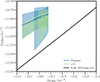 |
Fig. D.1. Comparison of the RAR of Grus I assuming two different tracer density profiles. The solid lines represent the estimated median RAR: the αβγ profile for the tracers in green, and a Plummer profile in blue. The shaded area corresponds to the 68% confidence interval. |
Appendix E: Galaxies with gas
Figure E.1 illustrates how the RARs of Antlia B and Leo T are affected by the inclusion or exclusion of their gas content. The dashed lines represent the first case, in which the gas is assumed to follow the same mass distribution as the stars, while the solid lines correspond to the scenario where only the stellar component is considered. As expected under our simplifying assumption, removing the gas shifts the RAR horizontally toward lower baryonic accelerations, without altering the overall shape of the relation. This shift reflects the reduced baryonic content at all radii when the gas is omitted. Despite this change, the qualitative behaviour of the RAR remains consistent, and our conclusions are unaffected.
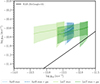 |
Fig. E.1. Comparison of the RAR of AntB and LeoT with and without their gas content. The solid lines represent their estimated median RAR considering only the mass of the stars and the dashed lines represent their estimated median RAR considering also their gas content. The shaded area corresponds to the 68% confidence interval. For this comparison, we used the gas and stellar mass described in Table 1. |
All Tables
Properties of simulated EDGE dwarf galaxies at redshift z = 0 used in this paper.
MOND internal and external accelerations of our observed sample of dwarf galaxies.
All Figures
|
Fig. 1. Stellar mass, M★, against the half-light radius, r1/2, for our galaxy sample. The circles indicate the classical dSphs, and the triangles represent the dwarfs from MUSE-Faint. Objects are colour-coded by the number of stars with velocities available for each object. The red stars represent the EDGE simulated dwarfs. |
| In the text | |
|
Fig. 2. Test of our recovery of RAR by applying GRAVSPHERE to mock data drawn from simulated EDGE dwarfs. For this test, we used all of the simulated star particles to fit the photometric light profile and a random 1000 stars to measure the line-of-sight velocity dispersion profile (similar to our more poorly sampled observed dwarfs; see Table 1). The shaded band marks the 68% confidence intervals. The true answer (as determined directly from the simulations, using Equations (1) and (2), assuming spherical symmetry) is marked by the solid lines. The solid black line marks the RAR derived by McGaugh et al. (2016) for SPARC local spiral galaxies. The dashed black line marks gobs = gbar. |
| In the text | |
|
Fig. 3. Radial acceleration relation (RAR) for our sample of dwarf galaxies. Each colour corresponds to a different galaxy, where the shaded area corresponds to the 68% confidence interval and the solid line marks the median value. The dotted lines correspond to extrapolations beyond the kinematic data range. The solid black line marks the RAR derived by McGaugh et al. (2016) for SPARC local spiral galaxies. The dashed black line marks gobs = gbar. |
| In the text | |
|
Fig. 4. Radial acceleration relation for EDGE simulated dwarf galaxies. The colours show each simulation as marked in the legend. The solid black line corresponds to the RAR derived by McGaugh et al. (2016) for SPARC local spiral galaxies. The black dashed line marks gobs = gbar. Left: RAR of lower resolution simulations. Right: RAR of higher resolution simulations. |
| In the text | |
|
Fig. 5. Quantitative comparison of the EDGE simulated RAR with our observed dwarf galaxy sample. The black solid line corresponds to the RAR derived by McGaugh et al. (2016) for SPARC local spiral galaxies. The median and 68% scatter in the observed gobs − gbar relations are marked by the grey solid lines and shaded regions, respectively. The gobs − gbar relations estimated directly from the simulations are represented by solid red lines. The blacked dashed line marks gobs = gbar. The small blue points mark the positions of the dSphs on this relation Lelli et al. (2017), while the blue circles indicate the mean and 1σ scatter of the binned data. At the bottom, the residuals relative to the McGaugh et al. (2016) relation (black solid line) are represented for the observed, the simulated, and the Lelli et al. (2017) data. |
| In the text | |
|
Fig. B.1. gobs − gbar relations for genetically modified versions of Halo 1459 (MX02, MX03) extended down to r = 0.01 kpc. The black solid line marks the RAR derived by McGaugh et al. (2016) for SPARC local spiral galaxies. The blacked dashed line marks gobs = gbar. |
| In the text | |
|
Fig. B.2. Effect of the mass-modelling pipeline and observational uncertainties on the RAR. The 68% scatter obtained for the observed and for the mocks from the simulated gobs − gbar relations are marked by the grey and red shaded regions, respectively. The black solid line marks the RAR derived by McGaugh et al. (2016) for SPARC local spiral galaxies. The blacked dashed line marks gobs = gbar. |
| In the text | |
|
Fig. C.1. GRAVSPHERE fits for the velocity dispersion profile (left), surface brightness profile (centre), and mass profile (right) of the observed dwarf galaxies under study. The vertical red line in each plot represents the half-light radius. |
| In the text | |
|
Fig. C.2. Continuation. |
| In the text | |
|
Fig. C.3. Continuation. |
| In the text | |
|
Fig. D.1. Comparison of the RAR of Grus I assuming two different tracer density profiles. The solid lines represent the estimated median RAR: the αβγ profile for the tracers in green, and a Plummer profile in blue. The shaded area corresponds to the 68% confidence interval. |
| In the text | |
|
Fig. E.1. Comparison of the RAR of AntB and LeoT with and without their gas content. The solid lines represent their estimated median RAR considering only the mass of the stars and the dashed lines represent their estimated median RAR considering also their gas content. The shaded area corresponds to the 68% confidence interval. For this comparison, we used the gas and stellar mass described in Table 1. |
| In the text | |
Current usage metrics show cumulative count of Article Views (full-text article views including HTML views, PDF and ePub downloads, according to the available data) and Abstracts Views on Vision4Press platform.
Data correspond to usage on the plateform after 2015. The current usage metrics is available 48-96 hours after online publication and is updated daily on week days.
Initial download of the metrics may take a while.