


| Issue |
A&A
Volume 707, March 2026
|
|
|---|---|---|
| Article Number | A275 | |
| Number of page(s) | 9 | |
| Section | Catalogs and data | |
| DOI | https://doi.org/10.1051/0004-6361/202558188 | |
| Published online | 19 March 2026 | |
A rotation-based census of blue lurker candidates in open clusters
1
Astronomical Institute, Faculty of Mathematics and Physics, Charles University,
V Holesovickách 2,
180 00
Praha 8,
Czech Republic
2
Institute of Astronomy, National Central University,
300 Zhongda Road,
Zhongli
32001
Taoyuan,
Taiwan
3
Dipartimento di Fisica e Astronomia, Università di Firenze,
Via G. Sansone 1,
50019
Sesto Fiorentino,
FI,
Italy
4
INAF – Osservatorio Astrofisico di Arcetri,
Largo E. Fermi 5,
50125
Firenze,
Italy
★ Corresponding authors: This email address is being protected from spambots. You need JavaScript enabled to view it.
; This email address is being protected from spambots. You need JavaScript enabled to view it.
; This email address is being protected from spambots. You need JavaScript enabled to view it.
Received:
21
November
2025
Accepted:
28
January
2026
Abstract
Aims. We have compiled a list of blue lurker (BL) candidates in open clusters using the available rotation catalogs. Blue lurkers are rejuvenated main-sequence stars hidden among normal main-sequence stars on color-magnitude diagrams of star clusters. In comparison to BLs, blue straggler stars, which formed via similar mass transfers or mergers, occupy a distinct space in color-magnitude diagrams.
Methods. Blue lurkers can be identified by their unusually faster rotation compared to similar mass stars, which is a signature of recent accretion, or by the presence of a companion (e.g., an extremely low mass white dwarf), which can only be formed by mass donation. We searched for fast-rotating stars on the main sequence of open clusters using Kepler, TESS, and spectroscopic rotation indicators, such as rotation periods and v sin i measurements.
Results. We identified 97 new BL candidates across 35 open clusters, almost tripling the previously known sample of 36. Based on the estimated completeness of ≈3%, thousands of BLs are likely hidden within the cluster population. Detailed spectroscopic and time series analyses will be essential to confirming their mass-transfer histories.
Key words: methods: observational / catalogs / binaries: general / blue stragglers / stars: rotation / open clusters and associations: general
© The Authors 2026
 Open Access article, published by EDP Sciences, under the terms of the Creative Commons Attribution License (https://creativecommons.org/licenses/by/4.0), which permits unrestricted use, distribution, and reproduction in any medium, provided the original work is properly cited.
This article is published in open access under the Subscribe to Open model. This email address is being protected from spambots. You need JavaScript enabled to view it. to support open access publication.
1 Introduction
Stars that undergo mass exchange or mergers can experience rejuvenation, appearing younger and more massive than predicted by single stellar evolution. The most prominent examples of such systems are blue straggler stars (BSSs), which lie above and to the bluer side of the main-sequence turnoff (MSTO) in cluster color-magnitude diagrams (CMDs). These stars are understood to form through mass transfer in binaries (McCrea 1964) or stellar mergers or collisions (Hills & Day 1976).
A related but less conspicuous class, known as blue lurkers (BLs), represents main-sequence stars that have also undergone mass accretion or mergers but remain photometrically indistinguishable from normal main-sequence stars. Blue lurkers are therefore considered the main-sequence counterparts of BSSs (see Sect. 2 for a formal definition).
Both BSSs and BLs are key to understanding the longterm effects of binary evolution, angular momentum transfer, and mass exchange in stellar populations. While most known examples reside in star clusters, Galactic field counterparts have also been identified (Bond & MacConnell 1971; Bhat et al. 2025), suggesting that similar processes operate in diverse Galactic environments. Comprehensive reviews by Mathieu & Pols (2025) and Wang & Ryu (2026) summarize the growing importance of these systems as probes of stellar interaction and rejuvenation.
The first dedicated search for BLs was conducted by Leiner et al. (2019), who used K2 light curves and v sin i measurements to identify rapidly rotating main-sequence stars in M 67. Jadhav et al. (2019) subsequently identified another BL in the same cluster based on the presence of an extremely low-mass white dwarf companion, which is a clear signature of past mass transfer. Since then, several clusters have been shown to host BL candidates (Subramaniam et al. 2020; Dattatrey et al. 2023; Narayan et al. 2026). However, no large-scale survey exists due to the rarity of these objects and the limited number of well-studied host clusters. Chemical signatures of accreted material could also reveal such systems, though no systematic abundance study has been undertaken yet.
There are more than 4000 BSSs known among Galactic globular clusters and more than 2000 among open clusters (Simunovic & Puzia 2016; Rain et al. 2021; Jadhav & Subramaniam 2021; Li et al. 2023; Carrasco-Varela et al. 2025). Assuming BSSs and BLs are formed by similar mechanisms, their population sizes should be similar within a cluster. This means that there should be thousands of BLs lurking along the main sequences.
In this work, we aim to present a formal definition of BLs and to compile a list of BL candidates. Similar to Leiner et al. (2019), we identify fast-rotating main-sequence stars that are potential BL candidates by using rotation catalogs derived from TESS, Kepler, and spectroscopic observations of open clusters.
2 The definition
Blue straggler stars are defined observationally as stars bluer and brighter than the cluster turnoff. However, the terms “bluer”, “brighter”, and even “turnoff” lack strict quantitative definitions. Moreover, the choice of CMD can influence which stars are classified as BSSs. For instance, UV-based CMDs used in globular clusters yield different selections than optical CMDs (Raso et al. 2017). Moreover, BSSs can have various ages (100 Myr-13 Gyr) and masses (10-0.9 M⊙) depending on the properties (age and MSTO mass) of their host clusters (Jadhav & Subramaniam 2021 ; Carrasco-Varela et al. 2025), and they can be single or part of a binary or higher-order system.
In the literature, the term “field-BSS” is used. These stars are typically identified through chemical peculiarities and age diagnostics, such as halo-like kinematics or low metallicity, that are inconsistent with their CMD positions (Bond & MacConnell 1971; Panthi et al. 2023). In such cases, the BSS moniker denotes evidence of a past mass-accretion event, even though no reference population (e.g., a cluster) is available to define their relative bluer or brighter nature.
Compared to BSSs, BLs are a more recently proposed class of objects, loosely defined and typically characterized by their method of detection rather than by strict physical criteria. A BL can be identified as (i) a fast rotator on the main sequence (Leiner et al. 2019); (ii) a main-sequence star hosting companions that can only form through mass transfer (specifically via mass accretion by the BL component; Jadhav et al. 2024); or (iii) a main-sequence star showing chemical signatures of past accretion, such as Li/C/O depletion or s-process element enhancement. However, an individual BL candidate may not satisfy all of these criteria, similar to how not all BSSs meet every diagnostic test.
To further complicate things, Bhat et al. (2025) recently proposed a term “field-pre-BL” (a BL progenitor in the field) for a low-mass system expected to undergo future mass transfer. However, stellar mass alone cannot be used to differentiate between a field-BSS and a field-BL without a clear and unified definition. Similar to the BSSs, BLs also have a range in mass (smaller than the cluster turnoffs) and age (all possible cluster ages from a few megayears to several gigayears). In fact, a BL in a young cluster can be more massive than a BSS in an old cluster. Furthermore, despite their name, BLs are not necessarily bluer in color, highlighting the need for a more physically motivated definition.
To decouple the definitions of BSSs and BLs from dependencies on mass, color, or host cluster properties, we propose the following physically motivated definitions1:
Blue straggler: a H-core-burning star that has gained mass through mergers, collisions, or mass transfer among relatively coeval stellar components to such a degree that a single star of comparable mass would have already evolved off the main sequence according to the standard single stellar evolutionary theory.
Blue lurker: A H-core-burning star that has gained mass through mergers, collisions, or mass transfer among relatively coeval stellar components to such a degree that a single star of comparable mass would still be on the main sequence according to the standard single stellar evolutionary theory.
Only the BSSs and BLs lying within clusters should be referred to as BSSs and BLs, while those in the field should be referred to as field-BSSs and field-BLs. These definitions are not perfect, as confirming H-core burning or accurately estimating the masses of post-interaction stars remains nontrivial, and no single stellar evolution model is without limitations. Furthermore, the unrestricted definitions encompass all stellar interactions resulting in a H-core burning star, classifying them as either a BSS or a BL. Nevertheless, the proposed definitions provide a useful conceptual framework for distinguishing between BSSs, field-BSSs, BLs, and field-BLs.
Differentiating between field-BLs and field-BSSs also requires knowledge of the progenitor ages. The most easily identifiable field-BLs are likely to be those that can be dynamically associated with a star cluster, such as ejected members or stars belonging to tidal tails, where the cluster age provides an independent constraint on the system’s age.
We note that these definitions assume that all stellar components were coeval, as is expected for the majority of stellar interactions. However, in rare cases, dynamical captures can produce binaries composed of stars with different ages (Gómez Maqueo Chew et al. 2012; Malkov & Kniazev 2022). Such systems may later interact, undergo rejuvenation, and form analogs of BSSs or BLs. We leave the naming of such systems to their discoverers.
3 Blue lurker selection
3.1 Identification based on stellar rotation
We compiled stellar rotation (Protation and v sin i) from multiple literature sources that analyzed one or more open clusters. The sample includes data from WIYN spectroscopy (Geller et al. 2010; Linck et al. 2024), TESS light curves (Healy et al. 2023; Sha et al. 2024), Kepler/K2 light curves (Douglas et al. 2019; Curtis et al. 2020), and STELLA telescope light curves (Fritzewski et al. 2023). We further incorporated the literaturebased rotation catalog of Van-Lane et al. (2025), who compiled period measurements derived from light-curve analyses using TESS, Kepler, K2, and Blanco telescope observations. Additionally, we crossmatched the Cantat-Gaudin et al. (2020) and Hunt & Reffert (2024) open cluster membership catalogs with Gaia-ESO DR5.1 (Bragaglia et al. 2022; Hourihane et al. 2023) to facilitate v sin i based selection. The catalogs were culled as recommended to remove invalid data or nonmembers.
We created diagnostic figures similar to Fig. 1 for all clusters. Figures A.1 and A.2 show the primary diagnostic plot for all clusters where BL candidates are identified via rotation. Note that the position of BLs known in the literature (which can be slow rotating) is also highlighted in Figs. A.1 and A.2 (e.g., in NGC 2682).
The BL candidates were selected based on their fast rotation among cluster members with either Protation <−5 days or v sin i >−30 km s−1. We also used an automated outlier detection algorithm (ISOLATIONFOREST from SKLEARN) to aid the outlier identification. However, no outlier detection algorithm is perfect, and they are heavily affected by the choice of various hyperparameters. We visually inspected the diagnostic plots with these outliers and manually created a list of BL candidates by adding or removing the automatically detected outliers. Radial velocity outliers (>3 standard deviations from the cluster mean value) were noted but not removed (discussed more in Sect. 4).
The detailed list of BL candidates is given in Table 1. We also list the previously identified BL candidates reported in the literature (bottom part of Table 1). Of the total 133 BL candidates, 12 were detected in X-ray, 35 have an excess UV flux (18 known from literature and 28 identified in Sect. 3.2), and 21 are eclipsing and spectroscopic binaries. Six outliers were classified as young stellar objects in the literature and were removed from the BL candidates. In addition, Bhat et al. (2025) mentioned a field-pre-BL candidate (Gaia DR3 4265540383431508736) that is not part of the list.
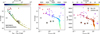 |
Fig. 1 Diagnostic plots for NGC 6811. Panel a: apparent Gaia CMD colored according to the rotation period (Van-Lane et al. 2025). Panel b: distribution of Protation and Gaia G magnitude colored according to the temperature. If the temperature was unavailable, the stars are shown as gray dots. Panel c: distribution of Protation and temperature colored according to the G magnitude. The BL candidates (black squares) and the automatically detected outliers (red crosses) are highlighted. |
Catalog of new (97) and previously known (36) BL candidates.
3.2 Spectral energy distributions
To create spectral energy distributions (SEDs) of the BL candidates, we used pre-computed crossmatches (which propagated proper motions, e.g., Marrese et al. 2017; Bianchi & Shiao 2020) to compile photometry from 2MASS (Cutri et al. 2003), GALEX GUVcat_AIS GR6+7 (Bianchi et al. 2017), PanSTARRS DR1 (Chambers et al. 2016), SDSS DR16 (Ahumada et al. 2020), and WISE (Cutri et al. 2021). Additionally, we performed a ≤1″ on-sky crossmatch with UVIT/AstroSat (Jadhav et al. 2021b, 2023, 2024; Piridi et al. 2024) and UVOT/Swift (Siegel et al. 2019) catalogs. Most sources have optical and IR data, while only 40 have a detection in at least one UV filter. Synthetic photometry for UVBRIugrizy, F606W, and F814W passbands from Gaia DR3 (Gaia Collaboration 2023) was used to augment any available data. A few SEDs were not fit either due to insufficient data or due to spatial crowding, which can lead to photometric contamination in non-Gaia filters.
The optical-IR SEDs were fit with the Kurucz-UVBLUE hybrid model (Castelli & Kurucz 2003; Rodríguez-Merino et al. 2005). The hybrid spectral models use the UVBLUE model for wavelengths <4700 Å and the Kurucz model in the redder region. The optical-IR SEDs were fit using BINARY_SED_FITTING2 (Jadhav et al. 2021a; Jadhav 2024) while assuming that the stellar distances, extinctions, and metal-licities are the same as the host cluster. The UV points were deliberately ignored in the fitting process to compare the observed UV flux with the expected flux of a single star.
The BL candidates span 4000-9000 K in Teff and 0.53.2 R⊙ in radii. The best-fit SED parameters for sources with enough data and reliable fits are listed in Table 1. We detected a significant fractional residual [(Fobs - Fmodel)/Fobs ≥ 0.3] in at least one UV filter for 28 BL candidates (we note that UV excess was already acknowledged in the literature for many of these sources). Figure A.3 shows the SEDs of the six BL candidates with excess flux in at least three UV filters. The number of UV excess filters is given in Table 1.
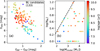 |
Fig. 2 Photometric properties and statistics of BL candidates. Panel a: absolute Gaia CMD of the 133 BL candidates. Panel b: distribution of the number of BLs and the cluster mass. The points are colored according to cluster age. The dashed line shows the upper limit on the number of BSSs for a given cluster mass, and it is taken from Jadhav & Subramaniam (2021, Eq. (1)). The four BLs in the globular cluster NGC 362 were assigned an age of 13 Gyr in panel a for visual convenience. |
4 Discussion
Figure 2a shows the absolute Gaia CMD of the BL candidates. Their (photometric) masses are in the range of 0.5-3 M⊙. The host open clusters have an age range of 18 Myr-7 Gyr (Cantat-Gaudin et al. 2020) and a mass range of 120-25000 M⊙ (Hunt & Reffert 2024). Figure 2b shows the number of BLs and the cluster mass. The dashed line is the empirical upper limit on the number of BSSs in a cluster (Jadhav & Subramaniam 2021, Eq. (1)). The agreement with the BSS limit for the BLs shows that the number of BSSs and BLs has a similar dependence on the cluster mass.
Confirming genuine BLs requires detection by more than one method of identification. Cross-verification between photometric and spectroscopic rotation indicators, using light-curve analysis of v sin i outliers and v sin i measurements of photometric outliers, will help confirm the rapid rotation of a potential BL. As mentioned in Sect. 2, BLs can also be identified through diagnostics unrelated to rotation. Characterizing their companions, such as extremely low mass white dwarfs, via spectroscopy or SEDs provides a powerful alternative approach. Similarly, chemical peculiarities such as s-process element enrichment or Li/C/O depletion in main-sequence stars may indicate a past episode of mass transfer. Similar to BSSs, most BLs are expected to reside in binary systems. Therefore, radial velocity monitoring is essential to identifying spectroscopic binaries and determining their orbital parameters and companion properties. Ultraviolet observations will further aid in detecting and characterizing hot compact companions by providing direct evidence of past mass transfer. The 28 BL candidates we identified with UV excess are perfect candidates for such analysis.
A subset of the BL candidates shows radial velocities inconsistent with their host clusters (highlighted in Table 1). These stars could be nonmembers or part of binary systems, which appear as outliers due to the orbital motion. Further RV monitoring is required to confirm membership and, for spectroscopic binaries, to determine their orbital and stellar parameters.
4.1 Contamination
Apart from mass accretion, stars can be fast-rotating due to other reasons and thus could represent false positives in our sample. (i) Most intermediate stellar mass stars (≈ 1.3-8 M⊙) are born as fast rotators (Cordoni et al. 2024), and they do not slow down significantly during their main-sequence lifetimes due to radiative envelopes, unless they are in short-period binary systems. Therefore, their maximum v sin i is observed to range from 100 km s−1 to 400 km s−1. (ii) Pre-main-sequence stars are also expected to spin up when they contract on the main sequence (Bouvier et al. 2014). The candidate list we obtained contains ten BLs in clusters younger than 100 Myr. These objects may be intrinsic fast rotators due to their youth rather than past mass-transfer events. (iii) High stellar rotation can arise from tidally locked close binaries without any history of mass transfer (Moraux et al. 2013). (iv) Rotation measurements can be affected by contamination from solar or lunar cycles (Getman et al. 2023), or by light-curve misclassification. (v) Minimal magnetic breaking in stars hotter than the Kraft break at 6200 K can lead to faster rotation (Schatzman 1962; Kraft 1967; Beyer & White 2024). (vi) The false positives can also be caused by erroneous rotation (Protation or v sin i) measurements. (vii) As younger stars typically rotate faster, misclassification of a younger star as a cluster member could result in a false BL classification. Improved membership catalogs and spectroscopic follow-up will be essential for refining the sample and quantifying its purity.
4.2 Completeness
4.2.1 Missing BLs due to the rotation detectability
The rotation-based search is only sensitive to stars exhibiting detectable photometric modulation or spectroscopic rotational broadening. Consequently, the present list excludes stars with minimal surface spot coverage, resulting in undetectable lightcurve periodicity, and those with low inclination angles that lead to a small v sin i. BSSs are known to spin up after mass transfer and subsequently spin down with time (Nine et al. 2023). A similar scenario likely applies to BLs, which may lose angular momentum and slow their rotation. The severity of the slowdown is determined by the mass of the BL: The lower mass BLs with convective envelopes slow down faster compared to more massive BLs with radiative envelopes. Determining the cooling ages of the white dwarf companions of BLs, in various mass ranges, offers a direct way to test this hypothesis. If there are too many rapidly rotating BLs in a cluster, then they would not appear as outliers and would be missed in this work. More theoretical effort is required to define the nominal rotation periods of stars across evolutionary phases (e.g., pre-main sequence, split main sequence, or extended MSTO) and to establish thresholds for identifying anomalously rapid rotators.
4.2.2 Missing BLs due to selection effects
Our identification process depends on cluster membership determination, which itself may include false positives and negatives. Moreover, since BLs are likely to reside in binaries, as suggested by the high binary fraction among BSSs, their astrometric solutions in Gaia can show excess noise, leading to their exclusion from membership catalogs (see discussion in Tagaev & Seleznev 2025 regarding the Hunt & Reffert 2024 catalog).
4.2.3 Completeness of the selection based on v sin i
Based on Gaia DR3-Radial Velocity Spectrometer (RVS) and Gaia-ESO DR5.1 data, 199 out of the 274 BSSs with measured v sin i values are rapid rotators (v sin i >−30 km s−1). Assuming BLs exhibit similar rotational properties, an ideal rotation-based census would detect roughly 72% of them. However, as not all high-v sin i stars are BLs and as our list excludes many fast rotators from intermediate-mass stars (1.5-8 M⊙) to avoid contamination, the effective completeness of the presented BL catalog is less than 72%. Conservatively assuming that 20% of the member stars are missing in Gaia membership catalogs (Tagaev & Seleznev 2025), the completeness reduces to less than 58% (72 × 0.8% = 58%). Furthermore, only about 5% of cluster main-sequence stars currently have v sin i measurements (based on Hunt & Reffert 2024 and Cantat-Gaudin et al. 2020 membership and Gaia -ESO, LAMOST, APOGEE, and GALAH surveys). Thus, the overall completeness is less than 2.9% (72 × 0.8 × 0.05% = 2.9%). The roughly 60 v sin i-based BL candidates identified in this work suggest a total BL population of more than approximately 2000, which is comparable to the current census of known open cluster BSSs. Since BLs remain on the main sequence for longer timescales after formation and can occupy the full extent of the main sequence, their intrinsic population could in fact exceed that of BSSs. This highlights the fact that rotation-based census is powerful in identifying BL candidates; however, it is primarily limited by data availability and quality.
5 Conclusions and summary
We conducted an observational survey of BL candidates in open clusters. Overall, we identified 97 new BL candidates across 35 open clusters using rotation measurements derived from TESS, Kepler, K2, and Gaia-ESO survey data. Including the 36 previously known BL candidates from five open clusters and one globular cluster, the total number of known or suspected BLs now stands at 133.
Based on clusters with significant BL and BSS populations, we expect their numbers to be comparable. Given that more than 4000 open cluster BSSs are currently known and the estimated ≈3% completeness of the present BL catalog, thousands of BLs likely remain undetected within Galactic clusters. Together, BLs and BSSs may constitute 5-10% of the total cluster population, underscoring their importance in refining our understanding of single and binary stellar evolution.
Expanding TESS-based rotation measurements for clusters and wide-scale spectroscopic data will be crucial to identifying additional BLs, and similar analyses of cluster tidal tails could reveal field-BLs dynamically linked to their parent clusters. Known binary BL candidates warrant targeted follow-up, while coordinated time series, spectroscopic, and UV observations will be essential to confirming their mass-transfer histories and establishing a comprehensive census of these post-interaction systems.
As most BSS progenitors are stars near the MSTO, their main-sequence lifetimes are typically extended as a result of mass accretion (Wang & Ryu 2026). In contrast, BLs may gain sufficient mass to accelerate their H-burning, thereby shortening their main-sequence phase. Hydrodynamical simulations exploring a grid of accretor birth masses, accreted mass, the H-content of the accreted material, the internal mixing, and epochs of mass transfer will be instrumental in identifying the regions of parameter space that lead to either lifetime extension following accretion or a more rapid evolutionary demise.
Overall, understanding the frequency and evolution of such interacting binaries is key to refining models of stellar populations. These systems highlight the limitations of singlestar evolutionary assumptions and emphasize the need for binary-inclusive frameworks to explain the observed properties of resolved and unresolved populations.
Data availability
The full version of Table 1 is available at the CDS via https://cdsarc.cds.unistra.fr/viz-bin/cat/J/A+A/707/A275.
Acknowledgements
We thank the anonymous referee for quick and constructive comments. E.R. acknowledges the support from the European Union (ERC-2022-AdG, “StarDance: the non-canonical evolution of stars in clusters”, Grant Agreement 101093572, PI: E. Pancino). Views and opinions expressed are, however, those of the author(s) only and do not necessarily reflect those of the European Union or the European Research Council. Neither the European Union nor the granting authority can be held responsible for them. The work used the following tools for the analysis: ASTROPY (Astropy Collaboration 2022); Astroquery (Ginsburg et al. 2019); Matplotlib (Hunter 2007); NumPy (Harris et al. 2020); SCIKIT-LEARN (Pedregosa et al. 2011); TOPCAT (Taylor 2005).
References
- Ahumada, R., Allende Prieto, C., Almeida, A., et al. 2020, ApJS, 249, 3 [NASA ADS] [CrossRef] [Google Scholar]
- Astropy Collaboration (Price-Whelan, A. M., et al.) 2022, ApJ, 935, 167 [NASA ADS] [CrossRef] [Google Scholar]
- Beyer, A. C., & White, R. J. 2024, ApJ, 973, 28 [Google Scholar]
- Bhat, A., Dorsch, M., Geier, S., et al. 2025, A&A, 700, L23 [NASA ADS] [CrossRef] [EDP Sciences] [Google Scholar]
- Bianchi, L., & Shiao, B. 2020, ApJS, 250, 36 [Google Scholar]
- Bianchi, L., Shiao, B., & Thilker, D. 2017, ApJS, 230, 24 [Google Scholar]
- Bond, H. E., & MacConnell, D. J. 1971, ApJ, 165, 51 [Google Scholar]
- Bouvier, J., Matt, S. P., Mohanty, S., et al. 2014, in Protostars and Planets VI, eds. H. Beuther, R. S. Klessen, C. P. Dullemond, & T. Henning (Tucson: University of Arizona Press), 433 [Google Scholar]
- Bragaglia, A., Alfaro, E. J., Flaccomio, E., et al. 2022, A&A, 659, A200 [NASA ADS] [CrossRef] [EDP Sciences] [Google Scholar]
- Cantat-Gaudin, T., Anders, F., Castro-Ginard, A., et al. 2020, A&A, 640, A1 [NASA ADS] [CrossRef] [EDP Sciences] [Google Scholar]
- Carrasco-Varela, F. F., Nayak, P. K., & Puzia, T. H. 2025, A&A, 699, A142 [NASA ADS] [CrossRef] [EDP Sciences] [Google Scholar]
- Castelli, F., & Kurucz, R. L. 2003, IAU Symp., 210, A20 [Google Scholar]
- Chambers, K. C., Magnier, E. A., Metcalfe, N., et al. 2016, arXiv e-prints [arXiv:1612.05560] [Google Scholar]
- Cordoni, G., Casagrande, L., Yu, J., et al. 2024, MNRAS, 532, 1547 [CrossRef] [Google Scholar]
- Curtis, J. L., Agüeros, M. A., Matt, S. P., et al. 2020, ApJ, 904, 140 [Google Scholar]
- Cutri, R. M., Skrutskie, M. F., van Dyk, S., et al. 2003, VizieR On-line Data Catalog: II/246 [Google Scholar]
- Cutri, R. M., Wright, E. L., Conrow, T., et al. 2021, VizieR On-line Data Catalog: II/328 [Google Scholar]
- Dattatrey, A. K., Yadav, R. K. S., Kumawat, G., et al. 2023, MNRAS, 523, L58 [CrossRef] [Google Scholar]
- Douglas, S. T., Curtis, J. L., Agüeros, M. A., et al. 2019, ApJ, 879, 100 [Google Scholar]
- Fritzewski, D. J., Barnes, S. A., Weingrill, J., et al. 2023, A&A, 674, A152 [NASA ADS] [CrossRef] [EDP Sciences] [Google Scholar]
- Gaia Collaboration (Montegriffo, P., et al.) 2023, A&A, 674, A33 [CrossRef] [EDP Sciences] [Google Scholar]
- Geller, A. M., Mathieu, R. D., Braden, E. K., et al. 2010, AJ, 139, 1383 [Google Scholar]
- Getman, K. V., Feigelson, E. D., & Garmire, G. P. 2023, ApJ, 952, 63 [NASA ADS] [CrossRef] [Google Scholar]
- Ginsburg, A., Sipocz, B. M., Brasseur, C. E., et al. 2019, AJ, 157, 98 [NASA ADS] [CrossRef] [Google Scholar]
- Gómez Maqueo Chew, Y., Stassun, K. G., Prša, A., et al. 2012, ApJ, 745, 58 [Google Scholar]
- Harris, C. R., Millman, K. J., van der Walt, S. J., et al. 2020, Nature, 585, 357 [NASA ADS] [CrossRef] [Google Scholar]
- Healy, B. F., McCullough, P. R., Schlaufman, K. C., & Kovacs, G. 2023, ApJ, 944, 39 [NASA ADS] [CrossRef] [Google Scholar]
- Hills, J. G., & Day, C. A. 1976, Astrophys. Lett., 17, 87 [NASA ADS] [Google Scholar]
- Hourihane, A., François, P., Worley, C. C., et al. 2023, A&A, 676, A129 [NASA ADS] [CrossRef] [EDP Sciences] [Google Scholar]
- Hunt, E. L., & Reffert, S. 2024, A&A, 686, A42 [NASA ADS] [CrossRef] [EDP Sciences] [Google Scholar]
- Hunter, J. D. 2007, Comput. Sci. Eng., 9, 90 [NASA ADS] [CrossRef] [Google Scholar]
- Jadhav, V. V. 2024, https://doi.org/10.5281/zenodo.13928317 [Google Scholar]
- Jadhav, V. V., & Subramaniam, A. 2021, MNRAS, 507, 1699 [NASA ADS] [CrossRef] [Google Scholar]
- Jadhav, V. V., Sindhu, N., & Subramaniam, A. 2019, ApJ, 886, 13 [NASA ADS] [CrossRef] [Google Scholar]
- Jadhav, V. V., Pandey, S., Subramaniam, A., & Sagar, R. 2021a, J. Astrophys. Astron., 42, 89 [NASA ADS] [CrossRef] [Google Scholar]
- Jadhav, V. V., Pennock, C. M., Subramaniam, A., Sagar, R., & Nayak, P. K. 2021b, MNRAS, 503, 236 [NASA ADS] [CrossRef] [Google Scholar]
- Jadhav, V. V., Subramaniam, A., & Sagar, R. 2023, A&A, 676, A47 [NASA ADS] [CrossRef] [EDP Sciences] [Google Scholar]
- Jadhav, V. V., Subramaniam, A., & Sagar, R. 2024, A&A, 688, A152 [NASA ADS] [CrossRef] [EDP Sciences] [Google Scholar]
- Kraft, R. P. 1967, ApJ, 150, 551 [Google Scholar]
- Leiner, E., Mathieu, R. D., Vanderburg, A., Gosnell, N. M., & Smith, J. C. 2019, ApJ, 881, 47 [Google Scholar]
- Li, C., Zhong, J., Qin, S., & Chen, L. 2023, A&A, 672, A81 [NASA ADS] [CrossRef] [EDP Sciences] [Google Scholar]
- Linck, E., Mathieu, R. D., & Latham, D. W. 2024, AJ, 168, 205 [Google Scholar]
- Malkov, O., & Kniazev, A. 2022, Open Astron., 31, 327 [Google Scholar]
- Marrese, P. M., Marinoni, S., Fabrizio, M., & Giuffrida, G. 2017, A&A, 607, A105 [NASA ADS] [CrossRef] [EDP Sciences] [Google Scholar]
- Mathieu, R. D., & Pols, O. R. 2025, ARA&A, 63, 467 [Google Scholar]
- McCrea, W. H. 1964, MNRAS, 128, 147 [Google Scholar]
- Moraux, E., Artemenko, S., Bouvier, J., et al. 2013, A&A, 560, A13 [NASA ADS] [CrossRef] [EDP Sciences] [Google Scholar]
- Narayan, R. S., Linck, E., Mathieu, R. D., & Geller, A. M. 2026, AJ, 171, 102 [Google Scholar]
- Nine, A. C., Mathieu, R. D., Gosnell, N. M., & Leiner, E. M. 2023, ApJ, 944, 145 [NASA ADS] [CrossRef] [Google Scholar]
- Panthi, A., & Vaidya, K. 2024, MNRAS, 527, 10335 [Google Scholar]
- Panthi, A., Subramaniam, A., Vaidya, K., et al. 2023, MNRAS, 525, 1311 [NASA ADS] [CrossRef] [Google Scholar]
- Pedregosa, F., Varoquaux, G., Gramfort, A., et al. 2011, J. Mach. Learn. Res., 12, 2825 [Google Scholar]
- Piridi, S., Kumar, R., Pandey, D., & Pradhan, A. C. 2024, ApJS, 275, 34 [Google Scholar]
- Rain, M. J., Ahumada, J. A., & Carraro, G. 2021, A&A, 650, A67 [NASA ADS] [CrossRef] [EDP Sciences] [Google Scholar]
- Rao, K. K., Vaidya, K., Agarwal, M., Balan, S., & Bhattacharya, S. 2023, MNRAS, 526, 1057 [Google Scholar]
- Raso, S., Ferraro, F. R., Dalessandro, E., et al. 2017, ApJ, 839, 64 [NASA ADS] [CrossRef] [Google Scholar]
- Rodríguez-Merino, L. H., Chavez, M., Bertone, E., & Buzzoni, A. 2005, ApJ, 626, 411 [Google Scholar]
- Schatzman, E. 1962, Annal. Astrophys., 25, 18 [Google Scholar]
- Sha, L., Vanderburg, A. M., Bouma, L. G., & Huang, C. X. 2024, ApJ, 977, 103 [Google Scholar]
- Siegel, M. H., LaPorte, S. J., Porterfield, B. L., Hagen, L. M. Z., & Gronwall, C. A. 2019, AJ, 158, 35 [Google Scholar]
- Simunovic, M., & Puzia, T. H. 2016, MNRAS, 462, 3401 [Google Scholar]
- Subramaniam, A., Pandey, S., Jadhav, V. V., & Sahu, S. 2020, J. Astrophys. Astron., 41, 45 [NASA ADS] [CrossRef] [Google Scholar]
- Tagaev, D. I., & Seleznev, A. F. 2025, arXiv e-prints [arXiv:2509.10435] [Google Scholar]
- Taylor, M. B. 2005, ASP Conf. Ser., 347, 29 [Google Scholar]
- Van-Lane, P. R., Speagle, J. S., Eadie, G. M., et al. 2025, ApJ, 986, 59 [Google Scholar]
- Wang, C., & Ryu, T. 2026, in Encyclopedia of Astrophysics (USA: Callisto Reference), 2, 449 [Google Scholar]
Similarly, a “yellow straggler” would be a post-main-sequence subgiant or giant star that has gained mass through mergers, collisions, or mass transfer among relatively coeval stellar components.
Appendix A Supplementary table and figures
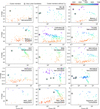 |
Fig. A.1 Distribution of the rotation periods and Gaia G magnitudes for clusters analyzed with light curves. The stars are colored by their temperature (if unavailable, the stars are shown as gray dots). The BL candidates are highlighted by the black squares. |
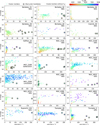 |
Fig. A.2 Distribution of the v sin i and Gaia G magnitudes for clusters analyzed with spectroscopy. The stars are colored by their temperature (if unavailable, the stars are shown as gray dots). The BL candidates are highlighted by the black squares. |
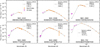 |
Fig. A.3 Spectral energy distributions of stars with significant excess flux in at least three UV filters. The UV (magenta) and optical-IR fluxes (orange) are shown using the corresponding flux errors. The best-fit Kurucz-UVBLUE model is shown in gray. |
All Tables
All Figures
|
Fig. 1 Diagnostic plots for NGC 6811. Panel a: apparent Gaia CMD colored according to the rotation period (Van-Lane et al. 2025). Panel b: distribution of Protation and Gaia G magnitude colored according to the temperature. If the temperature was unavailable, the stars are shown as gray dots. Panel c: distribution of Protation and temperature colored according to the G magnitude. The BL candidates (black squares) and the automatically detected outliers (red crosses) are highlighted. |
| In the text | |
|
Fig. 2 Photometric properties and statistics of BL candidates. Panel a: absolute Gaia CMD of the 133 BL candidates. Panel b: distribution of the number of BLs and the cluster mass. The points are colored according to cluster age. The dashed line shows the upper limit on the number of BSSs for a given cluster mass, and it is taken from Jadhav & Subramaniam (2021, Eq. (1)). The four BLs in the globular cluster NGC 362 were assigned an age of 13 Gyr in panel a for visual convenience. |
| In the text | |
|
Fig. A.1 Distribution of the rotation periods and Gaia G magnitudes for clusters analyzed with light curves. The stars are colored by their temperature (if unavailable, the stars are shown as gray dots). The BL candidates are highlighted by the black squares. |
| In the text | |
|
Fig. A.2 Distribution of the v sin i and Gaia G magnitudes for clusters analyzed with spectroscopy. The stars are colored by their temperature (if unavailable, the stars are shown as gray dots). The BL candidates are highlighted by the black squares. |
| In the text | |
|
Fig. A.3 Spectral energy distributions of stars with significant excess flux in at least three UV filters. The UV (magenta) and optical-IR fluxes (orange) are shown using the corresponding flux errors. The best-fit Kurucz-UVBLUE model is shown in gray. |
| In the text | |
Current usage metrics show cumulative count of Article Views (full-text article views including HTML views, PDF and ePub downloads, according to the available data) and Abstracts Views on Vision4Press platform.
Data correspond to usage on the plateform after 2015. The current usage metrics is available 48-96 hours after online publication and is updated daily on week days.
Initial download of the metrics may take a while.