


| Issue |
A&A
Volume 707, March 2026
|
|
|---|---|---|
| Article Number | A295 | |
| Number of page(s) | 4 | |
| Section | Celestial mechanics and astrometry | |
| DOI | https://doi.org/10.1051/0004-6361/202558803 | |
| Published online | 23 March 2026 | |
Two birds with one stone: Simultaneous realization of Lunar Coordinate Time and lunar geoid time with a single orbital clock
1
Purple Mountain Observatory, Chinese Academy of Sciences,
Nanjing
210023,
China
2
School of Astronomy and Space Science, University of Science and Technology of China,
Hefei
230026,
China
3
Shanghai Astronomical Observatory, Chinese Academy of Sciences,
Shanghai
200030,
China
4
School of Astronomy and Space Science, University of Chinese Academy of Sciences,
Beijing
100049,
China
★ Corresponding author: This email address is being protected from spambots. You need JavaScript enabled to view it.
Received:
28
December
2025
Accepted:
21
February
2026
Abstract
Context. There are three options for defining the lunar reference time. Option O1, using Lunar Coordinate Time, has the advantage of simplicity, while options O2 – using the lunar geoid (selenoid) time – and O3 – using an average alignment with Terrestrial Time – have the advantage of convenience for users with instruments on the lunar surface and those using Earth navigation satellite signals, respectively. Clock steering must be performed for all three options. O2 and O3 provide new scalings of spatial coordinates and mass parameters in the Solar System.
Aims. We propose a ‘time-aligned orbit’ in which the readings of an ideal clock in this orbit are equal to the selenoid time in O2; these readings can be converted to Lunar Coordinate Time in O1 via a known linear transformation.
Methods. We show that there exists a time-aligned orbit around the Moon with a semi-major axis of about 1.5 lunar radii that slightly depends on its inclination with respect to the equator of the Moon. We conducted a set of numerical simulations to assess to what extent a clock on these orbits could be used in O2 in a more realistic lunar environment.
Results. The proper time in our simulations de-synchronizes from the selenoid time by up to 190 ns after a year with a frequency offset of 6 × 10⁻¹⁵, which is only 3.75% of the frequency difference in O2 caused by the lunar surface topography. This could be further reduced to 13 ns and 4 × 10⁻¹⁶ if we are able to account for the deviation of the mean orbits in our simulations from the nominal ones.
Conclusions. One can simultaneously realize and use options O1 and O2 by deploying a single clock in the time-aligned orbit. This approach is scalable to other terrestrial planets beyond the Earth–Moon system.
Key words: time
© The Authors 2026
 Open Access article, published by EDP Sciences, under the terms of the Creative Commons Attribution License (https://creativecommons.org/licenses/by/4.0), which permits unrestricted use, distribution, and reproduction in any medium, provided the original work is properly cited.
This article is published in open access under the Subscribe to Open model. This email address is being protected from spambots. You need JavaScript enabled to view it. to support open access publication.
1 Introduction
The definition of a lunar reference time (LRT; IAU 2024b) has drawn much attention recently. It must satisfy the following (and potentially other) criteria (Bourgoin et al. 2026):
C1: it should be defined as a linear function of Lunar Coordinate Time (TCL; IAU 2024a).
C2: it should be practical and available so that all actors can refer to it. It should be based on Earth’s clocks until an accurate clock can be deployed on the Moon.
C3: it should have a clear relationship with the Coordinated Universal Time (UTC).
The first criterion leads to the following three options (Bourgoin et al. 2026):
O1: the LRT is exactly the same as the TCL.
O2: the LRT is a coordinate time that has the same average rate of the proper time of a clock on a given lunar geoid. We refer to this as the ‘selenoid time’ in this paper.
O3: the LRT deviates from Terrestrial Time (TT) by periodic variations only.
O1 has the obvious advantage of simplicity, but it would be inconvenient for clocks on the lunar surface with a frequency accuracy better than 3 × 10⁻¹¹ since such a clock would have a frequency offset with respect to the TCL at the same level (Bourgoin et al. 2026). Although O2 and O3 would be convenient for individuals using clocks on the lunar surface and Earth navigation satellite signals, respectively, their scalings of the TCL would imply the same scalings of spatial coordinates and mass parameters in the Solar System, which could cause confusion. Moreover, it is still very challenging to deploy and maintain clocks on the surface of the Moon.
In an attempt to reconcile these pros and cons, we propose a method that simultaneously realizes both O1 and O2. We show that there exists an orbit around the Moon on which the readings of an ideal clock equal the selenoid time (O2). Meanwhile, one can determine the TCL (O1) by scaling the readings of such an orbital clock with a factor related to the potential of the selenoid. We call this orbit the ‘time-aligned orbit’.
In Sect. 2, we explain the underlying reasons for the existence of the time-aligned orbit. We present the properties of the time-aligned orbit in a more realistic lunar environment with a numerical simulation in Sect. 3. We conclude this work and discuss its scalability to other planets in Sect. 4.
2 Theory
In this section we explain why a time-aligned orbit exists around the Moon and extend this concept to a more generic case. Under the Lunar Celestial Reference System (LCRS; IAU 2024a), the coordinate time (TCL) and the proper time (τ) of a clock in the vicinity of the Moon satisfy the following relation (Bourgoin et al. 2026):
![Mathematical equation: ${\rm{TCL}} - {\rm{TC}}{{\rm{L}}_0} = \tau - {\tau _0} + {1 \over {{c^2}}}\mathop \smallint \limits_{{\tau _0}}^\tau \left[ {{U_{\rm{M}}}(Y) + {{{{\dot Y}^2}} \over 2}} \right]{\rm{d}}\tau + O\left( {{c^{ - 4}}} \right),$](/articles/aa/full_html/2026/03/aa58803-25/aa58803-25-eq1.png) (1)
(1)
where τ0 is the initial reading of the clock, TCL0 is the TCL moment corresponding to τ0, Y and Ẏ aa58803-25are the position and velocity vectors of the clock in the LCRS, and UM(Y) represents the gravitational potential at the clock from the Moon, ignoring effects from all of the other bodies in the Solar System.
Considering the proper time (τs) of an ideal clock on the equator of a given selenoid with its specified potential (WM0), Eq. (1) leads to (Nelson 2011)
 (2)
(2)
with
 (3)
(3)
where MM, RM, and  are the mass, mean equatorial radius, and dynamical form factor of the Moon, and we neglect the higher-order spherical harmonic components of UM. The parameter ηM represents the ratio
 (4)
(4)
where ẎM aa58803-25is the rotational velocity at the location of the clock on the surface of the Moon, and  is the first cosmic velocity of the Moon.
For the proper time (τp) of an ideal clock in a mean circular orbit (ēp = 0) around the Moon, Eq. (1) gives (Kouba 2004; Formichella et al. 2021)
 (5)
(5)
with
![Mathematical equation: ${L_{\rm{P}}} \equiv {3 \over 2}{{G{M_{\rm{M}}}} \over {{c^2}{{\bar a}_{\rm{p}}}}}\left[ {1 + {7 \over 3}J_2^{\rm{M}}{{R_{\rm{M}}^2} \over {\bar a_{\rm{p}}^2}}\left( {1 - {3 \over 2}{{\sin }^2}{{\bar i}_{\rm{p}}}} \right)} \right],$](/articles/aa/full_html/2026/03/aa58803-25/aa58803-25-eq8.png) (6)
(6)
where āp, ēp, and īp are the mean semi-major axis, eccentricity, and inclination of the orbit with respect to the equator of the Moon, respectively, and we neglect the higher-order spherical harmonic components of UM. Although the contribution of J2 in Eq. (6) is well known, sign errors and a missing factor are found in the literature, as detailed by Formichella et al. (2021).
If we choose TCL for the coordinate simultaneity of these two clocks’ proper times (Eqs. (2) and (5)), we have
 (7)
(7)
After adjusting the initial constants in the above equation, we can align the orbital proper time (τp) with the selenoid time, i.e. τs = τp , as long as LP = LL. This leads to the specific mean semi-major axis
![Mathematical equation: ${{\bar a}_{\rm{p}}} = {3 \over 2}{{G{M_{\rm{M}}}} \over {{c^2}{L_{\rm{L}}}}}\left[ {1 + {{28} \over {27}}J_2^{\rm{M}}L_{\rm{L}}^2{{\left( {{{G{M_{\rm{M}}}} \over {{c^2}{R_{\rm{M}}}}}} \right)}^{ - 2}}\left( {1 - {3 \over 2}{{\sin }^2}{{\bar i}_{\rm{p}}}} \right)} \right],$](/articles/aa/full_html/2026/03/aa58803-25/aa58803-25-eq10.png) (8)
(8)
where we neglect the non-linear effect of  . We call such an orbit the ‘time-aligned orbit’. It has two distinctive properties: (i) the proper time of an ideal clock in the time-aligned orbit can naturally equal the selenoid time, which has the same average rate of the proper time of a clock on the selenoid; and (ii) the TCL can easily be found by scaling the proper time of an ideal clock in the time-aligned orbit with a known factor related the potential of the selenoid, i.e. TCL = (1 + LL)τp + constant.
We can drop the  term in Eq. (8) when specific inclination
  , and can thus determine the mean semi-major axis of the time-aligned orbit around the Moon using the following equation:
 (9)
(9)
Here we adopted LL = 3.14027 × 10⁻¹¹ (Ardalan & Karimi 2014). Then, using Eqs. (3) and (8), we can write
![Mathematical equation: ${{\bar a}_{\rm{p}}} \approx {3 \over 2}{R_{\rm{M}}}\left[ {1 + J_2^{\rm{M}}\left( {{{29} \over {54}} - {{14} \over 9}{{\sin }^2}{{\bar i}_{\rm{p}}}} \right) - {1 \over 2}{\eta _{\rm{M}}}} \right] \approx 1.5{R_{\rm{M}}},$](/articles/aa/full_html/2026/03/aa58803-25/aa58803-25-eq15.png) (10)
(10)
since  ≪ 1 and ηM ≪ 1 for the Moon. This provides us with the more helpful insight that if the rotational surface speed of a nearly spherical body is much lower than its first cosmic speed, then it has a time-aligned orbit above its surface with a height of about a half of the body’s radius.
With the help of the International Astronomical Union resolutions (Soffel et al. 2003; IAU 2024a), we can trace the proper time (τp) of an ideal clock in the time-aligned orbit back to UTC via
 (11)
(11)
Here the clock can have a significant frequency offset (k) of about 6.5 × 10−10 = 56 µs d−1 with respect to the UTC (Kopeikin & Kaplan 2024; Turyshev et al. 2025), P includes all of the periodic variations with amplitudes of up 1.6 ms, and the constant is a combination of the initial reading of the clock and other defining constants.
3 Simulation
To understand whether and to what extent a clock on the predicted time-aligned orbit could be used to realize the selenoid time in a realistic lunar environment, we carried out a set of numerical simulations. In these simulations, we included the point-mass gravitational effects of the Moon, Sun, and all planets and the higher-order spherical harmonics of the Moon. Effects of the Sun and planets are included through the tidal potential in the TCL-τ equation (Eq. (1)) and through the gravitational perturbations in the equations of motion of the orbital clock. Table 1 compares the model we used for theoretical analysis in Sect. 2 with that used in our numerical simulations.
We chose four different orbits, with initial inclinations of ip,0 = {0, 25◦, 54.74◦, 85◦} and initial semi-major axes (ap,0) calculated based on Eq. (8). We propagated the trajectory of each orbit for a year. By using Eq. (1), we can calculate the proper time ( ) on each simulated orbit from the TCL. As such, we can obtain the de-synchronization,
 (12)
(12)
which indicates how well a clock on the time-aligned orbit can be used to realize the selenoid time. We can derive its frequency offset (∆f∗) to determine the drift rate between them using
 (13)
(13)
where ⟨·⟩ means the average over a long-term time span.
Figure 1a shows that the de-synchronization (∆∗) grows with the initial inclination, from ∆∗ = 50 ns for ip,0 = 0 to ∆∗ = 190 ns for ip,0 = 85◦ after a year. This suggests that the frequency offset (∆f∗) is at the level of ≲ 6 × 10⁻¹⁵ (see Table 2 for details). This de-synchronization (∆∗) and frequency offset (∆f∗) demonstrate the deviations of the time and frequency of a clock in a time-aligned orbit, whose model takes the Moon’s point-mass and  terms only, from a more realistic one that includes more gravitational perturbations from the Sun, the planets, and high-order harmonics of the Moon. We compared this with the uncertainty when realizing the selenoid time in O2, finding that the offset (∆f∗) of the time-aligned orbit is just 3.75% of the frequency difference of 1.6 × 10⁻¹³ in O2 due to the high variations of the lunar surface topography (Bourgoin et al. 2026). This suggests that realizing O2 by deploying clocks in the time-aligned orbit would be less susceptible to interference from natural causes than by landing clocks on the lunar surface.
We hypothesize that the deviation of the mean orbital elements in our numerical simulations from those required by the time-aligned orbit (Eq. (8)) causes the de-synchronization and frequency offset depicted in Fig. 1a. To test this hypothesis, we corrected the simulated  , ∆∗, and ∆f∗ as
 (14)
(14)
 (15)
(15)
 (16)
(16)
with
![Mathematical equation: $\eqalign{ & \matrix{ {{\rm{\Delta }}{L_{\rm{P}}}} \hfill & { = {L_{\rm{P}}}\left( {\bar a_{\rm{p}}^ * ,\bar i_{\rm{p}}^ * } \right) - {L_{\rm{P}}}\left( {{{\bar a}_{\rm{p}}},{{\bar i}_{\rm{p}}}} \right)} \hfill \cr {} \hfill & { = - {3 \over 2}{{G{M_{\rm{M}}}} \over {{c^2}{{\bar a}_{\rm{p}}}}}{{{\rm{\Delta }}a} \over {{{\bar a}_{\rm{p}}}}}} \hfill \cr } \cr & - {{21} \over 2}J_2^{\rm{M}}{{G{M_{\rm{M}}}} \over {{c^2}{{\bar a}_{\rm{p}}}}}{{R_{\rm{M}}^2} \over {\bar a_{\rm{p}}^2}}\left( {1 - {3 \over 2}{{\sin }^2}{{\bar i}_{\rm{p}}}} \right){{{\rm{\Delta }}a} \over {{{\bar a}_{\rm{p}}}}} \cr & \matrix{ {} \hfill & { - {{21} \over 2}J_2^{\rm{M}}{{G{M_{\rm{M}}}} \over {{c^2}{{\bar a}_{\rm{p}}}}}{{R_{\rm{M}}^2} \over {\bar a_{\rm{p}}^2}}\sin {{\bar i}_{\rm{p}}}\cos {{\bar i}_{\rm{p}}}{\rm{\Delta }}i} \hfill \cr {} \hfill & { + O\left[ {{{({\rm{\Delta }}a)}^2},{\rm{\Delta }}a{\rm{\Delta }}i,{{({\rm{\Delta }}i)}^2}} \right],} \hfill \cr } \cr} $](/articles/aa/full_html/2026/03/aa58803-25/aa58803-25-eq29.png) (17)
(17)
where LP is defined in Eq. (6),  and
and  are the mean elements obtained by averaging outcomes of numerical simulations, and we neglect the non-linear effects of
  and
and  . Since
  , we believe the first term of ∆a in Eq. (17) plays the most important role there. Figure 1b shows that the absolute values of corrected
  are no more than 13 ns after a year and that the absolute corrected
  is no more than 4 × 10⁻¹⁶. This suggests that a more careful deployment of a clock into the time-aligned orbit could improve O2 performance by a factor of 10.
Comparison of the models for theoretical analysis and numerical simulations.
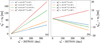 |
Fig. 1 Left panel: de-synchronizations ( |



4 Conclusions and discussion
In the context of defining the LRT and the challenges for landing clocks on the surface of the Moon, we show that there exist time-aligned orbits around the Moon with semi-major axes of about 1.5 lunar radii. The readings of an ideal clock in such an orbit can equal the selenoid time, and the same readings could easily be converted to the TCL via a known linear transformation. Therefore, it could be possible to simultaneously realize the LRT options O1 and O2 of Bourgoin et al. (2026) with a single orbital clock. To assess its performance, we conducted a set of numerical simulations. We find that the proper time in the time-aligned orbit under a more realistically lunar gravitational environment would de-synchronize from the selenoid time by up to 190 ns after a year with a frequency offset of 6 × 10⁻¹⁵, which is only 3.75% of the frequency difference in O2 caused by the lunar surface topography. Meanwhile, if we can account for the deviation of the mean orbital elements in our simulations from those required by the time-aligned orbits, we would reduce the de-synchronization and frequency offset by an order of magnitude to 13 ns and 4 × 10⁻¹⁶.
The terrestrial planets may also have their own time-aligned orbits (see Table 3). This would mean that it might be possible to realize the reference times of planets beyond the Earth–Moon system with clocks in these orbits. This shows that options based on the time-aligned orbits are scalable, meaning we could avoid the risks associated with landing clocks on the surfaces of these planets.
Comparison of nominal mean orbital elements ( ) and mean orbital elements (
 ) from our numerical simulations with σ = {a, e, i}.
Mean semi-major axis (āp) of the time-aligned orbits for four terrestrial planets.
Acknowledgements
We acknowledge very useful and helpful comments and suggestions from our anonymous referee. This work is funded by the National Natural Science Foundation of China (Grant Nos. 62394350, 62394351 and 12273116) and the Strategic Priority Research Program on Space Science of the Chinese Academy of Sciences (XDA300103000, XDA30040000, XDA30030000, XDA0350300, XDA30040500 and XDA0350404). J.Z. is funded by the Jiangsu Funding Program for Excellent Postdoctoral Talent (Grant No. 2025ZB724).
References
- Ardalan, A. A., & Karimi, R. 2014, Celest. Mech. Dyn. Astron., 118, 75 [Google Scholar]
- Bourgoin, A., Defraigne, P., & Meynadier, F. 2026, Metrologia, 63, 015003 [Google Scholar]
- Formichella, V., Galleani, L., Signorile, G., & Sesia, I. 2021, GPS Solut., 25, 56 [Google Scholar]
- IAU 2024a, Resolution II: “to establish a standard Lunar Celestial Reference System (LCRS) and Lunar Coordinate Time (TCL)”, https://www.iau.org/Iau/Publications/List-of-Resolutions [Google Scholar]
- IAU 2024b, Resolution III: “on the establishment of a coordinated lunar time standard by international agreement”, https://www.iau.org/Iau/Publications/List-of-Resolutions [Google Scholar]
- Kopeikin, S. M., & Kaplan, G. H. 2024, Phys. Rev. D, 110, 084047 [Google Scholar]
- Kouba, J. 2004, GPS Solut., 8, 170 [Google Scholar]
- Nelson, R. A. 2011, Metrologia, 48, S171 [Google Scholar]
- Soffel, M., Klioner, S. A., Petit, G., et al. 2003, AJ, 126, 2687 [Google Scholar]
- Turyshev, S. G., Williams, J. G., Boggs, D. H., & Park, R. S. 2025, ApJ, 985, 140 [Google Scholar]
All Tables
Comparison of nominal mean orbital elements () and mean orbital elements () from our numerical simulations with σ = {a, e, i}.
Mean semi-major axis (āp) of the time-aligned orbits for four terrestrial planets.
All Figures
|
Fig. 1 Left panel: de-synchronizations ( |
| In the text | |
Current usage metrics show cumulative count of Article Views (full-text article views including HTML views, PDF and ePub downloads, according to the available data) and Abstracts Views on Vision4Press platform.
Data correspond to usage on the plateform after 2015. The current usage metrics is available 48-96 hours after online publication and is updated daily on week days.
Initial download of the metrics may take a while.