


| Issue |
A&A
Volume 703, November 2025
|
|
|---|---|---|
| Article Number | A65 | |
| Number of page(s) | 22 | |
| Section | Planets, planetary systems, and small bodies | |
| DOI | https://doi.org/10.1051/0004-6361/202555669 | |
| Published online | 05 November 2025 | |
Disentangling disc and atmospheric signatures of young brown dwarfs with JWST/NIRSpec
1
Leiden Observatory, Leiden University,
PO Box 9513,
2300
RA
Leiden,
The Netherlands
2
Department of Physics, University of Warwick,
Coventry
CV4 7AL,
UK
3
Centre for Exoplanets and Habitability, University of Warwick,
Gibbet Hill Road,
Coventry
CV4 7AL,
UK
★ Corresponding author: This email address is being protected from spambots. You need JavaScript enabled to view it.
Received:
26
May
2025
Accepted:
11
September
2025
Abstract
Context. Young brown dwarfs serve as analogues of giant planets and provide benchmarks for atmospheric and formation models. JWST has enabled access to near-infrared spectra of brown dwarfs with unprecedented sensitivity.
Aims. We aim to constrain the chemical compositions, temperature structures, isotopic ratios, properties of the continuum and line emission from their circumstellar discs.
Methods. We performed atmospheric retrievals and disc modelling on JWST/NIRSpec medium-resolution (R ~ 2700) spectra covering 0.97–5.27 μm. Our approach combines radiative transfer, line-by-line opacities, parametrised temperature profiles, and flexible equilibrium chemistry for the atmospheres. We also included a ring component from the disc, with blackbody continuum and optically thin CO slab emission.
Results. We detected and constrained more than twenty molecular and atomic species in the atmospheres, including 12CO, H2O, CO2, SiO, and several hydrides. The CO fundamental band at 4.6 μm enables detections of 13CO and C18O. We report isotope ratios of carbon: 12C/13C = 79−11+14 (TWA 27A) and 75−2+2 (TWA 28), and oxygen: 16O/18O = 645−70+80 (TWA 27A) and 681−50+53 (TWA 28) based on water isotopologues. Both objects show significant excess infrared emission, which we modelled as warm (≈650 K) blackbody rings. We identified optically thin CO emission from hot gas (≥1600 K) in the discs, necessary to reproduce the redder part of the spectra. The atmospheric carbon-to-oxygen ratios are 0.54±0.02 (TWA 27A) and 0.59±0.02 (TWA 28), consistent with solar values.
Conclusions. We characterised the atmospheres and discs of two young brown dwarfs through simultaneous constraints on temperature, composition, isotope ratios, and disc properties. These observations demonstrate the ability of JWST/NIRSpec to study young objects, enabling future studies of circumplanetary discs.
Key words: techniques: spectroscopic / planets and satellites: atmospheres / brown dwarfs
© The Authors 2025
 Open Access article, published by EDP Sciences, under the terms of the Creative Commons Attribution License (https://creativecommons.org/licenses/by/4.0), which permits unrestricted use, distribution, and reproduction in any medium, provided the original work is properly cited.
This article is published in open access under the Subscribe to Open model. This email address is being protected from spambots. You need JavaScript enabled to view it. to support open access publication.
1 Introduction
Young brown dwarfs (YBDs) share chemical compositions and temperatures with hot gas giant exoplanets. Atmospheric characterisation of YBDs serves as a benchmark for the study of directly imaged companions such as TWA 27B, GQ Lup B, and the HR 8799 planets (Chauvin et al. 2005; Neuhäuser et al. 2005; Marois et al. 2008). The presence of numerous molecular features and atomic lines complicates the modelling of substellar atmospheres (Kirkpatrick et al. 1993; Allard & Hauschildt 1995) but advances in linelists and retrieval methods are bridging the gap between observations and models. Evolutionary models require detailed opacity information to calculate cooling rates and predict the spectral energy distribution for a range of masses and ages (Baraffe et al. 2002; Fortney et al. 2005). Condensates and clouds can strongly affect observed spectra, especially as objects cool through the L- and T-dwarf sequence (Ackerman & Marley 2001; Saumon & Marley 2008; Helling & Casewell 2014). At T ≳ 2000 K, clouds are less likely and photospheres are expected to be cloud-free (Tremblin et al. 2015; Marley et al. 2021). Accretion can be relevant for young systems and may imprint strong emission lines in the optical and near-infrared (e.g., Hα, Paβ and Brγ) (Muzerolle et al. 2005; Natta et al. 2004; Bowler et al. 2011; Alcalá et al. 2014). Young brown dwarfs are thought to undergo an accretion phase and show disc fractions similar to young stars (Luhman 2012). Discs are inferred from infrared excess and veiling of photospheric lines (Hartigan et al. 1989; McClure et al. 2013; Christiaens et al. 2019; Sanchis et al. 2020). At longer wavelengths, disc emission can dominate over the photospheric signal and interfere with atmospheric features (Oberg et al. 2023).
Atmospheric composition, including elemental and isotopic ratios, provides insight into the formation and evolution of brown dwarfs and exoplanets (Öberg et al. 2011; Mollière et al. 2022). Isotopic ratios are thought to be tracers of formation environments (Mollière & Snellen 2019; Zhang et al. 2021a), but are challenging to measure due to weak features and blending. Ground-based high-resolution spectroscopy (HRS) can constrain 12C/13C using high signal-to-noise K-band data (2.3 μm) (e.g. Zhang et al. 2021a,b; Xuan et al. 2024b; González Picos et al. 2025a). However, the strongest CO features are in the fundamental band at 4.6 μm, which is difficult to observe from the ground. Crossfield et al. (2019) detected 13CO and C18O in M dwarfs using high-resolution M- and K-band spectroscopy, finding ratios higher than solar. Access to the fundamental CO band at 4.6 μm is essential for robust isotopic measurements of carbon and oxygen, and may be the only suitable approach for faint sources.
Space-based infrared spectroscopy with JWST/NIRSpec and MIRI enables the detection of individual isotopologues in cool atmospheres (Miles et al. 2023; Faherty et al. 2024; Biller et al. 2024). These instruments provide high sensitivity for characterising low-mass atmospheres and allow detailed measurements to be taken of composition, temperature structure, and clouds. Recent JWST/NIRSpec results include detections of 13CO, C18O, and C17O in VHS 1256 b (Gandhi et al. 2023), 13CO in WISE J1828 (Lew et al. 2024) and 2MASS 04150935 (Hood et al. 2024), and 15NH3 in WISE J1828 and WISE 0855 using MIRI/MRS (Barrado et al. 2023; Kühnle et al. 2025). JWST/NIRSpec also enabled the measurement of the deuterium-to-hydrogen ratio via CH3D (Rowland et al. 2024). The analysis of a T-dwarf binary by Matthews et al. (2025) reports the unexpected presence of C2H2 and HCN as potential opacity sources in their atmospheres. JWST observations are pushing the requirements of atmospheric models to meet the demands of accurately describing the numerous spectral features and diversity observed in the atmospheres of brown dwarfs and exoplanets (e.g. Faherty et al. 2024).
In this work, we present atmospheric retrievals of the YBDs, TWA 27A and TWA 28, using full JWST/NIRSpec coverage in high-resolution mode (M24; Manjavacas et al. 2024) to constrain temperature structure, molecular abundances, isotopic ratios, and disc properties. TWA 27A and TWA 28 are members of the TW Hydrae association (TWA; de la Reza et al. 1989; Kastner et al. 1997; Webb et al. 1999), the nearest young moving group (<100 pc, 10 ± 3 Myr; Bell et al. 2015). TWA is a benchmark young associations, with a well-characterised initial mass function and detailed kinematic studies (e.g. Gagné et al. 2017; Luhman 2023).
TWA 27A is a 21 ± 6 MJup YBD with Teff ≈ 2400–2600 K, log g = 4.0 ± 0.5, and spectral type M8β (Gizis 2002; Mamajek 2005; Venuti et al. 2019; Cooper et al. 2024). Its companion, TWA 27B (2M1207 b), was the first directly imaged planetary-mass object (Chauvin et al. 2005). Previous studies focused on the companion’s mass and fundamental properties (e.g. Mamajek & Meyer 2007; Ricci et al. 2017; Luhman et al. 2023) and recent analysis of JWST/NIRSpec presented a comprehensive examination of its atmospheric parameters and reported the presence of a patchy clouds (Zhang et al. 2025).
TWA 28 (SS1102) is similar, with 20 ± 5 MJup, Teff ≈ 2400–2600 K, log g = 4.0 ± 0.5, and spectral type M8.5β (Scholz et al. 2005; Venuti et al. 2019; Cooper et al. 2024). Observations confirm both objects as young, low-mass sources with circumstellar discs (Riaz & Gizis 2008; Morrow et al. 2008; Herczeg et al. 2009; Venuti et al. 2019). Spitzer detected infrared excesses and dust settling (Morrow et al. 2008). JWST/NIRSpec spectra require an additional emitting source to model flux beyond 2.5 μm (Manjavacas et al. 2024, M24).
In Section 2, we describe our data reduction and retrieval approach. Section 3 presents the retrieval results, while Section 4 interprets these findings and compares them with previous work. Section 5 summarises the main results.
2 Methods
2.1 Observations
Observations of TWA 28 and TWA 27A were conducted using the integral field unit (IFU) of the JWST (Böker et al. 2022; Gardner et al. 2023) as part of the guaranteed time observations (GTO) programme 1270 (PI: S. Birkmann). The observations covered a wavelength range of 0.97–5.27 μm, utilising the highest resolution mode of the Near-Infrared Spectrograph (NIRSpec) with the three gratings G140H, G235H, and G395H (see M24 for more details on the observing setup).
We obtained stage 2 data (software version 1.18.0) products from the Barbara A. Mikulski Archive for Space Telescopes (MAST). We performed a custom extraction routine to obtain spectra from the calibrated images at each dithering position using a circular aperture of four pixels (0.4 arcsec). We find that this radius optimises the signal-to-noise ratio and minimises fringing effects known to be present in the IFU (Law et al. 2023). Our extraction leads to fewer bad pixels than M24, likely due to pipeline improvements and our custom routine to reject outliers from spectra at different dithering positions. We applied a wavelength-dependent aperture correction by comparing extractions with a six-pixel aperture, increasing the flux by five to ten percent towards redder wavelengths. Absolute flux calibration is not critical for our analysis and we discuss potential pitfalls in Section 4.
2.2 Atmospheric modelling
We generated atmospheric models using the radiative transfer code petitRADTRANS (v2.7, Mollière et al. 2019), which computes synthetic spectra from line-by-line and continuum opacities, atmospheric temperature, volume mixing ratios of chemical species, and surface gravity.
We used state-of-the-art line lists to generate line-by-line high-resolution opacities. Opacities were calculated with pyROX1 (de Regt et al. 2025) using transitions, states, and partition functions from ExoMol (Tennyson et al. 2024), HITEMP/HITRAN (Rothman et al. 2010; Gordon et al. 2017), and Kurucz (Castelli & Kurucz 2003). Table A.1 lists all opacity sources, including line lists, Rayleigh scattering, and quasi-continuum opacities.
2.2.1 Temperature profile
The temperature of each atmospheric layer was set following the parametrisation described in González Picos et al. 2025b, which extends the gradient-based temperature profile of Zhang et al. (2023). We defined seven pressure levels where the temperature gradients are measured, fitting for the location of these pressure levels and the values of the temperature gradients. The temperature gradient at a finer grid of equally spaced forty atmospheric layers was determined by linear interpolation of the temperature gradients at the seven pressure levels. This approach explores a wide range of temperature profiles, balancing physically motivated prior knowledge with the flexibility to fit the data. Our prior distributions ensured a decreasing temperature with decreasing pressure, i.e., positive temperature gradients (see Table C.1).
2.2.2 Chemical composition
We determined the abundances of chemical species using an extended chemical equilibrium approach. For each species, we fitted deviations from equilibrium, creating a hybrid model that combines the flexibility of free-composition retrievals (e.g. Line et al. 2015) with the physically motivated structure of chemical equilibrium models (e.g. Marley et al. 2021). Individual species abundances can vary independently, whilst leveraging altitude-dependent profiles and priors informed by chemical equilibrium.
A grid of chemical abundances as a function of pressure and temperature was generated using the software package FastChem (v2.0, Kitzmann et al. 2024). At each model evaluation, the chemical composition for the given temperature profile was calculated via linear grid interpolation. Offset parameters were then applied to the nominal abundances. To assess the impact of individual species and achieve a better fit to the data, we allowed the volume mixing ratio of individual species (Xi) to deviate from chemical equilibrium by a corresponding factor αi in log-space,
![Mathematical equation: $\[\log~ X_i=\log~ X_{i, \mathrm{eq}}+\alpha_i.\]$](/articles/aa/full_html/2025/11/aa55669-25/aa55669-25-eq5.png) (1)
(1)
The α-parameters were sampled from a normal distribution with a mean of 0 and a standard deviation of 1, enabling the exploration of non-equilibrium conditions while favouring chemical equilibrium in the absence of strong model preference.
2.3 Slab model
We included a disc component in the atmospheric model that consists of a blackbody continuum Bλ(TBB) and line emission Lλ. We introduced two free parameters to describe the blackbody emission, the temperature TBB and the radius RBB of the emitting region. The prior ranges were set to uniformly cover a wide parameter space, including the values found by the literature (Boucher et al. 2016).
We consider additional line emission from optically-thin gas in the disc by including a slab model with a single excitation temperature ![Mathematical equation: $\[T_{\mathrm{ex}}^{\text {slab}}\]$](/articles/aa/full_html/2025/11/aa55669-25/aa55669-25-eq6.png) , gas column density
, gas column density ![Mathematical equation: $\[N_{\text {col }}^{\text {slab}}\]$](/articles/aa/full_html/2025/11/aa55669-25/aa55669-25-eq7.png) and the extent of the ring as defined by the effective radius Rslab, corresponding to the surface of an annulus extending from inner to outer edge of the ring. A precomputed grid of slab models is calculated using the software package iris (Romero-Mirza et al. 2024b) spanning a range of excitation temperatures from 300 to 2000 K in steps of 50 K and gas column densities from 1015 to 1020 cm−2 with a log-spacing of approximately 0.5 dex. We included three species in the slab model, 12CO, 13CO, and H2O. Initially we attempted to retrieve the slab parameters for each species but found that only 12CO was well constrained by the data. We therefore only fitted for the parameters of the slab model for 12CO but include the other species in the model. The column density of 13CO was determined from Nslab(12CO) and the atmospheric isotope ratio 12C/13C, assuming the atmospheric 12C/13C is representative of the disc. The column density was fixed to that of 12CO in the slab model. We note that the inclusion of 13CO and H2O in the slab model did not noticeably improve the fit to the data but was included to provide a more complete model of the disc and avoid potential biases in the isotopic ratios.
and the extent of the ring as defined by the effective radius Rslab, corresponding to the surface of an annulus extending from inner to outer edge of the ring. A precomputed grid of slab models is calculated using the software package iris (Romero-Mirza et al. 2024b) spanning a range of excitation temperatures from 300 to 2000 K in steps of 50 K and gas column densities from 1015 to 1020 cm−2 with a log-spacing of approximately 0.5 dex. We included three species in the slab model, 12CO, 13CO, and H2O. Initially we attempted to retrieve the slab parameters for each species but found that only 12CO was well constrained by the data. We therefore only fitted for the parameters of the slab model for 12CO but include the other species in the model. The column density of 13CO was determined from Nslab(12CO) and the atmospheric isotope ratio 12C/13C, assuming the atmospheric 12C/13C is representative of the disc. The column density was fixed to that of 12CO in the slab model. We note that the inclusion of 13CO and H2O in the slab model did not noticeably improve the fit to the data but was included to provide a more complete model of the disc and avoid potential biases in the isotopic ratios.
2.4 Instrumental line profile
The model spectra were convolved with a Gaussian instrumental line profile with the instrumental full width at half maximum (FWHM) at each wavelength2. Additional broadening effects such as rotational broadening were not included since they were expected to be significantly smaller than the instrumental broadening.
2.5 Bayesian retrieval
We explored the high-dimensional parameter space of the atmospheric and disc models using a Bayesian inference approach. Our models contained up to 51 free parameters (see priors and descriptions in Table C.1). We used the nested sampling algorithm (Feroz et al. 2009) as implemented in the PyMultiNest package (Buchner 2016). We ran retrievals using importance nested sampling (Feroz et al. 2019) with 800 live points in a constant efficiency mode of 5%, and stopping criterion at Bayesian evidence Δ ln 𝒵 = 0.5. We assessed the convergence of the results with different numbers of live points and determined 800 to be a reasonable number to balance stable results and computational cost. We note that the Bayesian evidence in constant efficiency mode may be inaccurate (Feroz et al. 2019); however, we did not employ this quantity for model comparison or other purposes. While 51 parameters approaches the upper limit for nested sampling, our convergence tests with different live points suggested the results were stable. Retrieval studies of similar objects (e.g. Gandhi et al. 2023; Hood et al. 2024) were increasing in complexity and thus elevating the number of free parameters. Our model required additional parameters for the disc component and detailed temperature structure that pushed the dimensionality of the parameter space over 40, akin to the recent analysis of a young, cloudy brown dwarf with JWST/NIRSpec (Mollière et al. 2025). Novel methods for high-dimensional inference may be necessary to keep up with the increasing complexity of these models (e.g. (Vasist et al. 2023; Gebhard et al. 2025)).
We assumed a Gaussian likelihood function for the data, which can be expressed as log-likelihood:
![Mathematical equation: $\[\ln~ \mathcal{L}(\theta)=-\frac{1}{2} N ~\ln (2 \pi)-\frac{1}{2} ~\ln~ |\Sigma|-\frac{1}{2}(d-m(\theta))^T \Sigma^{-1}(d-m(\theta))\]$](/articles/aa/full_html/2025/11/aa55669-25/aa55669-25-eq8.png) (2)
(2)
where N is the number of data points, Σ is the covariance matrix, d is the observed data, m(θ) is the model given the parameters θ.
The covariance matrix Σ was calculated from the uncertainties of the data, the correlated noise between pixels, and the local deviations from the mean of the residuals of the fit. We constructed a covariance matrix adapted from Czekala et al. 2015 that accounts for correlated noise and provides a robust framework to manage local residual features. In summary, the covariance matrix was calculated as Σ = Σobs + Σcorr + Σout. The individual components of the covariance matrix were defined as
![Mathematical equation: $\[\Sigma_{\mathrm{obs}}=\delta_{i j} \sigma_{\mathrm{obs}}^2 \times 10^{2 b}\]$](/articles/aa/full_html/2025/11/aa55669-25/aa55669-25-eq9.png) (3)
(3)
![Mathematical equation: $\[\Sigma_{\mathrm{corr}}=\sigma_{\mathrm{eff}}^2\left(1+\frac{\sqrt{3}\left|x_i-x_j\right|}{l_{\mathrm{G}}}\right) ~\exp~ \left(-\frac{\sqrt{3}\left|x_i-x_j\right|}{l_{\mathrm{G}}}\right)\]$](/articles/aa/full_html/2025/11/aa55669-25/aa55669-25-eq10.png) (4)
(4)
![Mathematical equation: $\[\Sigma_{\text {out }}=\sum_k a_k^2 ~\exp~ \left(-\frac{\left(x_i-x_k\right) \cdot\left(x_j-x_k\right)}{2 l_k^2}\right)\]$](/articles/aa/full_html/2025/11/aa55669-25/aa55669-25-eq11.png) (5)
(5)
The first term is the diagonal covariance of the observational uncertainties, scaled by a factor 102b to account for underestimated uncertainties. A separate factor bgrating was applied to each grating to account for the different noise levels at different wavelengths.
The second term accounts for correlated noise in the data, which may be present due to instrumental effects (e.g. fringing or interpolation errors) or due to residual features from a mismatch between the model and the data. We modelled this using a Matérn kernel of order 3/2 (Matérn 1986), with an amplitude σeff = 10b × median(σi) and a global length scale lG in units of velocity.
The third term accounts for outliers in the data that may introduce local correlated noise (Czekala et al. 2015). We modelled this using a Gaussian kernel with amplitude ak and fixed length scale lk. Outlier locations and amplitudes were identified from the fit residuals at each model evaluation. Outliers were flagged as pixels with a chi-square per pixel ![Mathematical equation: $\[\chi_{i}=\left(d_{i}-\right. \left.m_{i}\right) \Sigma_{\text {obs}+ \text {corr}, \mathrm{ij}}^{-1}\left(d_{i}-m_{i}\right)\]$](/articles/aa/full_html/2025/11/aa55669-25/aa55669-25-eq12.png) exceeding 6σ. To preserve the definition of outliers, we limited the number density of local kernels to a maximum of five per 40 nm. Based on initial tests, we fix the kernel length scale to lk = 30 km s−1, which effectively captures the extent of local outliers. The residuals are overplotted with the square root of the diagonal of the fitted covariance matrix (see Appendix B).
exceeding 6σ. To preserve the definition of outliers, we limited the number density of local kernels to a maximum of five per 40 nm. Based on initial tests, we fix the kernel length scale to lk = 30 km s−1, which effectively captures the extent of local outliers. The residuals are overplotted with the square root of the diagonal of the fitted covariance matrix (see Appendix B).
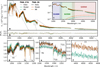 |
Fig. 1 JWST/NIRSpec observations and atmospheric models. A full wavelength coverage of JWST/NIRSpec observations and model fits for TWA 27A and TWA 28 are shown. (a) The observed spectra (black) and the best-fit model spectra (coloured lines) for TWA 27A (blue) and TWA 28 (orange) across the full wavelength range. (b) The relative residuals ΔFλ/Fλ = (Fλ,obs – Fλ,model)/Fλ,obs of the best-fit model. (c) The same data in log-scale, with blackbody contribution indicated and the coverage of each grating (G140H, G235H and G395H) shown as shaded regions. The increasing offset between datasets at redder wavelengths reflects distinct blackbody contributions in each system. (d)–(f) Zoomed regions from each grating with key absorption features labelled. |
3 Results
Our atmospheric retrievals of TWA 27A and TWA 28 provide robust constraints on composition and temperature structure. Fig. 1 shows the best-fit models across the full wavelength range, with detailed spectral segments and opacity contributions in Fig. B.1 and Appendix B. Temperature profiles appear in Fig. 2, molecular detections via cross-correlation functions (CCFs) in Fig. 3, and all parameters with uncertainties in Table C.1.
3.1 Chemical composition
Our retrievals constrain more than twenty molecular and atomic species. We conduct a comprehensive analysis identifying the dominant molecular and atomic species in the different regions of the spectra (see Fig. B.1 and Appendix B). The vertical composition profiles for the major atmospheric species are shown in Fig. D.1.
At the reddest part of the spectra, the fundamental CO band enables the detection of the minor isotopologues of CO: 13CO, C18O, and tentative evidence of C17O. Between 4.0 and 5.2 μm, 12CO, H2O, CO2, and SiO dominate the opacity (Fig. 3).
Water dominates the absorption features between 2.5 and 4.0 μm. The isotopologue H218O is constrained across the entire wavelength range, with distinct lines identified from 2.5 μm towards redder wavelengths. Lines from OH, HF, and HCl are detected in this region too. Methane (CH4) is tentatively detected, with broad absorption near 3.3 μm. This detection remains tentative due to residuals in this region (see Fig. 1) and a highly non-equilibrium abundance for CH4 (see Appendix C).
In the 2.0–2.5 μm range, we observe the first overtone of 12CO and weak features from 13CO. This region also shows lines from Na, Ca, Ti, OH, and HF. The water absorption peak at 1.65 μm, a proposed gravity-sensitive feature, is clearly visible.
Between 1.4 and 2.0 μm, absorption from K, Al, and Ca is present, with a strong Ca signature at 1.96 μm. From 0.97 to 1.4 μm, we identify hydrides, oxides, and atomic features. FeH, TiO, and VO show strong absorption, along with Na and K doublets. We also constrain CrH, NaH, and AlH, and find evidence for AlO, which we retrieve as a free parameter due to its absence in our chemical equilibrium model. At the bluest region of the spectrum, the residuals exhibit significant structure, suggesting missing opacity sources or other unaccounted for effects.
We identify a continuum contribution from H− bound-free opacity at wavelengths shorter than 1.64 μm (Gray 2022). The retrieved H− abundance, log H− ≈ −8.84 ± 0.03, is consistent across both objects and matches chemical equilibrium predictions at relevant temperatures. This wavelength range probes deeper atmospheric layers. Our use of a constant-with-altitude abundance profile limits detailed interpretation, but the retrieved H− abundance should represent photospheric conditions.
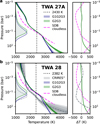 |
Fig. 2 Atmospheric temperature profiles for TWA 27A (a) and TWA 28 (b). Left panels: retrieved profiles from JWST/NIRSpec observations (G140H+G235H+G395H, blue lines) and excluding G140H (green lines), with 1-, 2-, and 3σ confidence intervals (shaded regions). CRIRES+ profile for TWA 28 (González Picos et al. 2024) and a cloud-less Sonora Diamondback model at Teff = 2400 K, log g = 4.0 (Morley et al. 2024) are shown for comparison. Right panels: residuals between median G140H+G235H+G395H profiles and other datasets. |
3.2 Temperature profile
We fitted seven temperature gradients at pressure levels determined by three free parameters to recover the temperature profile. Fig. 2 shows the resulting profiles with confidence intervals. TWA 28 is marginally cooler than TWA 27A, consistent with previous effective temperature estimates (Cooper et al. 2024). The tight constraints on the shape of the temperature profile result from the broad wavelength coverage and high S/N of the data. We compare with previous high-resolution K-band analysis of TWA 28 in Section 4.6.
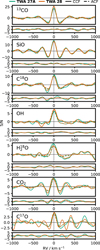 |
Fig. 3 Molecular detections via cross-correlation analysis. The CCF of selected molecules for TWA 27A and TWA 28, are computed between model residuals (with and without each species) and template spectra over radial velocities up to 2000 km s−1. S/N ratios are calculated by normalising the CCF peak to the standard deviation of the CCF-ACF difference (secondary panels). ACF is the autocorrelation function of each molecule. |
3.3 Detection of disc emission
Both objects show excess infrared emission beyond 2.5 μm. We modelled this as an optically thick ring with single-temperature blackbody emission, retrieving the temperature and radius of the emitting region. Fig. 1 (upper right inset) illustrates this continuum contribution.
![Mathematical equation: $\[\begin{aligned}\mathrm{TWA} ~28: T_{\mathrm{eff}}^{\mathrm{bb}} & =653 \pm 2 \mathrm{~K}, R^{\mathrm{bb}}=13.9 \pm 0.08 ~\mathrm{R}_{\mathrm{Jup}} \\\mathrm{TWA} ~27 \mathrm{A}: T_{\mathrm{eff}}^{\mathrm{bb}} & =643 \pm 4 \mathrm{~K}, R^{\mathrm{bb}}=11.9 \pm 0.15 ~\mathrm{R}_{\mathrm{Jup}}\end{aligned}\]$](/articles/aa/full_html/2025/11/aa55669-25/aa55669-25-eq13.png)
The retrieved values support the presence of warm dust in the inner disc, consistent with previous studies that identified infrared excess in these sources (Boucher et al. 2016; Venuti et al. 2019; Manjavacas et al. 2024), with Boucher et al. 2016 estimating disc temperatures >300 K, consistent with our values (see Section 4.3).
Strong residuals in the CO fundamental band from preliminary fits with atmospheric models suggest the presence of line emission in both systems. We quantified the scatter in the residuals from the best-fit model using the median absolute deviation (MAD; see Fig. 6). Atmospheric models alone cannot reproduce the observed CO line depths. Adding a slab component improves the fit to the data and leads to reasonable abundances of atmospheric 12CO. We constrained the column densities, excitation temperatures, sizes of emitting regions, and the radial velocity of the slab models (see Fig. 5). We present these values in the context of disc observations and theoretical models in Section 2.3.
4 Discussion
4.1 Deviations from solar-like chemical equilibrium
We estimated departures from chemical equilibrium for each species using the α parameter (see Fig. 4). Most species show positive α values, indicating super-solar metallicity or slight discrepancies with equilibrium chemistry. TWA 27A and TWA 28 exhibit consistent α values, reflecting their chemical similarity—unsurprising given their matched spectral types, ages, and distances.
Notably high values of α, such as those retrieved for OH, suggest significant departures from chemical equilibrium. The formation of OH through thermal dissociation of H2O is known to be efficient at temperatures exceeding 2000 K. A value of αOH = 1.0 indicates that the retrieved OH abundance is 10 times higher than that predicted by chemical equilibrium at solar-metallicity.
From the abundances of carbon- and oxygen-bearing species, we infer C/O ratios for each dataset (Fig. 7, left panel). Including the reddest grating (G395H) produces lower C/O ratios than using only the intermediate grating (G235H). This difference stems from atmospheric 12CO absorption competing with warm disc emission in the CO fundamental band.
We consider the C/O values derived from the G235H grating to be more representative of the intrinsic atmospheric composition, as this region is unaffected by the CO line emission from the disc at a significant level (see inset of Fig. 1). The resulting values are:
![Mathematical equation: $\[\mathrm{C} / \mathrm{O}_{\text {TWA } 27 \mathrm{A}}=0.54 \pm 0.02 \quad\text { and }\quad \mathrm{C}/\mathrm{O}_{\text {TWA } 28}=0.59 \pm 0.02.\]$](/articles/aa/full_html/2025/11/aa55669-25/aa55669-25-eq14.png) (6)
(6)
These are comparable to the solar value of 0.59 ± 0.08 (Asplund et al. 2021). A recent analysis of the planetary-mass companion in the TWA 27 system using JWST/NIRSpec (Zhang et al. 2025) found that a partial cloud deck atmosphere model best fits the spectrum of TWA 27b, with a retrieved sub-solar C/O ratio of 0.440 ± 0.012. This value differs from our measurement for the host brown dwarf by approximately 3σ, suggesting a potential slight chemical difference between the host brown dwarf and its companion. However, we note the difference is small and the uncertainties might be underestimated for one or both objects.
Although retrievals including the G395H grating consistently favour lower C/O values, we caution that these are likely affected by CO slab emission. Consequently, they may underestimate the true atmospheric C/O ratio. High-resolution spectroscopy might be able to provide a more robust measurement of the C/O ratio (e.g. Costes et al. 2024; Zhang et al. 2024).
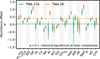 |
Fig. 4 Chemical abundance offsets from solar-composition chemical equilibrium. The 1-, 2-, and 3σ confidence intervals of α as defined in Equation (1) are shown for each of the retrieved species using chemical equilibrium models. The median value for each object is plotted as a horizontal dashed line. |
4.2 Isotope ratios
We report detections of several minor isotopologues of CO (13CO, C18O, C17O) and the secondary isotopologue of water, ![Mathematical equation: $\[\mathrm{H}_2^{18} \mathrm{O}\]$](/articles/aa/full_html/2025/11/aa55669-25/aa55669-25-eq15.png) (see Fig. 3). The fundamental CO band at 4.3–5.1 μm, covered by the reddest NIRSpec grating (G395H), enables robust constraints on the CO isotopologues. In contrast, retrievals using only the G235H grating yield no significant detections of 13CO and provide no constraints on C18O or C17O. Notably, the retrieved isotope ratios show minimal dependence on surface gravity and metallicity (see Fig. 5).
(see Fig. 3). The fundamental CO band at 4.3–5.1 μm, covered by the reddest NIRSpec grating (G395H), enables robust constraints on the CO isotopologues. In contrast, retrievals using only the G235H grating yield no significant detections of 13CO and provide no constraints on C18O or C17O. Notably, the retrieved isotope ratios show minimal dependence on surface gravity and metallicity (see Fig. 5).
In Table 1, we present the retrieved isotopologue ratios for each object. The inferred 12C/13C from CO is lower for TWA 27A (53 ± 3) compared to TWA 28 (75 ± 2). For the oxygen isotope ratios (16O/18O), we find consistent values between H2O and CO for TWA 28. However, TWA 27A shows a notable discrepancy, with the 16O/18O from H2O being significantly higher than that from CO. This suggests that the 12CO abundance in TWA 27A is underestimated, leading to systematically lower carbon and oxygen isotope ratios when derived from CO alone.
This interpretation is supported by prominent residuals in the CO band region of the TWA 27A spectrum, which are absent in the TWA 28 data (see Fig. 6c,d). We estimate a calibration factor to the 12CO abundance in TWA 27A by assuming that the 16O/18O values from H2O and CO should be homogeneous, as generally expected and supported by the consistency seen in TWA 28. Since the 16O/18O measured from H2O is not affected by the CO slab emission, it provides a reliable proxy for the true isotopic composition. The retrieved 16O/18O values for both objects agree within uncertainties and lie close to or slightly above the interstellar medium value (557 ± 30; Wilson 1999) and the solar value (511 ± 10; Ayres et al. 2013).
We find that the 12CO abundance for TWA 27A is underestimated by a factor of ≈1.51. Propagating this correction to the derived C/O and carbon isotope ratios results in:
![Mathematical equation: $\[\begin{aligned}\mathrm{C} / \mathrm{O}_{\text {TWA 27A }} & =0.58 \pm 0.04 \\{ }^{12} \mathrm{C} /{ }^{13} \mathrm{C}_{\text {TWA 27A }} & =79_{-11}^{+14}\end{aligned}\]$](/articles/aa/full_html/2025/11/aa55669-25/aa55669-25-eq16.png)
This calibration brings the C/O ratio into agreement with the value derived from the G235H grating and aligns the carbon isotope ratio with TWA 28 within 2σ. The increased uncertainty on the carbon isotope ratio is due to the propagated errors on the calibration factor that incorporates the spread in the 16O/18O from H2O and CO. Although this correction is approximate, it demonstrates the value of using multiple isotopologues to constrain chemical abundances. Additionally, we find tentative evidence for C17O in our spectra. Cross-correlation analysis indicates a signal-to-noise ratio of approximately 3 for this detection (see Fig. 3); however, the derived 16O/17O is poorly constrained and we opt to report a lower limit of ≈1000 for both objects.
We investigated the presence of spectral features from TiO isotopologues in the bluest region of the spectrum (0.97–1.63 μm). We performed two sets of retrievals: one including a line list with all stable isotopologues of TiO assuming terrestrial isotope ratios (Lodders et al. 2009; McKemmish et al. 2024), and another using only the 48TiO line list (McKemmish et al. 2024). To ensure a fair comparison, we fixed the temperature profile to that obtained from the fit to the entire wavelength range (see Fig. 2). We find slight differences in the resulting parameters between the two models, but they are generally consistent within 1σ uncertainties. The median absolute deviations of both fits do not change significantly, suggesting that the addition of secondary isotopologues does not clearly improve the fit, at least not at the fixed contribution set by terrestrial values. The variations from TiO isotopologues appear to be below the current noise threshold imposed by the mismatch between data and model. Future studies searching for Ti isotopes in TiO might benefit from improved fits in this region through the inclusion of additional oxides and hydrides. Alternatively, observations at other wavelength regions, such as the optical range covering the 0.75 μm band of TiO, and at higher resolving power, might be more amenable to the measurement of these elusive isotopologues (Pavlenko et al. 2020; Serindag et al. 2021).
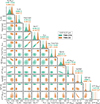 |
Fig. 5 Corner plot of the posterior distributions of selected parameters for TWA 27A and TWA 28. The parameters are the radius, surface temperature, surface gravity, logarithm of the volume mixing ratio of the H− bound-free opacity, the α parameter of water, the carbon isotopologue ratio, the effective temperature and size of the blackbody, the logarithm of the column density, the excitation temperature and the size of the slab model. The titles indicate the median and the 16th and 84th percentiles of the posterior distributions for each target retrieved from the fit to the entire wavelength range. |
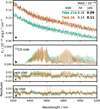 |
Fig. 6 Fundamental CO band with disc slab emission. (a) Best-fit spectra of TWA 27A and TWA 28 in the CO band. (b). Retrieved slab emission. (c, d) Residuals of the fit excluding (c) and including (d) the slab model. |
Isotope ratios derived from JWST/NIRSpec observations.
4.3 Disc properties
The wide wavelength coverage and simultaneous fit of the atmosphere and disc enable the characterisation of the excess continuum and line emission properties.
We find that the excess continuum emission of both objects is well described by a ring-like structure emitting as a single-temperature blackbody at approximately 650 K for both objects (see values in Table C.1). The size of the disc appears slightly larger for TWA 27A compared to TWA 28, but this may result from the inclination of the system rather than the actual size of the disc. The retrieved sizes of these discs are small compared to other discs around young stars, which typically span a radial range of several dozens of au (e.g. Huang et al. 2018). This result is consistent with ALMA observations of the TWA 27 system that report a compact disc (Ricci et al. 2017). The inferred blackbody temperature of both discs is remarkably similar, identical within 1σ uncertainties. These values agree with previous near-infrared observations of the same systems by Boucher et al. (2016) that report disc temperatures of approximately 250–850 K.
We estimated the disc cavity size using the Stefan-Boltzmann relation following Eq. (1) from Cugno et al. (2024). Using effective temperatures from Cooper et al. (2024) and our retrieved radii (R = 3.08 ± 0.01 RJup and 3.10 ± 0.01 RJup, respectively), we calculated bolometric luminosities of log(Lbol/L⊙) = −2.48 ± 0.02 (TWA 27A) and −2.54 ± 0.03 (TWA 28). The cavity radii, estimated as ![Mathematical equation: $\[R_{\text {cavity }}=\sqrt{L_{\mathrm{bol}} /\left(16 \pi \sigma T_{\mathrm{bb}}^{4}\right)}\]$](/articles/aa/full_html/2025/11/aa55669-25/aa55669-25-eq26.png) where Tbb is the effective temperature of the blackbody disc from our retrievals (see Section 3.3), are 22.50 ± 0.64 RJup and 20.49 ± 0.74 RJup for TWA 27A and TWA 28, respectively. These estimates suggest the presence of substantial inner disc cavities, consistent with observations of other young substellar objects (Cugno et al. 2024). We note that these are rough estimates that assume simplified disc geometry and neglect potential heating effects. Notably, discs around similar analogue substellar companions show comparable disc temperatures and sizes, namely GQ Lup B (Tdisc = 575–630 K, Rdisc = 23–28 RJ; Cugno et al. 2024) and YSES 1b (Tdisc = 320–520 K, Rdisc = 5.6–18 RJ; Hoch et al. 2025).
where Tbb is the effective temperature of the blackbody disc from our retrievals (see Section 3.3), are 22.50 ± 0.64 RJup and 20.49 ± 0.74 RJup for TWA 27A and TWA 28, respectively. These estimates suggest the presence of substantial inner disc cavities, consistent with observations of other young substellar objects (Cugno et al. 2024). We note that these are rough estimates that assume simplified disc geometry and neglect potential heating effects. Notably, discs around similar analogue substellar companions show comparable disc temperatures and sizes, namely GQ Lup B (Tdisc = 575–630 K, Rdisc = 23–28 RJ; Cugno et al. 2024) and YSES 1b (Tdisc = 320–520 K, Rdisc = 5.6–18 RJ; Hoch et al. 2025).
We extended our best-fit model to longer wavelengths to assess the validity of the blackbody approximation in regions where the disc contribution becomes more prominent. In Fig. E.1 we show that our models are in good agreement with Spitzer/IRS observations (Riaz & Gizis 2008) up to 11 and 12 μm for TWA 27A and TWA 28, respectively. This suggests the single-temperature blackbody correctly describes the dominant continuum emission from surrounding dust at the wavelengths considered in the present work, but additional emission from colder dust may be necessary to match observations in the mid-infrared.
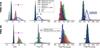 |
Fig. 7 Posterior distributions of atmospheric parameters retrieved from the JWST/NIRSpec observations of TWA 27A (top row) and TWA 28 (bottom row). From left to right, the panels show the carbon-to-oxygen ratio, carbon isotope ratio and oxygen isotope ratio from H2O and CO. The vertical axis of each panel represents the posterior probability density (not shown). The oxygen-isotope homogeneity calibration is applied to TWA 27A, with the resulting posteriors indicated with an arrow. Reference values for the interstellar medium (ISM), the solar value, and literature values are shown where available. Results from JWST/NIRSpec for the planetary-mass companion of TWA 27A (Zhang et al. 2025) and for TWA 28 from HRS CRIRES+ observations (González Picos et al. 2024) are shown in grey. |
4.3.1 Line emission
We constrained the excitation temperature of both objects, finding a value of Tex (TWA 28) = 1688 ± 36 K and a lower limit of Tex(TWA 27A) > 2000 K (the edge of our prior). These temperatures are significantly higher than the continuum temperature of 650 K, suggesting that the CO gas emission originates in a different part of the disc. Elevated excitation temperatures have been observed in other systems (e.g. Temmink et al. 2024) and are often attributed to emission in non-local thermodynamic equilibrium conditions, namely UV pumping (Krotkov et al. 1980). For these brown dwarfs (Teff ≈ 2400 K), the UV flux likely originates from nearby stars in the TWA association rather than from the brown dwarfs themselves, which are too cool to produce significant UV emission. Notably, Bast et al. (2011) reported observations of UV-excited CO vibrational emission in several protoplanetary discs at temperatures around 1700 K. The slab modelling used in this work assumes LTE conditions (Romero-Mirza et al. 2024a), which may lead to limited physical interpretation of slab parameters. The retrieved column densities (see Table C.1) are in the range of 1016−1018 cm−2 for both objects, which is the order of magnitude range observed in other substellar discs (e.g. Pascucci et al. 2013). However, we refrain from further interpretation due to the strong correlation with the size of the emitting region (see Fig. 5). JWST/MIRI detected CO2 emission around 15 μm in TWA 27A’s inner disc (Arabhavi et al. 2025). That study found no CO emission—likely because photospheric absorption and disc emission overlap, complicating line identification as also underscored in the present work (see Section 4.2).
In addition, we detect a velocity shift of the slab line emission with respect to the photospheric lines of 8 ± 2 and 4 ± 1 km s−1 for TWA 27A and TWA 28, respectively. This velocity shift is consistent with the range of velocities determined by the spatially integrated CO emission observed by ALMA (Ricci et al. 2017). At the resolving power of JWST/NIRSpec, the atmospheric and disc CO emission is unresolved, but velocity shifts of a few km s−1 are within reach of current high-resolution ground-based spectroscopy (e.g. Grant et al. 2024).
4.4 Missing opacity sources
The best-fit model spectrum reproduces most observed spectral features, while the residuals show an overall scatter at a level of 5% (see residuals panel in Fig. 1). However, significant residuals remain at certain wavelengths, particularly in the blue part of the spectrum and around 2.9–3.5 μm, showing two apparently broad, unidentified features. These structured residuals suggest missing molecules in our chemical inventory or inaccurate line lists. We discuss our attempts to account for these features:
– 0.97–1.30 μm: this region is dominated by H2O, hydrides (FeH, HF, CrH, NaH), oxides (TiO, VO), and atomic species (Na, K, Fe). We tested additional atoms (Mg, Al, Si, Mn, Cr, V, Cs, Li) but found no constraints on their abundances. Some residual features show molecular bandhead structure, but none of the known opacity of SiH, NH, SH, CH, MgO, or ZrO matched the observed features.
– 1.59–1.71 μm: the dominant opacity source is H2O, followed by 12CO, OH, and a weak contribution from FeH. Several absorption lines in the data remain unaccounted for, with residuals similar to those seen in high-resolution spectra of a nearby M4 dwarf star (Jahandar et al. 2024).
– 2.9–3.6 μm: this region is primarily dominated by H2O, with additional contributions from OH, HCl, and HF. We identify two prominent dips (D1: 2960–3140 nm and D2: 3360–3520 nm) where the data points fall significantly below the model. We consider these features to be real rather than instrumental effects because both gratings G235H and G395H cover the D1 feature and show remarkable agreement. We rule out fringing as a possible instrumental systematic to explain the double-peak structure, as analysis of different dithering positions and extraction apertures shows no evidence for fringing effects at the level of the residuals (Dumont et al. 2025).
We tested several carbon- and nitrogen-bearing molecules that could contribute to these features, including CH4, NH3, HCN, C2H2, CH, NH, SH, SiH, H2S, MgO, AlO, and SiO. While CH4 and C2H2 improved the fit, they required abundances 2–3 orders of magnitude higher than predicted by chemical equilibrium. C2H2 partially matched the D1 feature; however, the presence of this molecule above 2000 K is highly disfavoured by thermochemical models (Kitzmann et al. 2024). CH4 improved the overall fit but did not reproduce either dip, instead adding uniform opacity. In our final retrievals, we included CH4 as a tentative opacity source but note that it is also highly disfavoured by chemical equilibrium. The detection of C2H2 and HCN in (Matthews et al. 2025) suggests that these molecules might be present in the atmosphere of substellar objects despite the negligible abundances predicted by chemical equilibrium, but may be explained by ionisation effects (Helling & Rimmer 2019).
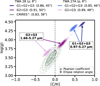 |
Fig. 8 Surface gravity-metallicity degeneracy analysis. Posterior distributions of the surface gravity and the inferred metallicity are shown. The CRIRES+ results from GP24 are included for reference. The ellipses indicate the 68%, 95%, and 99% confidence regions. The legend lists the Pearson correlation coefficient (ρ) and the rotation angle (θ) of the ellipse. |
4.5 Surface gravity and absolute abundances
Our atmospheric retrieval simultaneously fits radius, surface gravity, and blackbody disc emission parameters. The retrieved surface gravities exhibit strong dependence on the selected wavelength range (Fig. 8) and show significant correlation with the abundances of the main opacity sources or metallicity (Fig. 8), similar to previous findings from HRS of TWA 28 (González Picos et al. 2024). We note that the metallicity values shown in Fig. 8 consider only carbon-bearing species, as we fit individual alpha parameters for each species rather than a global metallicity. This approach allows us to capture species-specific deviations from chemical equilibrium while maintaining the flexibility to model complex atmospheric chemistry.
Notably, including the bluest spectral region (G140H, 0.97–1.89 μm) drives both surface gravity and metallicity to higher values compared to fits using only the redder spectrum (1.66–5.27 μm). Although several alkali lines in the G140H region are proposed as gravity-sensitive indicators, the poor model fit in this spectral region may introduce systematic biases in the retrieved surface gravity values.
To assess the consistency of solutions across different wavelength subsets, we examined the linear correlation between surface gravity and metallicity for various data combinations (Fig. 8). The corresponding values of surface gravities at [C/H]=0 as extrapolated from the correlation line remain broadly consistent: log g ≈ 4.10–4.17 and log g ≈ 4.03–4.10 for TWA 27A and TWA 28, respectively. This suggests compatible solutions despite the presence of strong parameter degeneracies and likely underestimated uncertainties.
4.6 Comparison with CRIRES+ observations of TWA 28
High-resolution K-band spectroscopy of TWA 28 was obtained with the upgraded CRyogenic InfraRed Echelle Spectrometer at the Very Large Telescope (Dorn et al. 2023; VLT/CRIRES+). The atmospheric retrieval analysis was published in González Picos et al. 2024 (hereafter GP24) as part of the ESO SupJup survey (de Regt et al. 2024).
4.6.1 Temperature profile
We compare the retrieved temperature profiles in Fig. 2 with the results of GP24. While the slope of the profile in the photosphere is similar, we find differences in the photospheric pressure level, likely arising from differences in the retrieved surface gravities and metallicity (see Fig. 8).
GP24 reported a surface gravity (log g = 3.48 ± 0.15) compared to this work (log g ≈ 3.8–4.4). The spread of values presented in this work is attributed to the different wavelength ranges considered (see Section 4.5). The broader contribution function of the JWST/NIRSpec data, enabled by its wide wavelength coverage, provides sensitivity to a larger range of atmospheric pressures. However, pressure regions outside the main contribution function are poorly constrained. The different slopes at the bottom of the atmosphere between CRIRES+ and NIRSpec likely reflect differences in spectral coverage and the lack of absolute flux calibration in the CRIRES+ data. Uncertainties in flux calibration and its correlation with the brown dwarf radius can also affect the inferred shape of the lower part of the temperature profile.
We also compare our retrieved P-T profiles with Sonora Diamondback models at Teff = 2400 K, log g = 4.0 (Morley et al. 2024). The JWST/NIRSpec profiles show good agreement with theoretical models at the peak of the contribution function, but discrepancies are present at higher and lower pressures. At lower pressures, the retrieved temperature profiles are hotter than the theoretical models, which may suggest the presence of clouds such as Al2O3 or Mg2SiO4 condensates (Morley et al. 2024). Discrepancies at higher pressures may originate from non-adiabatic effects (Tremblin et al. 2019) or departures from chemical equilibrium (Mukherjee et al. 2024), but we do not investigate these effects in detail in the present work.
We report the photospheric temperature for each dataset as the temperature within the region encompassing the 90 th percentile of the integrated contribution function (see Fig. 2). The photospheric temperatures of TWA 28 are consistent between datasets: TJWST/NIRSpec = 2438 ± 139 K and TCRIRES = 2334 ± 95 K. The larger uncertainty for JWST/NIRSpec reflects its broader contribution function. For reference, the derived photospheric temperature of TWA 27A is TTWA27A = 2540 ± 135 K, consistent with TWA 27A being marginally hotter than TWA 28.
4.6.2 Carbon-to-oxygen ratio
The C/O ratio derived from the G235H grating is 0.60 ± 0.03. This value agrees well with the measurement of 0.61 ± 0.02 from GP24. We consider the HRS measurement at 1.90–2.45 μm to be the most sensitive probe of the C/O ratio. When including the G395H grating, we find systematically lower C/O ratios. This difference arises from the CO slab emission in the circumstellar disc, which affects the CO fundamental band region. The emission lines effectively decrease the line depth of the photospheric absorption lines, leading to an underestimation of the 12CO abundance in the atmospheric model.
4.6.3 Isotope ratios
Measurements of CO isotopologues from the fundamental band provide more precise constraints on the 12C/13C ratio, resulting in narrower posterior distributions (see Fig. 7; see also Gandhi et al. 2023). However, the accuracy of the 12C/13C ratio retrieved from NIRSpec is a priori uncertain due to potential contamination by the CO slab emission.
We find good agreement between the 12C/13C ratio measured in this work (75 ± 2) and the value reported in GP24 (![Mathematical equation: $\[81_{-19}^{+28}\]$](/articles/aa/full_html/2025/11/aa55669-25/aa55669-25-eq27.png) ). This agreement suggests that slab emission does not significantly affect the derived 12C/13C ratio but we caution that a slight offset to lower values might still be present in the retrieved value due to the potentially underestimated atmospheric 12CO abundance. For the 16O/18O ratio, GP24 reported a tentative detection of H218O with a value of
). This agreement suggests that slab emission does not significantly affect the derived 12C/13C ratio but we caution that a slight offset to lower values might still be present in the retrieved value due to the potentially underestimated atmospheric 12CO abundance. For the 16O/18O ratio, GP24 reported a tentative detection of H218O with a value of ![Mathematical equation: $\[205_{-62}^{+140}\]$](/articles/aa/full_html/2025/11/aa55669-25/aa55669-25-eq28.png) . In contrast, our NIRSpec observations result in a significantly higher value of
. In contrast, our NIRSpec observations result in a significantly higher value of ![Mathematical equation: $\[663_{-47}^{+53}\]$](/articles/aa/full_html/2025/11/aa55669-25/aa55669-25-eq29.png) for TWA 28. This likely represents a more accurate measurement, as it benefits from both the increased wavelength coverage of NIRSpec and the consistent 16O/18O ratios derived from H2O and CO (see right column of Fig. 7).
for TWA 28. This likely represents a more accurate measurement, as it benefits from both the increased wavelength coverage of NIRSpec and the consistent 16O/18O ratios derived from H2O and CO (see right column of Fig. 7).
We note that measuring 16O/18O from K-band spectroscopy requires very high signal-to-noise ratios to achieve comparable precisions to NIRSpec observations (Xuan et al. 2024a). While ground-based M-band spectroscopy may enable measurements of 16O/18O in the atmospheres of amenable cool stars and brown dwarfs (Crossfield et al. 2019), current instrumentation may not provide the necessary signal-to-noise at the required spectral resolution to robustly constrain 16O/18O in the atmospheres of fainter objects. Therefore, JWST/NIRSpec remains a state-of-the-art tool for studying carbon and oxygen isotopic ratios in cool atmospheres.
4.7 Fundamental parameters
We report the fundamental parameters of the two targets as retrieved in this work and compared with literature values in Table 2. Our retrievals directly fit for the radius and the surface gravity, from which we infer the mass. We estimate the effective temperature of our models as calculated from the integrated flux over a wide wavelength range from 0.35 to 28 μm. We advise considering these values with caution, as the wavelength range considered here does not cover the entire photosphere of the brown dwarfs and the uncertainties on the effective temperature are likely underestimated.
Physical properties of TWA 27A and TWA 28 from different studies.
4.7.1 Comparison with stellar evolution models
Stellar evolution models provide powerful tools for estimating the fundamental parameters of stars, brown dwarfs and planets. The cooling tracks of Phillips et al. (2020) describe the temporal evolution of the radius for objects of different masses. From our flux-calibrated near-infrared spectra, we adopt radii of RTWA 28 = 3.08 ± 0.03 RJ and RTWA 27A = 3.09 ± 0.02 RJ for TWA 28 and TWA 27A, respectively, where the uncertainties account for the spread of values between different wavelength ranges.
These values exceed those predicted for objects with masses between 20 and 40 MJup at ages of ~10 Myr (Fig. 9), potentially indicating more massive or younger objects. The striking difference between the full wavelength range (0.97–5.27 μm) and the redder range (1.63–5.27 μm) results deserves particular attention. The 1.63–5.27 μm analysis produces mass estimates of 16.9±1.4 and 28.6±3.3 MJ for TWA 27A and TWA 28, respectively, which align well with evolutionary models and previous literature. In contrast, the full wavelength range yields unphysically high masses of 80.5±6.6 and 105.7±5.4 MJ, suggesting that the bluest spectral region (G140H) introduces systematic biases that affect the retrieved surface gravity and consequently the inferred masses (see Table 2). Since objects with discs are expected to be younger than those without, the detection of discs in both objects may suggest they are younger than their disc-free counterparts in TWA, as proposed by Venuti et al. (2019). Following the 10 Myr evolutionary track (Fig. 9a), predicted surface gravities for objects with masses between 10 and 30 MJup cover the range of log g ≈ 3.7–4.2. The inferred effective temperatures are consistent with the values from the evolutionary models, in particular they agree within one sigma with Venuti et al. (2019) and Manjavacas et al. (2024) but are slightly higher (around 200 K than the values from Cooper et al. (2024).
Several important caveats must be considered when interpreting these results. The retrieved radii are degenerate with the temperature profile, and may be affected by flux calibration uncertainties that introduce systematic errors not fully accounted for in our analysis. We note that an improved and well-tested flux calibration of NIRSpec data is necessary to obtain reliable results of derived effective temperatures, masses and overall comparison with evolutionary models. Additionally, the relatively low temperatures inferred for the lower atmosphere may indicate an overestimated radius. Previous JWST/NIRSpec analyses by M24 reported lower radii: RTWA 28(M24) = 2.41–3.14 RJ and RTWA 27A (M24) = 2.50–2.91 RJ, which align more closely with evolutionary model predictions while remaining broadly consistent with our results.
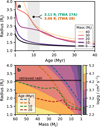 |
Fig. 9 Evolution tracks of young substellar objects. (a) Radius tracks for objects with masses between 5 and 40 MJup for the first 40 Myr after formation (Phillips et al. 2020). (b) Physical parameter space of surface gravity for radii between 1 and 4 RJup and masses between 1 and 60 MJup. Tracks of different ages are overlaid. The horizontal line indicates the range of retrieved radii for TWA 27A and TWA 28 (3.06–3.11 RJup). |
4.7.2 Literature mass estimates
Given that both YBDs belong to the TWA moving group with an estimated age of 10 Myr (e.g. Mamajek 2005; Bell et al. 2015), their masses can be estimated from bolometric luminosity or radius measurements. However, in the absence of dynamical mass constraints, evolutionary model estimates carry significant uncertainties and are inherently model-dependent.
Venuti et al. (2019) estimated masses for TWA objects using the Baraffe et al. (2015) evolutionary tracks based on effective temperature and luminosity. They derived masses of 20 and 21 MJup for TWA 27A and TWA 28, respectively, with typical uncertainties of 5 MJup, and corresponding radii of 3.4 and 2.82 RJ. The discrepancy between these radius estimates and our values may reflect degeneracies with disc properties, and the different wavelength coverage of the instrument (0.39–2.45 μm; Vernet et al. 2011).
In contrast, M24 performed spectroscopic analysis of the same JWST/NIRSpec dataset using self-consistent atmospheric models but with a different data reduction. Their analysis produced mass estimates spanning an extremely broad range from low-mass stars to planetary-mass objects (10–90 MJup) and surface gravities of log g = 4.0 ± 0.5 for both objects. These broad uncertainties highlight the fundamental challenges of constraining precise masses and surface gravities of low-mass objects from medium-resolution spectroscopy.
5 Conclusions
JWST/NIRSpec spectroscopy enables an unprecedented characterisation of atmospheric and disc properties in YBDs. Using radiative transfer models, flexible chemistry, and Bayesian retrievals, we report the following findings:
The detection of more than twenty molecular and atomic species, including 12CO, H2O, CO2, SiO, and hydrides (FeH, NaH, CrH and AlH). JWST’s broad wavelength coverage and sensitivity, combined with state-of-the-art atmospheric models, reveal species not previously detected in brown dwarf atmospheres such as CO2 and SiO;
A robust detection of 13CO and C18O through observations of the CO fundamental band. We derive carbon isotope ratios of 75 ± 2 (TWA 28) and
![Mathematical equation: $\[79_{-11}^{+14}\]$](/articles/aa/full_html/2025/11/aa55669-25/aa55669-25-eq38.png) (TWA 27A, after calibration for disc contamination effects). Oxygen isotope ratios are consistent between CO and water molecules in TWA 28, but require correction in TWA 27A due to inaccuracies in disc line emission affecting the inferred CO abundances. We report oxygen isotope measurements of
(TWA 27A, after calibration for disc contamination effects). Oxygen isotope ratios are consistent between CO and water molecules in TWA 28, but require correction in TWA 27A due to inaccuracies in disc line emission affecting the inferred CO abundances. We report oxygen isotope measurements of ![Mathematical equation: $\[645_{-70}^{+80}\]$](/articles/aa/full_html/2025/11/aa55669-25/aa55669-25-eq39.png) and
and ![Mathematical equation: $\[681_{-50}^{+53}\]$](/articles/aa/full_html/2025/11/aa55669-25/aa55669-25-eq40.png) for TWA 27A and TWA 28, respectively, derived from water isotopologues;
for TWA 27A and TWA 28, respectively, derived from water isotopologues;Well-constrained temperature profiles for both objects, with TWA 28 being marginally cooler than TWA 27A. The photospheric temperature of TWA 28 agrees with previous HRS studies, though differences in the temperature profile shape arise from degeneracies between surface gravity and metallicity (see Fig. 2);
Significant excess infrared emission detected in both objects, modelled as warm blackbody rings (approximately 640–650 K) with radii around 12–14 RJup. We also identify optically thin CO line emission from hot disc gas, which is essential for accurately reproducing the observed spectra at 4.6 μm (see Fig. 6) and ensuring consistent fitting of the 2.3 μm CO absorption band;
Carbon-to-oxygen ratios for both objects consistent with solar values. We infer super-solar metallicities, though the absolute values remain degenerate with surface gravity;
Detailed comparison with previous ground-based HRS observations of TWA 28 shows that the JWST/NIRSpec carbon-to-oxygen ratio agrees with the HRS value when excluding the region affected by CO slab emission. The retrieved carbon isotope ratios are consistent with HRS measurements, suggesting that slab emission does not significantly affect the derived 12C/13C of TWA 28;
Mass estimates from radii and surface gravities indicate that the blue spectral region (grating G140H) biases surface gravities to unphysically high values. However, the joint fit of G235H and G395H gratings yields mass estimates broadly consistent with evolutionary models and existing literature, supporting mass ranges from 15 to 30 MJup.
These observations demonstrate JWST/NIRSpec’s capabilities for young substellar characterisation. Simultaneous constraints on temperature, chemistry, isotopic ratios, and disc properties enable the disentanglement of atmospheric and circumstellar features. CO emission from hot disc gas demonstrates why coupled atmosphere-disc models are essential for accurate abundance measurements in young systems. Future HRS may resolve blended spectral features (Brandl et al. 2021; Oberg et al. 2023), but JWST’s broad coverage remains crucial for comprehensive analyses. Expanding such studies to younger, low-mass objects will bridge the gap to circumstellar and circumplanetary environments at early stages of evolution.
Acknowledgements
We thank E. Manjavacas for providing the original version of the reduced data. We thank G. Giardino for providing calibration measurements of JWST/NIRSpec/IFU used to assess possible instrumental effects. D.G.P and I.S. acknowledge NWO grant OCENW.M.21.010. Support for this work was provided by the NL-NWO Spinoza (SPI.2022.004). This work used the Dutch national e-infrastructure with the support of the SURF Cooperative using grant no. EINF-4556. This work is based on observations made with the NASA/ESA/CSA James Webb Space Telescope. The data were obtained from the Mikulski Archive for Space Telescopes at the Space Telescope Science Institute, which is operated by the Association of Universities for Research in Astronomy, Inc., under NASA contract NAS 5-03127 for JWST. These observations are associated with GTO program 1270 (P.I. S. Birkmann). The data described here may be obtained from www.doi.org/10.17909/gp39-v372.
Software: NumPy (Harris et al. 2020), SciPy (Virtanen et al. 2020), Matplotlib (Hunter 2007), jwst (Bushouse et al. 2025), petitRADTRANS (Mollière et al. 2019), fastchem (Kitzmann et al. 2024), PyAstronomy (Czesla et al. 2019), Astropy (Astropy Collaboration 2022), corner (Foreman-Mackey 2016), ExoMol (Tennyson et al. 2024), HITEMP (Rothman et al. 2010), iris (Romero-Mirza et al. 2024b), pyROX (de Regt et al. 2025).
Appendix A Opacity sources
Opacity sources and references used in this work.
Appendix B Best-fit model spectra
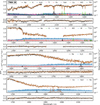 |
Fig. B.1 Molecular opacity contributions to the best-fit model. The observed spectra (black) and the best-fit model spectrum of TWA 28 (orange) are shown with the opacity sources sorted by contribution in each segment of the spectrum. The smaller panels of each segment show the relative residuals as defined in Fig. 1. The opacity is weighted by the retrieved abundances of the species to scale the contribution of each species. The observed spectra and best-fit models are available at González Picos et al. 2025 (doi.org/10.5281/zenodo.15781138). |
Appendix C Best-fit model parameters
Summary of the free parameters and the retrieved values with 1σ uncertainties. The prior ranges and the distributions used (uniform or normal) are indicated.
Appendix D Vertical composition profiles
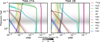 |
Fig. D.1 Vertical composition profiles. Volume mixing ratios of the retrieved molecules as a function of pressure for TWA 27A and TWA 28 are shown. Species are colour-coded as indicated in the legend. Darker background regions indicate higher values of the contribution function. |
Appendix E Extended data with Spitzer/IRS observations
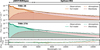 |
Fig. E.1 Extended wavelength model validation with Spitzer/IRS data. The best-fit model spectra of TWA 27A and TWA 28 are extended to the Spitzer/IRS wavelength range (Riaz & Gizis 2008). Observed spectra are shown in black and the best-fit model spectra are shown as solid lines. Dashed brown lines represent blackbody emission from the disc and the dashed line with corresponding colour represents the atmospheric model. Data beyond 11 and 12 μm begin to clearly deviate from our best-fit model for TWA 27A and TWA 28, respectively. |
References
- Ackerman, A. S., & Marley, M. S. 2001, ApJ, 556, 872 [Google Scholar]
- Alcalá, J. M., Natta, A., Manara, C. F., et al. 2014, A&A, 561, A2 [NASA ADS] [CrossRef] [EDP Sciences] [Google Scholar]
- Allard, F., & Hauschildt, P. H. 1995, ApJ, 445, 433 [NASA ADS] [CrossRef] [Google Scholar]
- Allard, N. F., Spiegelman, F., Leininger, T., & Molliere, P. 2019, A&A, 628, A120 [NASA ADS] [CrossRef] [EDP Sciences] [Google Scholar]
- Arabhavi, A. M., Kamp, I., van Dishoeck, E. F., et al. 2025, ApJ, 984, L62 [Google Scholar]
- Asplund, M., Amarsi, A. M., & Grevesse, N. 2021, A&A, 653, A141 [NASA ADS] [CrossRef] [EDP Sciences] [Google Scholar]
- Astropy Collaboration (Price-Whelan, A. M., et al.) 2022, ApJ, 935, 167 [NASA ADS] [CrossRef] [Google Scholar]
- Ayres, T. R., Lyons, J. R., Ludwig, H. G., Caffau, E., & Wedemeyer-Böhm, S. 2013, ApJ, 765, 46 [NASA ADS] [CrossRef] [Google Scholar]
- Azzam, A. A. A., Tennyson, J., Yurchenko, S. N., & Naumenko, O. V. MNRAS, 460, 4063 [Google Scholar]
- Baraffe, I., Chabrier, G., Allard, F., & Hauschildt, P. H. 2002, A&A, 382, 563 [CrossRef] [EDP Sciences] [Google Scholar]
- Baraffe, I., Homeier, D., Allard, F., & Chabrier, G. 2015, A&A, 577, A42 [NASA ADS] [CrossRef] [EDP Sciences] [Google Scholar]
- Barrado, D., Mollière, P., Patapis, P., et al. 2023, Nature, 624, 263 [NASA ADS] [CrossRef] [Google Scholar]
- Bast, J. E., Brown, J. M., Herczeg, G. J., van Dishoeck, E. F., & Pontoppidan, K. M. 2011, A&A, 527, A119 [NASA ADS] [CrossRef] [EDP Sciences] [Google Scholar]
- Bell, C. P. M., Mamajek, E. E., & Naylor, T. 2015, MNRAS, 454, 593 [Google Scholar]
- Bernath, P. F. 2020, J. Quant. Spec. Radiat. Transf., 240, 106687 [NASA ADS] [CrossRef] [Google Scholar]
- Biller, B. A., Vos, J. M., Zhou, Y., et al. 2024, MNRAS, 532, 2207 [NASA ADS] [CrossRef] [Google Scholar]
- Böker, T., Arribas, S., Lützgendorf, N., et al. 2022, A&A, 661, A82 [NASA ADS] [CrossRef] [EDP Sciences] [Google Scholar]
- Borysow, J., Frommhold, L., & Birnbaum, G. 1988, ApJ, 326, 509 [NASA ADS] [CrossRef] [Google Scholar]
- Boucher, A., Lafrenière, D., Gagné, J., et al. 2016, ApJ, 832, 50 [NASA ADS] [CrossRef] [Google Scholar]
- Bowesman, C. A., Qu, Q., McKemmish, L. K., Yurchenko, S. N., & Tennyson, J. 2024, MNRAS, 529, 1321 [NASA ADS] [CrossRef] [Google Scholar]
- Bowler, B. P., Liu, M. C., Kraus, A. L., Mann, A. W., & Ireland, M. J. 2011, ApJ, 743, 148 [Google Scholar]
- Brandl, B., Bettonvil, F., van Boekel, R., et al. 2021, The Messenger, 182, 22 [NASA ADS] [Google Scholar]
- Buchner, J. 2016, PyMultiNest: Python interface for MultiNest, Astrophysics Source Code Library [record ascl:1606.005] [Google Scholar]
- Burrows, A., Dulick, M., Bauschlicher, Jr., C. W., et al. 2005, ApJ, 624, 988 [NASA ADS] [CrossRef] [Google Scholar]
- Bushouse, H., Eisenhamer, J., Dencheva, N., et al. 2025, JWST Calibration Pipeline [Google Scholar]
- Castelli, F., & Kurucz, R. L. 2003, in IAU Symposium, 210, Modelling of Stellar Atmospheres, ed., A20 [Google Scholar]
- Chan, Y. M., & Dalgarno, A. 1965, Proc. Phys. Soc., 85, 227 [NASA ADS] [CrossRef] [Google Scholar]
- Chauvin, G., Lagrange, A. M., Dumas, C., et al. 2005, A&A, 438, L25 [CrossRef] [EDP Sciences] [Google Scholar]
- Christiaens, V., Cantalloube, F., Casassus, S., et al. 2019, ApJ, 877, L33 [Google Scholar]
- Chubb, K. L., Naumenko, O., Keely, S., et al. 2018, J. Quant., 218, 178 [Google Scholar]
- Chubb, K. L., Tennyson, J., & Yurchenko, S. N. 2020, MNRAS, 493, 1531 [NASA ADS] [CrossRef] [Google Scholar]
- Cooper, W. J., Smart, R. L., Jones, H. R. A., & Sarro, L. M. 2024, MNRAS, 527, 1521 [Google Scholar]
- Costes, J. C., Xuan, J. W., Vigan, A., et al. 2024, A&A, 686, A294 [NASA ADS] [CrossRef] [EDP Sciences] [Google Scholar]
- Crossfield, I. J. M., Lothringer, J. D., Flores, B., et al. 2019, ApJ, 871, L3 [NASA ADS] [CrossRef] [Google Scholar]
- Cugno, G., Patapis, P., Banzatti, A., et al. 2024, ApJ, 966, L21 [NASA ADS] [CrossRef] [Google Scholar]
- Czekala, I., Andrews, S. M., Mandel, K. S., Hogg, D. W., & Green, G. M. 2015, ApJ, 812, 128 [NASA ADS] [CrossRef] [Google Scholar]
- Czesla, S., Schröter, S., Schneider, C. P., et al. 2019, PyA: Python astronomy-related packages, Astrophysics Source Code Library [record ascl:1906.010] [Google Scholar]
- Dalgarno, A., & Williams, D. A. 1962, ApJ, 136, 690 [NASA ADS] [CrossRef] [Google Scholar]
- de la Reza, R., Torres, C. A. O., Quast, G., Castilho, B. V., & Vieira, G. L. 1989, ApJ, 343, L61 [NASA ADS] [CrossRef] [Google Scholar]
- de Regt, S., Gandhi, S., Snellen, I. A. G., et al. 2024, A&A, 688, A116 [NASA ADS] [CrossRef] [EDP Sciences] [Google Scholar]
- de Regt, S., González Picos, D., & Siebenaler, L. 2025, samderegt/pyROX: (v1.0.0). Zenodo. https://doi.org/10.5281/zenodo.17112048 [Google Scholar]
- Dorn, R. J., Bristow, P., Smoker, J. V., et al. 2023, A&A, 671, A24 [NASA ADS] [CrossRef] [EDP Sciences] [Google Scholar]
- Dulick, M., Bauschlicher, Jr., C. W., Burrows, A., et al. 2003, ApJ, 594, 651 [NASA ADS] [CrossRef] [Google Scholar]
- Dumont, A., Neumayer, N., Seth, A. C., et al. 2025, arXiv e-prints [arXiv:2503.09697] [Google Scholar]
- Faherty, J. K., Burningham, B., Gagné, J., et al. 2024, Nature, 628, 511 [NASA ADS] [CrossRef] [Google Scholar]
- Feroz, F., Hobson, M. P., & Bridges, M. 2009, MNRAS, 398, 1601 [NASA ADS] [CrossRef] [Google Scholar]
- Feroz, F., Hobson, M. P., Cameron, E., & Pettitt, A. N. 2019, Open J. Astrophys., 2, 10 [Google Scholar]
- Foreman-Mackey, D. 2016, JOSS, 1, 24 [NASA ADS] [CrossRef] [Google Scholar]
- Fortney, J. J., Marley, M. S., Hubickyj, O., Bodenheimer, P., & Lissauer, J. J. 2005, Astron. Nachr., 326, 925 [NASA ADS] [CrossRef] [Google Scholar]
- Gagné, J., Faherty, J. K., Mamajek, E. E., et al. 2017, ApJS, 228, 18 [CrossRef] [Google Scholar]
- Gandhi, S., de Regt, S., Snellen, I., et al. 2023, ApJ, 957, L36 [NASA ADS] [CrossRef] [Google Scholar]
- Gardner, J. P., Mather, J. C., Abbott, R., et al. 2023, PASP, 135, 068001 [NASA ADS] [CrossRef] [Google Scholar]
- Gebhard, T. D., Wildberger, J., Dax, M., et al. 2025, A&A, 693, A42 [NASA ADS] [CrossRef] [EDP Sciences] [Google Scholar]
- Gizis, J. E. 2002, ApJ, 575, 484 [NASA ADS] [CrossRef] [Google Scholar]
- González Picos, D., Snellen, I. A. G., de Regt, S., et al. 2024, A&A, 689, A212 [NASA ADS] [CrossRef] [EDP Sciences] [Google Scholar]
- González Picos, D., de Regt, S., Gandhi, S., Grasser, N., & Snellen, I. 2025. Disentangling disc and atmospheric signatures of young brown dwarfs with JWST/NIRSpec. Zenodo. https://doi.org/10.5281/zenodo.15781138 [Google Scholar]
- González Picos, D., Snellen, I., & de Regt, S. 2025a, Nat. Astron. [arXiv:2508.18424] [Google Scholar]
- González Picos, D., Snellen, I. A. G., de Regt, S., et al. 2025b, A&A, 693, A298 [NASA ADS] [CrossRef] [EDP Sciences] [Google Scholar]
- Gordon, I. E., Rothman, L. S., Hill, C., et al. 2017, J. Quant. Spec. Radiat. Transf., 203, 3 [NASA ADS] [CrossRef] [Google Scholar]
- Grant, S. L., Bettoni, G., Banzatti, A., et al. 2024, A&A, 684, A213 [NASA ADS] [CrossRef] [EDP Sciences] [Google Scholar]
- Gray, D. F. 2022, The Observation and Analysis of Stellar Photospheres [Google Scholar]
- Harris, C. R., Millman, K. J., van der Walt, S. J., et al. 2020, Nature, 585, 357 [NASA ADS] [CrossRef] [Google Scholar]
- Hartigan, P., Hartmann, L., Kenyon, S., Hewett, R., & Stauffer, J. 1989, ApJS, 70, 899 [NASA ADS] [CrossRef] [Google Scholar]
- Helling, C., & Casewell, S. 2014, A&A Rev., 22, 80 [NASA ADS] [CrossRef] [Google Scholar]
- Helling, C., & Rimmer, P. B. 2019, Philos. Trans. Roy. Soc. Lond. A, 377, 20180398 [NASA ADS] [Google Scholar]
- Herczeg, G. J., Cruz, K. L., & Hillenbrand, L. A. 2009, ApJ, 696, 1589 [Google Scholar]
- Hoch, K. K. W., Rowland, M., Petrus, S., et al. 2025, Nature, 643, 938 [Google Scholar]
- Hood, C. E., Mukherjee, S., Fortney, J. J., et al. 2024, arXiv e-prints [arXiv:2402.05345] [Google Scholar]
- Huang, J., Andrews, S. M., Cleeves, L. I., et al. 2018, ApJ, 852, 122 [Google Scholar]
- Hunter, J. D. 2007, Comput. Sci. Eng., 9, 90 [NASA ADS] [CrossRef] [Google Scholar]
- Jahandar, F., Doyon, R., Artigau, É., et al. 2024, ApJ, 966, 56 [CrossRef] [Google Scholar]
- Kastner, J. H., Zuckerman, B., Weintraub, D. A., & Forveille, T. 1997, Science, 277, 67 [Google Scholar]
- Kirkpatrick, J. D., Henry, T. J., & Liebert, J. 1993, ApJ, 406, 701 [Google Scholar]
- Kitzmann, D., Stock, J. W., & Patzer, A. B. C. 2024, MNRAS, 527, 7263 [Google Scholar]
- Krotkov, R., Wang, D., & Scoville, N. Z. 1980, ApJ, 240, 940 [Google Scholar]
- Kühnle, H., Patapis, P., Mollière, P., et al. 2025, A&A, 695, A224 [NASA ADS] [CrossRef] [EDP Sciences] [Google Scholar]
- Law, D. R. E., Morrison, J., Argyriou, I., et al. 2023, AJ, 166, 45 [NASA ADS] [CrossRef] [Google Scholar]
- Lew, B. W. P., Roellig, T., Batalha, N. E., et al. 2024, AJ, 167, 237 [NASA ADS] [CrossRef] [Google Scholar]
- Li, G., Gordon, I. E., Rothman, L. S., et al. 2015, ApJS, 216, 15 [NASA ADS] [CrossRef] [Google Scholar]
- Line, M. R., Teske, J., Burningham, B., Fortney, J. J., & Marley, M. S. 2015, ApJ, 807, 183 [NASA ADS] [CrossRef] [Google Scholar]
- Lodders, K., Palme, H., & Gail, H. P. 2009, Landolt Börnstein, 4B, 712 [Google Scholar]
- Luhman, K. L. 2012, ARA&A, 50, 65 [CrossRef] [Google Scholar]
- Luhman, K. L. 2023, AJ, 165, 269 [NASA ADS] [CrossRef] [Google Scholar]
- Luhman, K. L., Tremblin, P., Birkmann, S. M., et al. 2023, ApJ, 949, L36 [NASA ADS] [CrossRef] [Google Scholar]
- Mamajek, E. E. 2005, ApJ, 634, 1385 [NASA ADS] [CrossRef] [Google Scholar]
- Mamajek, E. E., & Meyer, M. R. 2007, ApJ, 668, L175 [NASA ADS] [CrossRef] [Google Scholar]
- Manjavacas, E., Tremblin, P., Birkmann, S., et al. 2024, AJ, 167, 168 [NASA ADS] [CrossRef] [Google Scholar]
- Marley, M. S., Saumon, D., Visscher, C., et al. 2021, ApJ, 920, 85 [NASA ADS] [CrossRef] [Google Scholar]
- Marois, C., Macintosh, B., Barman, T., et al. 2008, Science, 322, 1348 [Google Scholar]
- Matérn, B. 1986, Lecture Notes in Statistics, 36, Spatial Variation (New York, NY: Springer New York) [Google Scholar]
- Matthews, E. C., Mollière, P., Kühnle, H., et al. 2025, ApJ, 981, L31 [Google Scholar]
- McClure, M. K., Calvet, N., Espaillat, C., et al. 2013, ApJ, 769, 73 [NASA ADS] [CrossRef] [Google Scholar]
- McKemmish, L. K., Bowesman, C. A., Kefala, K., et al. 2024, RAS Tech. Instrum., 3, 565 [Google Scholar]
- Miles, B. E., Biller, B. A., Patapis, P., et al. 2023, ApJ, 946, L6 [NASA ADS] [CrossRef] [Google Scholar]
- Mitev, G. B., Tennyson, J., & Yurchenko, S. N. 2024, J. Chem. Phys., 160, 144110 [Google Scholar]
- Mollière, P., & Snellen, I. A. G. 2019, A&A, 622, A139 [NASA ADS] [CrossRef] [EDP Sciences] [Google Scholar]
- Mollière, P., Wardenier, J. P., van Boekel, R., et al. 2019, A&A, 627, A67 [Google Scholar]
- Mollière, P., Molyarova, T., Bitsch, B., et al. 2022, ApJ, 934, 74 [CrossRef] [Google Scholar]
- Mollière, P., Kühnle, H., Matthews, E. C., et al. 2025, arXiv e-prints [arXiv:2507.18691] [Google Scholar]
- Morley, C. V., Mukherjee, S., Marley, M. S., et al. 2024, ApJ, 975, 59 [NASA ADS] [CrossRef] [Google Scholar]
- Morrow, A. L., Luhman, K. L., Espaillat, C., et al. 2008, ApJ, 676, L143 [Google Scholar]
- Mukherjee, S., Fortney, J. J., Morley, C. V., et al. 2024, ApJ, 963, 73 [NASA ADS] [CrossRef] [Google Scholar]
- Muzerolle, J., Luhman, K. L., Briceño, C., Hartmann, L., & Calvet, N. 2005, ApJ, 625, 906 [NASA ADS] [CrossRef] [Google Scholar]
- Natta, A., Testi, L., Muzerolle, J., et al. 2004, A&A, 424, 603 [NASA ADS] [CrossRef] [EDP Sciences] [Google Scholar]
- Neuhäuser, R., Guenther, E. W., Wuchterl, G., et al. 2005, A&A, 435, L13 [NASA ADS] [CrossRef] [EDP Sciences] [Google Scholar]
- Öberg, K. I., Murray-Clay, R., & Bergin, E. A. 2011, ApJ, 743, L16 [Google Scholar]
- Oberg, N., Kamp, I., Cazaux, S., Rab, C., & Czoske, O. 2023, A&A, 670, A74 [NASA ADS] [CrossRef] [EDP Sciences] [Google Scholar]
- Pascucci, I., Herczeg, G., Carr, J. S., & Bruderer, S. 2013, ApJ, 779, 178 [NASA ADS] [CrossRef] [Google Scholar]
- Pavlenko, Y. V., Yurchenko, S. N., McKemmish, L. K., & Tennyson, J. 2020, A&A, 642, A77 [NASA ADS] [CrossRef] [EDP Sciences] [Google Scholar]
- Phillips, M. W., Tremblin, P., Baraffe, I., et al. 2020, A&A, 637, A38 [NASA ADS] [CrossRef] [EDP Sciences] [Google Scholar]
- Polyansky, O. L., Kyuberis, A. A., Lodi, L., et al. 2017, MNRAS, 466, 1363 [NASA ADS] [CrossRef] [Google Scholar]
- Polyansky, O. L., Kyuberis, A. A., Zobov, N. F., et al. 2018, MNRAS, 480, 2597 [NASA ADS] [CrossRef] [Google Scholar]
- Riaz, B., & Gizis, J. E. 2008, ApJ, 681, 1584 [CrossRef] [Google Scholar]
- Ricci, L., Cazzoletti, P., Czekala, I., et al. 2017, AJ, 154, 24 [NASA ADS] [CrossRef] [Google Scholar]
- Romero-Mirza, C. E., Banzatti, A., Öberg, K. I., et al. 2024a, ApJ, 975, 78 [NASA ADS] [CrossRef] [Google Scholar]
- Romero-Mirza, C. E., Öberg, K. I., Banzatti, A., et al. 2024b, ApJ, 964, 36 [CrossRef] [Google Scholar]
- Rothman, L. S., Gordon, I. E., Barber, R. J., et al. 2010, J. Quant., 111, 2139 [Google Scholar]
- Rowland, M. J., Morley, C. V., Miles, B. E., et al. 2024, ApJ, 977, L49 [Google Scholar]
- Sanchis, E., Testi, L., Natta, A., et al. 2020, A&A, 633, A114 [NASA ADS] [CrossRef] [EDP Sciences] [Google Scholar]
- Saumon, D., & Marley, M. S. 2008, ApJ, 689, 1327 [Google Scholar]
- Scholz, R. D., McCaughrean, M. J., Zinnecker, H., & Lodieu, N. 2005, A&A, 430, L49 [NASA ADS] [CrossRef] [EDP Sciences] [Google Scholar]
- Serindag, D. B., Nugroho, S. K., Mollière, P., et al. 2021, A&A, 645, A90 [EDP Sciences] [Google Scholar]
- Temmink, M., van Dishoeck, E. F., Grant, S. L., et al. 2024, A&A, 686, A117 [NASA ADS] [CrossRef] [EDP Sciences] [Google Scholar]
- Tennyson, J., Yurchenko, S. N., Zhang, J., et al. 2024, J. Quant., 326, 109083 [Google Scholar]
- Tremblin, P., Amundsen, D. S., Mourier, P., et al. 2015, ApJ, 804, L17 [CrossRef] [Google Scholar]
- Tremblin, P., Padioleau, T., Phillips, M. W., et al. 2019, ApJ, 876, 144 [Google Scholar]
- Vasist, M., Rozet, F., Absil, O., et al. 2023, A&A, 672, A147 [NASA ADS] [CrossRef] [EDP Sciences] [Google Scholar]
- Venuti, L., Stelzer, B., Alcalá, J. M., et al. 2019, A&A, 632, A46 [NASA ADS] [CrossRef] [EDP Sciences] [Google Scholar]
- Vernet, J., Dekker, H., D’Odorico, S., et al. 2011, A&A, 536, A105 [NASA ADS] [CrossRef] [EDP Sciences] [Google Scholar]
- Virtanen, P., Gommers, R., Oliphant, T. E., et al. 2020, Nature 17, 261 [Google Scholar]
- Webb, R. A., Zuckerman, B., Platais, I., et al. 1999, ApJ, 512, L63 [NASA ADS] [CrossRef] [Google Scholar]
- Wilson, T. L. 1999, Rep. Progr. Phys., 62, 143 [CrossRef] [Google Scholar]
- Wilzewski, J. S., Gordon, I. E., Kochanov, R. V., Hill, C., & Rothman, L. S. 2016, J. Quant. Spec. Radiat. Transf., 168, 193 [NASA ADS] [CrossRef] [Google Scholar]
- Xuan, J. W., Hsu, C.-C., Finnerty, L., et al. 2024a, ApJ, 970, 71 [CrossRef] [Google Scholar]
- Xuan, J. W., Wang, J., Finnerty, L., et al. 2024b, ApJ, 962, 10 [NASA ADS] [CrossRef] [Google Scholar]
- Yurchenko, S. N., Mellor, T. M., Freedman, R. S., & Tennyson, J. 2020, MNRAS, 496, 5282 [NASA ADS] [CrossRef] [Google Scholar]
- Yurchenko, S. N., Tennyson, J., Syme, A.-M., et al. 2022, MNRAS, 510, 903 [Google Scholar]
- Yurchenko, S. N., Szajna, W., Hakalla, R., et al. 2024, MNRAS, 527, 9736 [Google Scholar]
- Zhang, Y., Snellen, I. A. G., Bohn, A. J., et al. 2021a, Nature, 595, 370 [NASA ADS] [CrossRef] [Google Scholar]
- Zhang, Y., Snellen, I. A. G., & Mollière, P. 2021b, A&A, 656, A76 [NASA ADS] [CrossRef] [EDP Sciences] [Google Scholar]
- Zhang, Z., Mollière, P., Hawkins, K., et al. 2023, AJ, 166, 198 [NASA ADS] [CrossRef] [Google Scholar]
- Zhang, Y., Xuan, J. W., Mawet, D., et al. 2024, AJ, 168, 131 [Google Scholar]
- Zhang, Z., Mollière, P., Fortney, J. J., & Marley, M. S. 2025, AJ, 170, 64 [Google Scholar]
Spectral resolution curves are available at https://jwst-docs.stsci.edu/
All Tables
Summary of the free parameters and the retrieved values with 1σ uncertainties. The prior ranges and the distributions used (uniform or normal) are indicated.
All Figures
|
Fig. 1 JWST/NIRSpec observations and atmospheric models. A full wavelength coverage of JWST/NIRSpec observations and model fits for TWA 27A and TWA 28 are shown. (a) The observed spectra (black) and the best-fit model spectra (coloured lines) for TWA 27A (blue) and TWA 28 (orange) across the full wavelength range. (b) The relative residuals ΔFλ/Fλ = (Fλ,obs – Fλ,model)/Fλ,obs of the best-fit model. (c) The same data in log-scale, with blackbody contribution indicated and the coverage of each grating (G140H, G235H and G395H) shown as shaded regions. The increasing offset between datasets at redder wavelengths reflects distinct blackbody contributions in each system. (d)–(f) Zoomed regions from each grating with key absorption features labelled. |
| In the text | |
|
Fig. 2 Atmospheric temperature profiles for TWA 27A (a) and TWA 28 (b). Left panels: retrieved profiles from JWST/NIRSpec observations (G140H+G235H+G395H, blue lines) and excluding G140H (green lines), with 1-, 2-, and 3σ confidence intervals (shaded regions). CRIRES+ profile for TWA 28 (González Picos et al. 2024) and a cloud-less Sonora Diamondback model at Teff = 2400 K, log g = 4.0 (Morley et al. 2024) are shown for comparison. Right panels: residuals between median G140H+G235H+G395H profiles and other datasets. |
| In the text | |
|
Fig. 3 Molecular detections via cross-correlation analysis. The CCF of selected molecules for TWA 27A and TWA 28, are computed between model residuals (with and without each species) and template spectra over radial velocities up to 2000 km s−1. S/N ratios are calculated by normalising the CCF peak to the standard deviation of the CCF-ACF difference (secondary panels). ACF is the autocorrelation function of each molecule. |
| In the text | |
|
Fig. 4 Chemical abundance offsets from solar-composition chemical equilibrium. The 1-, 2-, and 3σ confidence intervals of α as defined in Equation (1) are shown for each of the retrieved species using chemical equilibrium models. The median value for each object is plotted as a horizontal dashed line. |
| In the text | |
|
Fig. 5 Corner plot of the posterior distributions of selected parameters for TWA 27A and TWA 28. The parameters are the radius, surface temperature, surface gravity, logarithm of the volume mixing ratio of the H− bound-free opacity, the α parameter of water, the carbon isotopologue ratio, the effective temperature and size of the blackbody, the logarithm of the column density, the excitation temperature and the size of the slab model. The titles indicate the median and the 16th and 84th percentiles of the posterior distributions for each target retrieved from the fit to the entire wavelength range. |
| In the text | |
|
Fig. 6 Fundamental CO band with disc slab emission. (a) Best-fit spectra of TWA 27A and TWA 28 in the CO band. (b). Retrieved slab emission. (c, d) Residuals of the fit excluding (c) and including (d) the slab model. |
| In the text | |
|
Fig. 7 Posterior distributions of atmospheric parameters retrieved from the JWST/NIRSpec observations of TWA 27A (top row) and TWA 28 (bottom row). From left to right, the panels show the carbon-to-oxygen ratio, carbon isotope ratio and oxygen isotope ratio from H2O and CO. The vertical axis of each panel represents the posterior probability density (not shown). The oxygen-isotope homogeneity calibration is applied to TWA 27A, with the resulting posteriors indicated with an arrow. Reference values for the interstellar medium (ISM), the solar value, and literature values are shown where available. Results from JWST/NIRSpec for the planetary-mass companion of TWA 27A (Zhang et al. 2025) and for TWA 28 from HRS CRIRES+ observations (González Picos et al. 2024) are shown in grey. |
| In the text | |
|
Fig. 8 Surface gravity-metallicity degeneracy analysis. Posterior distributions of the surface gravity and the inferred metallicity are shown. The CRIRES+ results from GP24 are included for reference. The ellipses indicate the 68%, 95%, and 99% confidence regions. The legend lists the Pearson correlation coefficient (ρ) and the rotation angle (θ) of the ellipse. |
| In the text | |
|
Fig. 9 Evolution tracks of young substellar objects. (a) Radius tracks for objects with masses between 5 and 40 MJup for the first 40 Myr after formation (Phillips et al. 2020). (b) Physical parameter space of surface gravity for radii between 1 and 4 RJup and masses between 1 and 60 MJup. Tracks of different ages are overlaid. The horizontal line indicates the range of retrieved radii for TWA 27A and TWA 28 (3.06–3.11 RJup). |
| In the text | |
|
Fig. B.1 Molecular opacity contributions to the best-fit model. The observed spectra (black) and the best-fit model spectrum of TWA 28 (orange) are shown with the opacity sources sorted by contribution in each segment of the spectrum. The smaller panels of each segment show the relative residuals as defined in Fig. 1. The opacity is weighted by the retrieved abundances of the species to scale the contribution of each species. The observed spectra and best-fit models are available at González Picos et al. 2025 (doi.org/10.5281/zenodo.15781138). |
| In the text | |
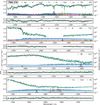 |
Fig. B.2 Same as Fig. B.1 but for TWA 27A. |
| In the text | |
|
Fig. D.1 Vertical composition profiles. Volume mixing ratios of the retrieved molecules as a function of pressure for TWA 27A and TWA 28 are shown. Species are colour-coded as indicated in the legend. Darker background regions indicate higher values of the contribution function. |
| In the text | |
|
Fig. E.1 Extended wavelength model validation with Spitzer/IRS data. The best-fit model spectra of TWA 27A and TWA 28 are extended to the Spitzer/IRS wavelength range (Riaz & Gizis 2008). Observed spectra are shown in black and the best-fit model spectra are shown as solid lines. Dashed brown lines represent blackbody emission from the disc and the dashed line with corresponding colour represents the atmospheric model. Data beyond 11 and 12 μm begin to clearly deviate from our best-fit model for TWA 27A and TWA 28, respectively. |
| In the text | |
Current usage metrics show cumulative count of Article Views (full-text article views including HTML views, PDF and ePub downloads, according to the available data) and Abstracts Views on Vision4Press platform.
Data correspond to usage on the plateform after 2015. The current usage metrics is available 48-96 hours after online publication and is updated daily on week days.
Initial download of the metrics may take a while.