


| Issue |
A&A
Volume 705, January 2026
|
|
|---|---|---|
| Article Number | A77 | |
| Number of page(s) | 10 | |
| Section | Extragalactic astronomy | |
| DOI | https://doi.org/10.1051/0004-6361/202450574 | |
| Published online | 06 January 2026 | |
Tracing satellite planes in the Sculptor group
II. Discovery of five faint dwarf galaxies in the DESI Legacy Survey
1
Centro de Estudios de Física del Cosmos de Aragón (CEFCA), Unidad Asociada al CSIC, Plaza San Juan 1, 44001 Teruel, Spain
2
ARAID Foundation, Avda. de Ranillas, 1-D, E-50018 Zaragoza, Spain
3
Instituto de Astrofísica de Andalucía, CSIC, Glorieta de la Astronomía, E-18080 Granada, Spain
4
Ruhr University Bochum, Faculty of Physics and Astronomy, Astronomical Institute (AIRUB), 44780 Bochum, Germany
5
Leibniz-Institut für Astrophysik Potsdam (AIP), An der Sternwarte 16, D-14482 Potsdam, Germany
6
Department of Physics, University of Surrey, Guildford GU2 7XH, UK
7
Special Astrophysical Observatory of the Russian Academy of Sciences, Nizhnij Arkhyz 369167, Russia
8
UAI – Unione Astrofili Italiani /P.I. Sezione Nazionale di Ricerca Profondo Cielo, 72024 Oria, Italy
9
Perimeter Institute for Theoretical Physics, 31 Caroline St N, Waterloo, Canada
★★ Corresponding author: This email address is being protected from spambots. You need JavaScript enabled to view it.
Received:
30
April
2024
Accepted:
22
October
2025
Abstract
Context. Although substantial progress has been made in reconciling lambda cold dark matter (ΛCDM) simulations with the observed abundance and distribution of satellite galaxies, important tensions persist. Studying satellite systems around spiral galaxies thus remains key to addressing these tensions.
Aims. In this series of papers, we report the first results of an ongoing systematic survey, using Dark Energy Camera images, of faint dwarf spheroidal galaxies in the vicinity of the bright late-type spiral NGC 253 galaxy, the brightest member of the Sculptor filament located at a distance of 3.7 Mpc towards Anti-Virgo.
Methods. We performed a new NGC 253 satellite search by means of visual inspection, using reprocessed co-added image cutouts from the DESI Legacy image surveys, reaching a very low surface brightness regime (28.0–29.0 mag arcsec−2). We used GALFIT software to derive the photometric and structural properties of the five dwarf galaxy candidates.
Results. Five new dwarf galaxy candidates have been discovered in the vicinity of NGC 253, which we named Do V, Do VI, Do VII, Do VIII, and Do IX. Assuming that they are associated with NGC 253, their total absolute V-magnitudes fall in the −7 to −9 mag range, which is typical for dwarf satellites in the local Universe. The central surface brightness tends to be extremely low for all the discovered dwarfs and falls roughly in the range of 25–26 mag arcsec−2 in the g band. We present a new list of galaxy candidates located around the giant spiral NGC 253.
Conclusions. With the inclusion of these additional satellite candidates, the overall spatial distribution of the system becomes less flattened and is now broadly consistent with the analogues drawn from the ΛCDM expectations. Interestingly, the distribution appears to be rather lopsided. However, firm conclusions about the presence or absence of a correlated satellite structure are hampered, as distance information is lacking, the census of observed dwarfs in the system remains far from complete, and spectroscopic velocities are not even available for most known satellites.
Key words: galaxies: dwarf / galaxies: individual: NGC 253 / galaxies: structure / dark matter
ARAID Fellow.
© The Authors 2026
 Open Access article, published by EDP Sciences, under the terms of the Creative Commons Attribution License (https://creativecommons.org/licenses/by/4.0), which permits unrestricted use, distribution, and reproduction in any medium, provided the original work is properly cited.
This article is published in open access under the Subscribe to Open model. This email address is being protected from spambots. You need JavaScript enabled to view it. to support open access publication.
1. Introduction
Although the lambda cold dark matter (ΛCDM) model is extremely successful in describing the observable Universe on large scales (e.g. Planck Collaboration VI 2020), it has faced difficulties reproducing observations at smaller scales, for example, of nearby galaxy groups. Tensions remain between the number of observed satellite dwarf galaxies versus theoretical predictions.
To date, there are ∼631 known satellite galaxies of the Milky Way, yet simulations predict thousands of subhalos with masses large enough to form a satellite galaxy (Mpeak ≳ 107 M⊙) (Bullock & Boylan-Kolchin 2017). Recent studies give us some probable computational solutions (see, for example, the dark-matter-only simulations and cumulative number counts of dwarf galaxies in the studies of Garrison-Kimmel et al. 2014, 2017). At the same time, for the astronomical community considerable hope still lies in the discovery of additional faint and ultra-faint satellites in the nearby galaxy groups.
Here is a very incomplete list of works with recent discoveries: Danieli et al. (2017), Makarova et al. (2018), Karachentseva et al. (2023, 2024), Anand et al. (2024).
The other important problem is the existence of ‘satellite planes’ preferably discovered in the nearby Universe. The anisotropic distribution of Galactic satellites is well known (Lynden-Bell 1976), and is hardly explained within the modern theory of structure formation. Analysis of the system of satellites of the Milky Way led to the discovery of a planar structure of their distribution (Pawlowski et al. 2012). The existence of the satellite plane contradicts the predictions of the subhalo distribution in the ΛCDM theory (Pawlowski 2018). Similar planar structures were later found around several nearby giant galaxies. Ibata et al. (2013) found a thin plane in the Andromeda galaxy satellite system. Tully et al. (2015) reported on the planar structure of the satellites around Centaurus A, later shown to also show a strong velocity coherence reminiscent of rotation Müller et al. 2018. More recently, Karachentsev & Kroupa (2024) reported the discovery of a co-rotating satellite structure around NGC 4490. The apparent prevalence of these planar structures challenges the ΛCDM paradigm (Pawlowski & Kroupa 2020; Müller et al. 2021), but this conclusion is based on a limited number of hosts. Additionally, there are works that argue that planar structures do not pose a challenge to the ΛCDM paradigm (see, e.g. Boylan-Kolchin 2021). Consequently, it is crucial to search for similar structures around additional hosts to understand the abundance, significance, and degree of flatness of satellite planes. This aim requires overcoming the challenges of discovering additional dwarf galaxies and measuring their distances with high precision. Both tasks are fundamental for a better understanding of the galaxy distribution, cosmic structure formation, and the formation and evolution of galaxies in group and field environments.
One intriguing nearby structure that has so far been neglected in this context is a conglomeration of bright spiral galaxies in the constellation of Sculptor, including NGC 24, NGC 45, NGC 55, NGC 247, NGC 253, NGC 300, and NGC 7793. Together with their dwarf satellites, it forms a loose filament stretched along the line of sight from the Local Group to a distance of about 7 Mpc (Jerjen et al. 1998; Karachentsev et al. 2003). The filament is located in the Local Supercluster plane, almost in the Anti-Virgo direction. The central part of the filament is the group of dwarf galaxies around the late-type luminous spiral NGC 253, at a distance of 3.70 Mpc (Anand et al. 2021). This galaxy, also known as the Sculptor Galaxy, dominates the group. Its luminosity, log LK/L⊙ = 10.98, exceeds the luminosity of the Milky Way or the Andromeda galaxy (Karachentsev et al. 2021), and it is 11 times brighter than the second brightest galaxy in the group – NGC 247. NGC 253 is one of the closest starburst galaxies, with a present-day star formation rate of 5 M⊙ yr−1 (Melo et al. 2002). It is suggested that the starburst was triggered by a merger with a gas-rich dwarf in the past 200 Myr (Davidge 2010).
Martínez-Delgado et al. (2021, hereafter Paper I) claim the possible existence of a flattened and velocity-correlated dwarf system around NGC 253. This satellite plane is only 31 kpc thick, with a minor-to-major axis ratio of 0.14. If this is true, then it turns out that most of nearby giant galaxies, i.e. the Milky Way (Kroupa et al. 2005), Andromeda galaxy (Metz et al. 2007), Centaurus A (Tully et al. 2015), M 81 (Chiboucas et al. 2013), as well as NGC 253 (Paper I), have extended satellite planes, which would be extremely intriguing.
At a distance of 3.7 Mpc, NGC 253 is one of the closest spirals to the Local Group and thus the natural place to dig for low-surface brightness (LSB) dwarf galaxies, which could provide new insights on the presence of satellite planes around nearby galaxies outside the Local Group. This member of the Sculptor group has been surveyed for satellite galaxies in the past (Cote et al. 1997; Karachentseva & Karachentsev 1998; Jerjen et al. 1998; Karachentseva & Karachentsev 2000; Jerjen et al. 2000; Sand et al. 2014; Toloba et al. 2016; Mutlu-Pakdil et al. 2021; Carlsten et al. 2022; Mutlu-Pakdil et al. 2024; Okamoto et al. 2024).
In the last years, the exquisite imaging from the DESI Legacy Surveys (Dey et al. 2019) has probed for the first time large-scale sky regions at a very low surface brightness regime (28.0–29.0 mag arcsec−2). This has allowed the discovery of many very faint dwarf satellites around nearby galaxies, using automatic detection algorithms (Tanoglidis et al. 2021) and systematic visual inspection of these public deep images (Martínez-Delgado et al. 2021; Karachentsev et al. 2022; Karachentsev & Kaisina 2022; Martínez-Delgado et al. 2023). Three new dwarf galaxies, Do II, Do III, and Do IV, were reported in the vicinity of NGC 253 in the framework of a systematic low surface brightness galaxy search. Mutlu-Pakdil et al. (2021) independently discovered DoII and presented its confirmation with HST data, while Mutlu-Pakdil et al. 2024 provided confirmation for the candidates discussed in Paper I as well as for the other two satellites, which previously lacked distance information. Their total absolute magnitudes, transformed to the V band, fall in the range from about −7 to about −9 mag at the distance of NGC 253, which is typical for satellite dwarf galaxies in the Local Universe.
In this paper, we present the discovery of five low-surface brightness dwarf galaxies around the NGC 253–NGC 247 group in the Sculptor group, using DESI Legacy Surveys imaging data. With this updated census of low-mass systems, we revise our previous result on the possible existence of a spatially flattened and velocity-correlated dwarf galaxy system around NGC 253.
2. Searching strategy and data analysis
2.1. Searching strategy and image cutout data
The dwarf galaxy satellite candidates reported in this paper were found by amateur astronomer Giuseppe Donatiello (abbreviated Do), by visual inspection of the Dark Energy Camera (DECam, Flaugher et al. 2015) images of the Sculptor group of galaxies, available from DESI Legacy Imaging surveys (Dey et al. 2019). A total of 13 candidates were detected in a total explored area of 15 × 10 degrees. These systems were not identified in previous automatic searches of diffuse stellar systems, based on resolved stellar source density maps extracted from these data (e.g. Tanoglidis et al. 2021). The typical angular resolution of these data (estimated from the viewing of the images) is ∼0.9″.
For this paper, we focus only on those brighter candidates, whose images from the DESI Legacy Imaging surveys were suitable for a feasible photometry and structural analysis (see the next subsection), following the same approach described in Paper I. The given names with their corresponding positions are given in Table 1.
Coordinates of five newly detected satellite candidates.
The image cutouts centred on each satellite candidate were obtained by co-adding DESI Legacy survey images of these systems using LEGACYPIPE software from DESI Legacy Imaging surveys (see, for example, Fig. 2 in Martínez-Delgado et al. 2023). A colour version of the resulting co-added image cutouts of these five dwarf galaxies is shown in Fig. 1 (top and right panels). The surface brightness limits of these images in the vicinity of NGC 253 region are μ = 29.3, 29.0 and 27.7 mag arcsec−2 for the g, r, and z bands respectively, measured as 3σ in 10 × 10 arcsec boxes, as estimated in Paper I.
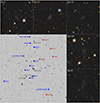 |
Fig. 1. Left panel: Position of six dwarf galaxy candidates (solid red circles) reported in this study with respect to spiral NGC 253. The purple circular line corresponds to the area explored by the PISCes survey (Toloba et al. 2016), extending up to ∼150 kpc from the centre of NGC 253. The total field of view of this image is 15 |


2.2. Photometric analysis
After creating the image cutouts, the images were further processed. Here, we used the GNU Astronomy Utilities (Akhlaghi & Ichikawa 2015, gnuastro2). During image processing, the following utilities were incorporated: astarithmetic, astcrop, aststatistics, asttable, astscript-psf-select-stars, astscript-psf-stamp, astscript-psf-scale-factor, astscript-psf-unite (Akhlaghi & Ichikawa 2015; Akhlaghi 2019; Infante-Sainz et al. 2020). First, we find the saturation level of the image and mask out all saturated pixels. This step is necessary to build up the empirical model of the extended PSF (ePSF).
To build up the ePSF models (g and r bands), first we defined two distinct sets of stars: bright stars (stars that show saturation in the centre, mstar < 15.5) and faint stars (16 < mstar < 20). The faint stars were stacked to build the inner part of the ePSFs, while the set of bright stars built the outer regions3. In total, we used 498 faint stars for the inner part of the effective ePSF, and 56 bright stars for the outer part.
To extract reliable structural parameters for our satellite galaxy candidates, we fitted the 2D light distribution of all candidates with Sersic profiles of one component (see Fig. 2), by using galfit (Peng et al. 2002, 2010). Here, we used our ePSF kernels for the convolution of the model images. If there were bright sources in the image, close to the satellite candidate, we also fitted these to reduce their impact on our low surface brightness targets. We started the fitting process in the r band and used the best fitting parameters as initial parameters for the fitting of the g band. To derive the effective surface brightness of our targets, we re-ran galfit, using the sersic2 function (this function is similar to the standard sersic model, but returns the effective surface brightness instead of an integrated magnitude per source), while fixing all other parameters to the best fitting values of the previous run. To find a solution for Do V, we had to fix the effective radius found in the r band during the fitting of the g-band data. In Table 2, we list the results of the fitting process for all galaxies in g and r bands4.
Photometric and structural properties for five satellite candidates.
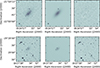 |
Fig. 2. Light profile GALFIT modelling results Top row:G band for Do VI. Bottom row:R band for Do VII. |
In order to compare the detected dwarf galaxy candidates with already confirmed Local Group dwarf galaxies, we calculated V-band magnitudes and surface brightness values based on the transformation given by Abbott et al. (2021):
 (1)
(1)
In Table 3, we present the derived surface brightness values, as well as absolute magnitudes and the physical extent of each dwarf galaxy candidate, assuming that they have the same distance as NGC 253. In the three panels in Fig. 3, we compare the derived photometric properties with the Local Group dwarf galaxy sample described in McConnachie (2012). Under the assumption that our dwarf galaxy candidates are part of the NGC 253 group, we find good agreement between the photometric properties of our targets and the Local Group dwarf galaxies.
Derived V-band properties and physical sizes of dwarf candidates.
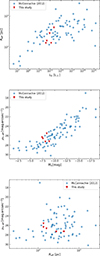 |
Fig. 3. Comparison of satellite dwarf galaxy candidates against confirmed Local Group dwarf galaxies. |
3. Discussion
3.1. Updating the Sculptor group dwarf galaxy census
In Paper I we gave a detailed description of the structure of the NGC 253 group. We estimated the NGC 253 group mass of about 8 × 10¹¹ M⊙, virial and the so-called turn-around radii, equal to R200 = 186 and Rta = 706 kpc respectively. Since then, there have been no changes in known velocities, but the tip of the red giant branch (TRGB) distances have been measured for a large number of dwarfs and the group has been replenished with new members and candidates. We summarize the current status of the group in Table A.1. It lists galaxies less than  away from NGC 253, which corresponds to a projected distance of 1 Mpc. The galaxies are ordered according to their projected distance. Within 500 kpc, NGC 253 contains 14 confirmed satellites and five new candidates. A group of galaxies around NGC 7793 at 3.63 Mpc (Anand et al. 2021) is located at the boundary of the system and just beginning their infall to the NGC 253 group. According to TRGB-distance measurements, the galaxies DDO 226 and NGC 59, although projected onto the NGC 253 group, are located outside its turn-around radius. Note that Sculptor SR turned out to be a background galaxy at a distance of about 19 Mpc (Mutlu-Pakdil et al. 2024).
Increasing the number of galaxies with known distances from nine (Paper I) to 15 (this compilation) allows us to build a more accurate map of the group (Fig. 4). Note that the typical accuracy of distance estimates is comparable to the size of the virial zone around the central galaxy. Nevertheless, it is clear that the distribution of satellites in the plane of the Local Supercluster, and perpendicular to it, has different widths. The map illustrates the feature, noted in Paper I, that the satellites form a flat structure lying close to the plane of the Local Supercluster. The TRGB distance of dw0036−2828, measured by Mutlu-Pakdil et al. (2024), confirms its membership in the NGC 253 group and significantly increases the extent of the satellite plane. Obviously, Do VII and IX can belong to the same plane, while Do V, VI, and VIII should lead to its thickening.
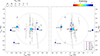 |
Fig. 4. Distribution of galaxies around NGC 253 in supergalactic coordinates. Left-hand panel: Projection on the plane of the Local Supercluster. Right-hand panel: Its edge-on view. The sizes and colours of the dots reflect the B-band absolute magnitude and morphology of the galaxies, according to the legends above. The line segments correspond to the distance errors. The dotted circles mark the virial zone of R200 = 190 and the turn-around radius of Rta = 710 kpc around NGC 253. The expected positions of the discovered galaxies are indicated by magenta symbols. |
3.2. Revising the existence of a plane of satellite galaxies around NGC 253
The increase in the number of galaxies around NGC 253 for which distances are available allows us to revisit the issue of a potential plane of satellites in this system. To do so, we updated our comparison to systems selected from cosmological simulations, following the same procedure as outlined in Paper I. However, we now considered the 14 satellites with measured distances, up from only seven before (see Fig. 5). We again studied the 3D distribution via a tensor of inertia (ToI) fitting method, accounting for distance uncertainties with 1000 Monte Carlo realisations. Figure 6 shows the results of our plane fits.
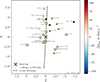 |
Fig. 5. On-sky distribution of the galaxies around NGC 253 in equatorial coordinates relative to position of NGC 253 (black cross). Galaxies with available velocity measurements are colour-coded by their line-of-sight velocity component relative to that of NGC 253. Galaxies with available distance measurements are plotted as open white circles, while our new candidates are plotted as filled black stars. Yellow boxes mark objects within 600 kpc of NGC 253, either measured in three dimensions if distances have been measured, or in projection for those objects for which such data is not available. The on-sky orientation of the major axis of the spatial distribution of these highlighted objects is shown as a dashed black line. |
As before, we considered all dwarfs within 600 kpc, thereby including only those 14 with measured distances. Overall, the relative and absolute flattening of the distribution becomes much wider. With the new sample of objects, we find an rms height from the best-fit plane of Δrms = 87 ± 6 kpc, and a minor-to-major axis ratio of c/a = 0.35 ± 0.05. These values have almost tripled from those based on the earlier, smaller sample in Paper I (Δrms = 31 ± 5 kpc and c/a = 0.14 ± 0.03).
The normal direction to the best-fit plane, however, remains in a similar orientation as before, and is still aligned well with the Supergalactic plane. It also remains within (19 ± 6)° to the e1-direction, where e1 is the eigenvector of the tidal tensor at the position of NGC 253, which corresponds to the axis along which material in the cosmic web is compressed the fastest. This alignment has been found for several nearby satellite structures (Libeskind et al. 2018). Similarly, the best-fit plane remains close to an edge-on orientation with an inclination of i = (84 ± 5)°.
Completely random systems drawn from isotropy, but reproducing the observed system’s radial distribution, usually result in wider distributions (grey in Fig. 6), with Δrms = 131 ± 24 kpc, and c/a = 0.55 ± 0.11. However, given the wide spread in these parameters, the randomised and observed distributions overlap at the level of 1–2σ.
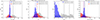 |
Fig. 6. Parameters of the ToI fit to the spatial distributions of galaxies with measured distances, that reside within 600 kpc of NGC 253. Shown are Δrms, the absolute rms plane height (far left); c/a, the minor-to-major axis ratio (middle left); i, the inclination of the best-fit plane with the line-of-sight (middle right); and dNGC 253, the perpendicular offset of the best-fit plane from NGC 253 (far right). Blue shows the realisations drawing from the observed galaxy distances. They are more flattened than randomised samples drawn from isotropic distributions with identical radial distributions (shown in grey). However, they appear to be consistent with the parameters of satellite systems in the cosmological IllustrisTNG-100 simulation (shown in red). The mean and standard deviations of the shown distributions are given in each panel. |
As in Paper I, we also compared with satellite systems selected from the IllustrisTNG-100, the cosmological hydrodynamical simulation (Springel et al. 2018; Nelson et al. 2019). We refer to that paper for the details, noting only that we now selected the 14 top-ranked galaxies per host to ensure the same number as in the observed sample. As analogues, we again selected host galaxies by virial mass, confined in the interval from 0.6 to 1.0 × 10¹² M⊙. We rejected those with another galaxy of virial mass > 0.5 × 10¹² M⊙ within 1.2 Mpc to ensure sufficient isolation. All galaxies with a separation of 600 kpc or less around the hosts are ranked, first by brightness and then by mass for those not containing stars. The flattening of the 13 top-ranked galaxies surrounding the host is measured. The resulting distributions in flattening and host offset are shown in red in Fig. 6.
The ΛCDM satellite systems are more flattened than the randomised systems, but their distribution comfortably encompasses the flattening of the observed NGC 253 system. This is the case in both absolute flattening (Δrms = 84 ± 27 kpc), and in the relative axis ratio (c/a = 0.44 ± 0.13). If we repeat the analysis considering only objects within 300 kpc of the host, these results do not change qualitatively. Also, within the smaller volume, there is no strong evidence for a substantially flattened overall distribution of the satellite system. In addition, the offset of the best-fit planes is broadly consistent among the observed, randomised, and simulated systems.
Although the conclusion of Mutlu-Pakdil et al. (2024) was not based on a quantitative comparison, we measured the overall spatial flattening and compared it with satellite systems selected from a full cosmological context. We find that the overall flattening of the system is consistent with these model expectations, and thus we can now quantitatively confirm that there is no longer any strong evidence for a spatially flattened satellite plane in this system.
We note that these results are for the total dwarf system, but do not account for possible subsamples. For example, the significant M 31 satellite plane is only composed of about half of the satellites, and proper motions indicate that a similar fraction can be expected to be actual satellite plane members for the Milky Way (Li et al. 2021; Taibi et al. 2024). However, as of now the number of satellites is too low and the number of spectroscopic velocities insufficient to attempt a meaningful subsample-analysis.
Maybe even more important is that the three more famous cases of satellite planes, those of the Milky Way, M 31, and Centaurus A, caution us not to over-interpret this result. This is because in all three cases the main evidence for cosmologically rare structures comes from the observed coherence of velocities. Such data are not available for most objects here, and of the five objects with available spectroscopic velocities, four do show a coherent velocity trend. Thus, since the spatial flattening remains close to edge-on (even if it is not as prominent as before), spectroscopic velocities remain a very promising avenue to shed light on this system and its status in regard to the issue of planes of satellite galaxies.
Beyond satellite planes, other phase-space correlations in systems of satellite galaxies are being increasingly investigated (see Pawlowski 2021, for a review). One of these is the issue of lopsided satellite systems (Libeskind et al. 2016; Pawlowski et al. 2017; Brainerd & Samuels 2020; Wang et al. 2021). The M 31 system was found to be highly lopsided, with a majority of its satellites residing on the side towards the Milky Way (Conn et al. 2013), an issue that in itself is very exceptional in a cosmological context (Kanehisa et al. in prep.). Interestingly, the NGC 253 system also appears to be rather lopsided, with a preference of members to be mostly in the north of NGC 253. The satellite distribution can be split in a slightly diagonal line to contain only four out of 14 galaxies, with measured distances that place them within 600 kpc of NGC 253 (bottom right half of Fig. 5). This asymmetry is also present in our additional candidates, of which four out of five are in the north, too.
4. Conclusions
In this paper, we reported the discovery of five dwarf spheroidal galaxies, possible satellites of the bright late-type spiral NGC 253 galaxy, from a systematic visual inspection of the DESI Legacy Survey images.
In Paper I we gave a detailed description of the structure of the NGC 253 group. We estimated the NGC 253 group mass of about 8 × 10¹¹ M⊙, virial and the so-called turn-around radii, equal to R200 = 186 and Rta = 706 kpc, respectively. Since then, the NGC 253 galaxy group was revised with new members with known photometric distances and candidate member galaxies. The new group list is given in Table A.1. The known number of satellite galaxies increased from nine to 15.
A group of galaxies around NGC 7793 is located at the boundary of the system and just begins their infall to the group. According to TRGB-distance measurements, the galaxies DDO 226 and NGC 59, although projected onto the group, are located outside its turn-around radius.
If confirmed as satellites, then the new, more accurate map of the NGC 253 group would illustrate the flat structure that lies close to the plane of the Local Supercluster. The discovered dwarfs Do VIII and X would belong to this plane, while Do V, VI, and IX should lead to its thickening.
With the inclusion of additional satellites with available distance measurements, the overall spatial distribution of the system is now considerably wider than before, with an rms height of Δrms = 87 ± 6 kpc, and a minor-to-major axis ratio of c/a = 0.35 ± 0.05. However, the distribution remains in an edge-on orientation and aligned with the Supergalactic plane. Although more flattened than expected for isotropic systems, we find these values to be consistent with those of systems in the IllustrisTNG-100 cosmological hydrodynamical simulation. We also notice a lopsidedness of the satellite distribution, with a preference of 10 out of 14 objects with distance measurements to reside on one side – approximately the northern – of NGC 253.
Despite this progress, there is no final verdict on the presence of a correlated satellite structure in the NGC 253 system. The dwarf census remains incomplete. The candidates presented in this work require spectroscopic follow-up and spatially-resolved photometric data to accurately derive their distances and velocities. Without complete velocity information (beyond the five objects with spectroscopic velocities currently available), the degree of kinematic coherence, the most important characteristic of other satellite planes, cannot be assessed and tested against cosmological expectations.
According to the Local Volume Database, https://github.com/apace7/local_volume_database (Pace 2025).
The exact procedure is explained in the gnuastro manual: https://www.gnu.org/software/gnuastro/manual/html_node/Building-the-extended-PSF.html
Parameter errors were estimated by galfit.
Acknowledgments
DMD acknowledges the grant CNS2022-136017 funding by MICIU/AEI /10.13039/501100011033 and the European Union NextGenerationEU/PRTR and finantial support from the Severo Ochoa Grant CEX2021-001131-S funded by MCIN/AEI/10.13039/501100011033. JS acknowledges financial support from project PID2022-138896NB-C53 and the Severo Ochoa grant CEX2021-001131-S funded by MCIN/AEI/ 10.13039/501100011033. DM and LM acknowledge support from the Russian Science Foundation grant N° 24–12–00277, https://rscf.ru/en/project/24-12-00277/. MSP acknowledges funding via a Leibniz-Junior Research Group (project number J94/2020). We acknowledge the usage of the HyperLeda database (http://leda.univ-lyon1.fr) (Makarov et al. 2014). This project used public archival data from the Dark Energy Survey. Funding for the DES Projects has been provided by the U.S. Department of Energy, the U.S. National Science Foundation, the Ministry of Science and Education of Spain, the Science and Technology FacilitiesCouncil of the United Kingdom, the Higher Education Funding Council for England, the National Center for Supercomputing Applications at the University of Illinois at Urbana-Champaign, the Kavli Institute of Cosmological Physics at the University of Chicago, the Center for Cosmology and Astro-Particle Physics at the Ohio State University, the Mitchell Institute for Fundamental Physics and Astronomy at Texas A&M University, Financiadora de Estudos e Projetos, Fundação Carlos Chagas Filho de Amparo à Pesquisa do Estado do Rio de Janeiro, Conselho Nacional de Desenvolvimento Científico e Tecnológico and the Ministério da Ciência, Tecnologia e Inovação, the Deutsche Forschungsgemeinschaft, and the Collaborating Institutions in the Dark Energy Survey. The Collaborating Institutions are Argonne National Laboratory, the University of California at Santa Cruz, the University of Cambridge, Centro de Investigaciones Energéticas, Medioambientales y Tecnológicas-Madrid, the University of Chicago, University College London, the DES-Brazil Consortium, the University of Edinburgh, the Eidgenössische Technische Hochschule (ETH) Zürich, Fermi National Accelerator Laboratory, the University of Illinois at Urbana-Champaign, the Institut de Ciències de l’Espai (IEEC/CSIC), the Institut de Física d’Altes Energies, Lawrence Berkeley National Laboratory, the Ludwig-Maximilians Universität München and the associated Excellence Cluster Universe, the University of Michigan, the National Optical Astronomy Observatory, the University of Nottingham, The Ohio State University, the OzDES Membership Consortium, the University of Pennsylvania, the University of Portsmouth, SLAC National Accelerator Laboratory, Stanford University, the University of Sussex, and Texas A&M University. Based in part on observations at Cerro Tololo Inter-American Observatory, National Optical Astronomy Observatory, which is operated by the Association of Universities for Research in Astronomy (AURA) under a cooperative agreement with the National Science Foundation. This work was partly done using GNU Astronomy Utilities (Gnuastro, ascl.net/1801.009) version 0.21. Work on Gnuastro has been funded by the Japanese Ministry of Education, Culture, Sports, Science, and Technology (MEXT) scholarship and its Grant-in-Aid for Scientific Research (21244012, 24253003), the European Research Council (ERC) advanced grant 339659-MUSICOS, the Spanish Ministry of Economy and Competitiveness (MINECO, grant number AYA2016-76219-P) and the NextGenerationEU grant through the Recovery and Resilience Facility project ICTS-MRR-2021-03-CEFCA. This research has made use of the NASA/IPAC Infrared Science Archive, which is funded by the National Aeronautics and Space Administration and operated by the California Institute of Technology.
References
- Abbott, T. M. C., Adamów, M., Aguena, M., et al. 2021, ApJS, 255, 20 [NASA ADS] [CrossRef] [Google Scholar]
- Akhlaghi, M. 2019, arXiv e-prints [arXiv:1909.11230] [Google Scholar]
- Akhlaghi, M., & Ichikawa, T. 2015, ApJS, 220, 1 [Google Scholar]
- Anand, G. S., Rizzi, L., Tully, R. B., et al. 2021, AJ, 162, 80 [CrossRef] [Google Scholar]
- Anand, G. S., Riess, A. G., Yuan, W., et al. 2024, ApJ, 966, 89 [NASA ADS] [CrossRef] [Google Scholar]
- Begum, A., Chengalur, J. N., Karachentsev, I. D., Sharina, M. E., & Kaisin, S. S. 2008, MNRAS, 386, 1667 [NASA ADS] [CrossRef] [Google Scholar]
- Bouchard, A., Jerjen, H., Da Costa, G. S., & Ott, J. 2005, AJ, 130, 2058 [Google Scholar]
- Boylan-Kolchin, M. 2021, Nat. Astron., 5, 1188 [NASA ADS] [CrossRef] [Google Scholar]
- Brainerd, T. G., & Samuels, A. 2020, ApJ, 898, L15 [NASA ADS] [CrossRef] [Google Scholar]
- Bullock, J. S., & Boylan-Kolchin, M. 2017, ARA&A, 55, 343 [Google Scholar]
- Carlsten, S. G., Greene, J. E., Beaton, R. L., Danieli, S., & Greco, J. P. 2022, ApJ, 933, 47 [CrossRef] [Google Scholar]
- Chiboucas, K., Jacobs, B. A., Tully, R. B., & Karachentsev, I. D. 2013, AJ, 146, 126 [Google Scholar]
- Colless, M., Peterson, B. A., Jackson, C., et al. 2003, arXiv e-prints [arXiv:0306581] [Google Scholar]
- Conn, A. R., Lewis, G. F., Ibata, R. A., et al. 2013, ApJ, 766, 120 [NASA ADS] [CrossRef] [Google Scholar]
- Cote, S., Freeman, K. C., Carignan, C., & Quinn, P. J. 1997, AJ, 114, 1313 [CrossRef] [Google Scholar]
- Danieli, S., van Dokkum, P., Merritt, A., et al. 2017, ApJ, 837, 136 [NASA ADS] [CrossRef] [Google Scholar]
- Davidge, T. J. 2010, ApJ, 725, 1342 [Google Scholar]
- Dey, A., Schlegel, D. J., Lang, D., et al. 2019, AJ, 157, 168 [Google Scholar]
- Flaugher, B., Diehl, H. T., Honscheid, K., et al. 2015, AJ, 150, 150 [Google Scholar]
- Garrison-Kimmel, S., Boylan-Kolchin, M., Bullock, J. S., & Lee, K. 2014, MNRAS, 438, 2578 [NASA ADS] [CrossRef] [Google Scholar]
- Garrison-Kimmel, S., Bullock, J. S., Boylan-Kolchin, M., & Bardwell, E. 2017, MNRAS, 464, 3108 [NASA ADS] [CrossRef] [Google Scholar]
- Ibata, R. A., Lewis, G. F., Conn, A. R., et al. 2013, Nature, 493, 62 [NASA ADS] [CrossRef] [Google Scholar]
- Infante-Sainz, R., Trujillo, I., & Román, J. 2020, MNRAS, 491, 5317 [Google Scholar]
- Jerjen, H., Freeman, K. C., & Binggeli, B. 1998, AJ, 116, 2873 [NASA ADS] [CrossRef] [Google Scholar]
- Jerjen, H., Binggeli, B., & Freeman, K. C. 2000, AJ, 119, 593 [NASA ADS] [CrossRef] [Google Scholar]
- Kaisina, E. I., Makarov, D. I., Karachentsev, I. D., & Kaisin, S. S. 2012, Astrophys. Bull., 67, 115 [NASA ADS] [CrossRef] [Google Scholar]
- Karachentsev, I. D., & Kaisina, E. I. 2022, Astrophys. Bull., 77, 372 [Google Scholar]
- Karachentsev, I. D., & Kroupa, P. 2024, MNRAS, 528, 2805 [NASA ADS] [CrossRef] [Google Scholar]
- Karachentsev, I. D., & Makarov, D. A. 1996, AJ, 111, 794 [NASA ADS] [CrossRef] [Google Scholar]
- Karachentsev, I. D., Grebel, E. K., Sharina, M. E., et al. 2003, A&A, 404, 93 [CrossRef] [EDP Sciences] [Google Scholar]
- Karachentsev, I. D., Tully, R. B., Anand, G. S., Rizzi, L., & Shaya, E. J. 2021, AJ, 161, 205 [Google Scholar]
- Karachentsev, I. D., Makarova, L. N., Anand, G. S., & Tully, R. B. 2022, AJ, 163, 234 [Google Scholar]
- Karachentsev, I. D., Nazarova, A. E., & Karachentseva, V. E. 2024, Astrophysics, 67, 267 [Google Scholar]
- Karachentseva, V. E., & Karachentsev, I. D. 1998, A&AS, 127, 409 [NASA ADS] [CrossRef] [EDP Sciences] [Google Scholar]
- Karachentseva, V. E., & Karachentsev, I. D. 2000, A&AS, 146, 359 [NASA ADS] [CrossRef] [EDP Sciences] [Google Scholar]
- Karachentseva, V. E., Karachentsev, I. D., Kaisina, E. I., & Kaisin, S. S. 2023, A&A, 678, A16 [NASA ADS] [CrossRef] [EDP Sciences] [Google Scholar]
- Kroupa, P., Theis, C., & Boily, C. M. 2005, A&A, 431, 517 [NASA ADS] [CrossRef] [EDP Sciences] [Google Scholar]
- Li, H., Hammer, F., Babusiaux, C., et al. 2021, ApJ, 916, 8 [CrossRef] [Google Scholar]
- Libeskind, N. I., Guo, Q., Tempel, E., & Ibata, R. 2016, ApJ, 830, 121 [NASA ADS] [CrossRef] [Google Scholar]
- Libeskind, N. I., van de Weygaert, R., Cautun, M., et al. 2018, MNRAS, 473, 1195 [NASA ADS] [CrossRef] [Google Scholar]
- Lynden-Bell, D. 1976, MNRAS, 174, 695 [NASA ADS] [Google Scholar]
- Makarov, D., Prugniel, P., Terekhova, N., Courtois, H., & Vauglin, I. 2014, A&A, 570, A13 [NASA ADS] [CrossRef] [EDP Sciences] [Google Scholar]
- Makarova, L. N., Makarov, D. I., Antipova, A. V., Karachentsev, I. D., & Tully, R. B. 2018, MNRAS, 474, 3221 [NASA ADS] [CrossRef] [Google Scholar]
- Martínez-Delgado, D., Makarov, D., Javanmardi, B., et al. 2021, A&A, 652, A48 [NASA ADS] [CrossRef] [EDP Sciences] [Google Scholar]
- Martínez-Delgado, D., Cooper, A. P., Román, J., et al. 2023, A&A, 671, A141 [NASA ADS] [CrossRef] [EDP Sciences] [Google Scholar]
- McConnachie, A. W. 2012, AJ, 144, 4 [Google Scholar]
- Melo, V. P., Pérez García, A. M., Acosta-Pulido, J. A., Muñoz-Tuñón, C., & Rodríguez Espinosa, J. M. 2002, ApJ, 574, 709 [NASA ADS] [CrossRef] [Google Scholar]
- Metz, M., Kroupa, P., & Jerjen, H. 2007, MNRAS, 374, 1125 [Google Scholar]
- Müller, O., Pawlowski, M. S., Jerjen, H., & Lelli, F. 2018, Science, 359, 534 [CrossRef] [Google Scholar]
- Müller, O., Pawlowski, M. S., Lelli, F., et al. 2021, A&A, 645, L5 [NASA ADS] [CrossRef] [EDP Sciences] [Google Scholar]
- Mutlu-Pakdil, B., Sand, D. J., Crnojević, D., et al. 2021, ApJ, 918, 88 [CrossRef] [Google Scholar]
- Mutlu-Pakdil, B., Sand, D. J., Crnojević, D., et al. 2022, ApJ, 926, 77 [NASA ADS] [CrossRef] [Google Scholar]
- Mutlu-Pakdil, B., Sand, D. J., Crnojević, D., et al. 2024, ApJ, 966, 188 [NASA ADS] [CrossRef] [Google Scholar]
- Nelson, D., Springel, V., Pillepich, A., et al. 2019, Comput. Astrophys. Cosmol., 6, 2 [Google Scholar]
- Okamoto, S., Ferguson, A. M. N., Arimoto, N., et al. 2024, ApJ, 967, L24 [Google Scholar]
- Pace, A. B. 2025, Open J. Astrophys., 8, 142 [Google Scholar]
- Pawlowski, M. S. 2018, Mod. Phys. Lett. A, 33, 1830004 [NASA ADS] [CrossRef] [Google Scholar]
- Pawlowski, M. S. 2021, Galaxies, 9, 66 [NASA ADS] [CrossRef] [Google Scholar]
- Pawlowski, M. S., & Kroupa, P. 2020, MNRAS, 491, 3042 [NASA ADS] [CrossRef] [Google Scholar]
- Pawlowski, M. S., Pflamm-Altenburg, J., & Kroupa, P. 2012, MNRAS, 423, 1109 [NASA ADS] [CrossRef] [Google Scholar]
- Pawlowski, M. S., Ibata, R. A., & Bullock, J. S. 2017, ApJ, 850, 132 [NASA ADS] [CrossRef] [Google Scholar]
- Peng, C. Y., Ho, L. C., Impey, C. D., & Rix, H.-W. 2002, AJ, 124, 266 [Google Scholar]
- Peng, C. Y., Ho, L. C., Impey, C. D., & Rix, H.-W. 2010, AJ, 139, 2097 [Google Scholar]
- Planck Collaboration VI. 2020, A&A, 641, A6 [NASA ADS] [CrossRef] [EDP Sciences] [Google Scholar]
- Sand, D. J., Crnojević, D., Strader, J., et al. 2014, ApJ, 793, L7 [Google Scholar]
- Schlafly, E. F., & Finkbeiner, D. P. 2011, ApJ, 737, 103 [Google Scholar]
- Springel, V., Pakmor, R., Pillepich, A., et al. 2018, MNRAS, 475, 676 [Google Scholar]
- Taibi, S., Pawlowski, M. S., Khoperskov, S., Steinmetz, M., & Libeskind, N. I. 2024, A&A, 681, A73 [NASA ADS] [CrossRef] [EDP Sciences] [Google Scholar]
- Tanoglidis, D., Drlica-Wagner, A., Wei, K., et al. 2021, ApJS, 252, 18 [Google Scholar]
- Toloba, E., Sand, D. J., Spekkens, K., et al. 2016, ApJ, 816, L5 [Google Scholar]
- Tully, R. B., Libeskind, N. I., Karachentsev, I. D., et al. 2015, ApJ, 802, L25 [Google Scholar]
- Wang, P., Libeskind, N. I., Pawlowski, M. S., et al. 2021, ApJ, 914, 78 [NASA ADS] [CrossRef] [Google Scholar]
- Westmeier, T., Obreschkow, D., Calabretta, M., et al. 2017, MNRAS, 472, 4832 [Google Scholar]
Appendix A: Update NGC 253 group
Galaxies in  neighborhood around NGC 253
All Tables
All Figures
|
Fig. 1. Left panel: Position of six dwarf galaxy candidates (solid red circles) reported in this study with respect to spiral NGC 253. The purple circular line corresponds to the area explored by the PISCes survey (Toloba et al. 2016), extending up to ∼150 kpc from the centre of NGC 253. The total field of view of this image is 15 |
| In the text | |
|
Fig. 2. Light profile GALFIT modelling results Top row:G band for Do VI. Bottom row:R band for Do VII. |
| In the text | |
|
Fig. 3. Comparison of satellite dwarf galaxy candidates against confirmed Local Group dwarf galaxies. |
| In the text | |
|
Fig. 4. Distribution of galaxies around NGC 253 in supergalactic coordinates. Left-hand panel: Projection on the plane of the Local Supercluster. Right-hand panel: Its edge-on view. The sizes and colours of the dots reflect the B-band absolute magnitude and morphology of the galaxies, according to the legends above. The line segments correspond to the distance errors. The dotted circles mark the virial zone of R200 = 190 and the turn-around radius of Rta = 710 kpc around NGC 253. The expected positions of the discovered galaxies are indicated by magenta symbols. |
| In the text | |
|
Fig. 5. On-sky distribution of the galaxies around NGC 253 in equatorial coordinates relative to position of NGC 253 (black cross). Galaxies with available velocity measurements are colour-coded by their line-of-sight velocity component relative to that of NGC 253. Galaxies with available distance measurements are plotted as open white circles, while our new candidates are plotted as filled black stars. Yellow boxes mark objects within 600 kpc of NGC 253, either measured in three dimensions if distances have been measured, or in projection for those objects for which such data is not available. The on-sky orientation of the major axis of the spatial distribution of these highlighted objects is shown as a dashed black line. |
| In the text | |
|
Fig. 6. Parameters of the ToI fit to the spatial distributions of galaxies with measured distances, that reside within 600 kpc of NGC 253. Shown are Δrms, the absolute rms plane height (far left); c/a, the minor-to-major axis ratio (middle left); i, the inclination of the best-fit plane with the line-of-sight (middle right); and dNGC 253, the perpendicular offset of the best-fit plane from NGC 253 (far right). Blue shows the realisations drawing from the observed galaxy distances. They are more flattened than randomised samples drawn from isotropic distributions with identical radial distributions (shown in grey). However, they appear to be consistent with the parameters of satellite systems in the cosmological IllustrisTNG-100 simulation (shown in red). The mean and standard deviations of the shown distributions are given in each panel. |
| In the text | |
Current usage metrics show cumulative count of Article Views (full-text article views including HTML views, PDF and ePub downloads, according to the available data) and Abstracts Views on Vision4Press platform.
Data correspond to usage on the plateform after 2015. The current usage metrics is available 48-96 hours after online publication and is updated daily on week days.
Initial download of the metrics may take a while.